
ApoB (Apolipoprotein B) is a blood test that estimates the number of atherogenic lipoprotein particles circulating in the bloodstream, but it is often under-explained in routine lab discussions. Many people see ApoB on reports without a clear explanation of what it actually reflects.
This guide explains ApoB in plain language: what it measures, how it relates to LDL cholesterol, and why trend direction over repeated tests is usually more informative than one isolated value.
Quick summary
- ApoB estimates the number of circulating atherogenic lipoprotein particles.
- LDL-C measures cholesterol content; ApoB estimates particle count.
- ApoB is strongest when interpreted with LDL, HDL, triglycerides, and non-HDL cholesterol.
- Longitudinal trend review is usually more useful than one standalone value.
- Clinical interpretation depends on your overall cardiovascular risk profile.
What ApoB actually measures
Apolipoprotein B (ApoB) is a structural protein found on the surface of several lipoprotein particles that carry lipids in the bloodstream. Each atherogenic lipoprotein particle carries one ApoB molecule, which creates a practical one-to-one relationship between ApoB concentration and particle number.
This is the core distinction from LDL cholesterol. LDL-C reports how much cholesterol is carried inside LDL particles. ApoB estimates how many particles are present. Two people can show similar LDL-C values while having meaningfully different particle counts.
Because vascular exposure accumulates across repeated particle contact with artery walls, ApoB is commonly used as additional cardiovascular risk context in modern lipid interpretation — complementary to LDL-C, not a universal replacement in every guideline or clinical setting.
ApoB in the lipid panel context
ApoB is rarely interpreted in isolation. It is most useful when reviewed with the rest of the lipid panel. A practical pattern is to track ApoB together with:
- LDL cholesterol
- HDL cholesterol
- Triglycerides
- Total cholesterol
- Non-HDL cholesterol
Units and typical ApoB ranges (normal levels)
ApoB is usually reported in mg/dL, though some laboratories use g/L. Keep one unit system across all entries when building a timeline.
| Category | Typical ApoB range (mg/dL) |
|---|---|
| Lower cardiovascular risk | Below ~80 |
| Moderate range | ~80-100 |
| Elevated | ~100-130 |
| High | Above ~130 |
These categories are orientation points, not strict diagnostic cutoffs. Final interpretation depends on age, family history, metabolic status, medication context, and clinician guidance.
Why ApoB can change over time
ApoB trends usually move gradually and reflect upstream metabolic drivers, especially liver-related lipoprotein production and clearance.
- Dietary composition and long-term calorie balance
- Body weight changes and visceral fat distribution
- Insulin sensitivity and metabolic syndrome context
- Physical activity consistency
- Lipid-lowering medication starts or dose adjustments
- Inherited lipoprotein metabolism patterns
ApoB often moves with LDL-C and triglycerides, but not always. That mismatch is one reason longitudinal panel review is valuable.
Particle count vs cholesterol content
ApoB is useful because particle count and cholesterol content are not identical concepts. Two people can have the same LDL-C number but different particle burden.
Example: one person may have fewer cholesterol-rich particles, while another has more cholesterol-poor particles. LDL-C can appear similar in both, but ApoB is often higher in the second pattern because there are more particles circulating.
This discordance is especially relevant in insulin resistance or higher-triglyceride states, where particle composition can shift.
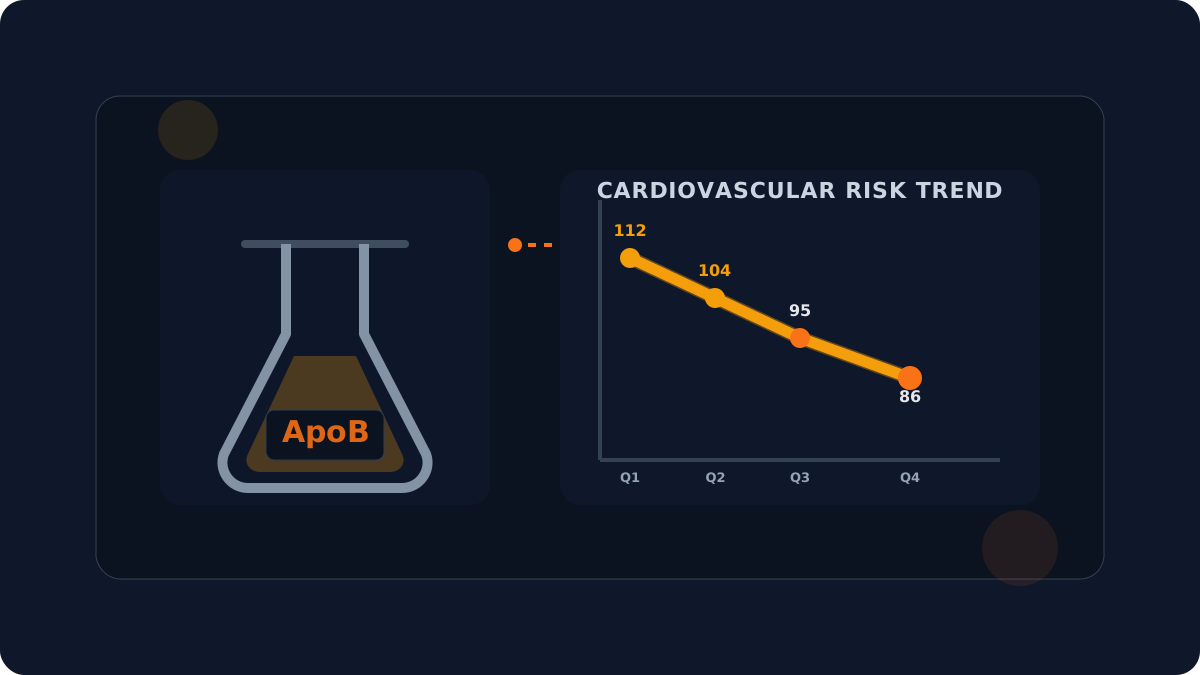
Example ApoB trend over time
Example multi-year trend showing a steady decrease in particle burden:
| Year | ApoB (mg/dL) |
|---|---|
| 2022 | 112 |
| 2023 | 104 |
| 2024 | 95 |
| 2025 | 86 |
Any single value may look only moderately different, but the direction across several years is clear. This pattern is easy to miss when reports are reviewed as separate snapshots.
ApoB vs LDL: what is the difference
ApoB does not replace LDL-C in routine interpretation; they are complementary. LDL-C remains central in many guidelines. ApoB reflects particle number, which can add context when LDL-C and clinical risk do not align.
When both markers move in the same direction, interpretation is usually straightforward. When they diverge, ApoB can clarify whether particle burden remains high despite a less concerning LDL-C value.
Practical tracking checklist
- Record ApoB under one stable marker name so timelines do not split across variants.
- Keep testing conditions similar between checks (timing, fasting status, medication routine).
- Log ApoB next to LDL-C and triglycerides on the same date row for easier discordance review.
- Flag periods with therapy changes, weight shifts, or major nutrition pattern changes.
- Judge trend direction over at least 2-3 follow-up points before drawing conclusions.
If you are deciding which markers deserve long-term tracking priority, use this focused biomarker framework.
Related biomarkers in lipid metabolism
- LDL cholesterol - cholesterol content carried by LDL particles.
- HDL cholesterol - reverse cholesterol transport context marker.
- Triglycerides - metabolic context for lipid transport patterns.
- Non-HDL cholesterol - broad estimate of atherogenic cholesterol burden.
Reviewing ApoB together with LDL-C, triglycerides, and non-HDL cholesterol usually gives a clearer cardiovascular signal than interpreting any single lipid marker in isolation.
Common ApoB questions
What is the long form of ApoB?
ApoB stands for apolipoprotein B. It is the main structural protein on atherogenic lipoprotein particles and helps estimate particle number.
Can ApoB be high when LDL cholesterol looks acceptable?
Yes. That pattern can occur when particle number is elevated despite moderate cholesterol content per particle. ApoB helps identify this discordance.
Is one ApoB result enough for interpretation?
Usually no. A single value gives a snapshot. Repeated values show direction, which is often more actionable.
Should ApoB be tracked with triglycerides?
In most cases yes, because triglyceride context helps explain particle composition patterns and metabolic status.
Track ApoB trends in one timeline
ApoB becomes more useful when each result is structured in one timeline with related lipid markers. Keep units consistent, preserve source reports, and review direction across repeated checks.