
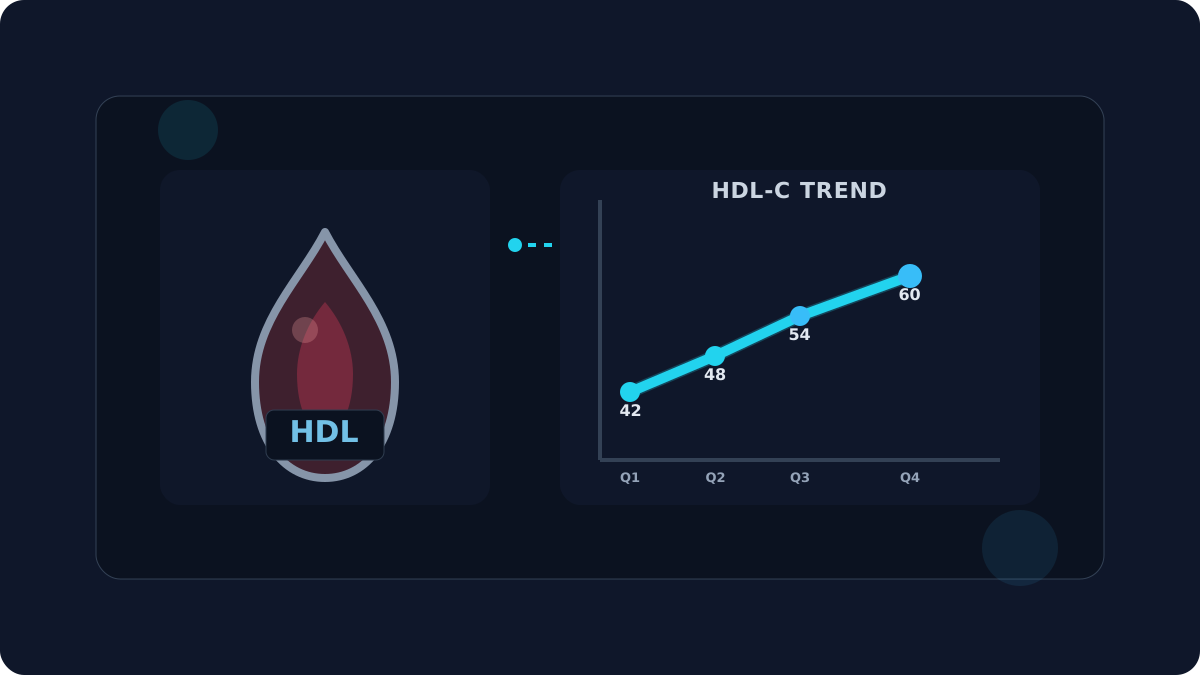
HDL cholesterol is one of the most widely recognized markers in the lipid panel, yet it is also one of the most misunderstood. HDL is often described as "good cholesterol," but that phrase hides the real biology.
HDL particles do not simply act as a protective substance. They participate in a dynamic transport system that moves cholesterol between tissues and the liver. Tracking HDL over time gives better context about lipid metabolism than one isolated value.
For broader interpretation, HDL is usually reviewed together with LDL cholesterol, triglycerides, and ApoB.
Quick summary
- HDL stands for high-density lipoprotein cholesterol.
- HDL particles help transport cholesterol away from tissues toward the liver.
- HDL values are interpreted alongside LDL cholesterol, triglycerides, and ApoB.
- Higher HDL has historically been associated with lower cardiovascular risk, but very high HDL is not always extra protective.
- Extremely high HDL does not always imply additional protection.
- Long-term HDL trends often reflect metabolic patterns over time.
What does HDL mean on a blood test?
HDL means high-density lipoprotein — a type of cholesterol-carrying particle in blood. On lab reports it often appears as HDL cholesterol or HDL-C. It is sometimes called "good cholesterol" because HDL particles help move cholesterol from tissues back toward the liver.
HDL is not a diagnosis by itself. It is one line in a lipid panel, usually interpreted together with LDL cholesterol, triglycerides, and ApoB for cardiovascular context.
What HDL cholesterol measures
Cholesterol cannot circulate freely in blood because it is not water-soluble. Instead, the body packages cholesterol into lipoprotein particles that function as transport vehicles.
HDL particles are the smallest and densest of these particles. Their role is linked to reverse cholesterol transport, where cholesterol is collected from peripheral tissues and moved back toward the liver for reuse or elimination.
Because of this function, HDL has long been viewed as protective. Modern evidence suggests that HDL particle function and metabolic context matter more than HDL concentration alone.
HDL in the lipid panel
HDL cholesterol is almost always measured as part of a standard lipid panel, which usually includes:
- LDL cholesterol
- HDL cholesterol
- Triglycerides
- Total cholesterol
- ApoB (in expanded panels)
Each marker describes a different dimension of lipid transport:
- LDL cholesterol estimates cholesterol carried by LDL particles.
- Triglycerides reflect circulating energy stored in lipid form.
- ApoB estimates the number of atherogenic lipoprotein particles.
- HDL cholesterol provides reverse cholesterol transport context.
Typical HDL ranges
HDL cholesterol is usually reported in mg/dL, though some laboratories use mmol/L.
| Category | HDL cholesterol (mg/dL) |
|---|---|
| Lower range | Below ~40 |
| Typical range | ~40-59 |
| Higher range | 60 and above |
These ranges are orientation points rather than strict diagnostic thresholds. Interpretation depends on full panel context and individual health history.
Why HDL levels change
HDL can shift gradually over years or more quickly when lifestyle patterns change.
- Physical activity patterns
- Body composition and visceral fat
- Dietary quality and carbohydrate load
- Alcohol intake
- Genetic lipid metabolism traits
- Insulin sensitivity and metabolic syndrome context
Lifestyle factors that influence HDL
- Exercise: Regular aerobic training is commonly associated with modest HDL increases.
- Diet: Lower refined carbohydrate intake and better dietary quality can support healthier HDL trends.
- Weight loss: Reducing visceral fat often improves HDL in parallel with triglycerides.
- Smoking: Ongoing smoking is associated with less favorable HDL patterns.
- Alcohol: Effects vary by dose and individual response, so interpretation needs context.
- Genetics: Inherited lipid metabolism traits can influence baseline HDL levels.
Because these factors interact, HDL often reflects broader metabolic state rather than one isolated pathway.
HDL and metabolic health
HDL often moves in the opposite direction of triglycerides in common metabolic patterns. High triglycerides with low HDL are frequently seen in insulin resistance, while lower triglycerides with higher HDL often appear with improved metabolic fitness.
For this reason, some clinicians review the triglyceride-to-HDL ratio as an added context signal. Ratios should still be interpreted within broader clinical context.
Example HDL trend over time
Example sequence illustrating gradual improvement:
| Measurement | HDL cholesterol (mg/dL) |
|---|---|
| Measurement 1 | 41 |
| Measurement 2 | 46 |
| Measurement 3 | 52 |
| Measurement 4 | 58 |
Each value may look only modestly different, but direction over repeated checks can show a sustained shift in lipid metabolism.
HDL vs LDL cholesterol
HDL and LDL describe different directions of lipid transport. LDL reflects particles that carry cholesterol toward tissues, while HDL reflects particles associated with returning cholesterol toward the liver.
Cardiovascular interpretation usually depends on the balance across multiple lipid markers rather than one value in isolation.
Practical HDL tracking checklist
- Track HDL together with LDL cholesterol, triglycerides, and ApoB when available.
- Keep testing conditions consistent between repeated checks.
- Avoid conclusions from one isolated measurement.
- Review direction across multiple checkpoints.
- Log major lifestyle changes that may influence lipid metabolism.
If you are building a focused long-term panel first, use this biomarker prioritization guide.
Related lipid biomarkers
- LDL cholesterol - cholesterol carried by LDL particles.
- Triglycerides - circulating lipid energy transport marker.
- ApoB - estimate of circulating atherogenic particle number.
- Non-HDL cholesterol - total cholesterol carried in atherogenic particles.
Common HDL questions
What is the long form of HDL?
HDL stands for high-density lipoprotein. HDL particles help transport cholesterol through the body and back toward the liver as part of lipid metabolism.
What is a good HDL level?
As a general orientation point, HDL below about 40 mg/dL is considered lower range, around 40-59 mg/dL is typical, and 60 mg/dL or higher is often viewed as favorable context. Interpretation still depends on the full lipid panel and individual clinical history.
Does higher HDL always mean lower cardiovascular risk?
Not necessarily. Historically, higher HDL was associated with lower cardiovascular risk, but extremely high HDL levels do not always translate into additional protection. HDL function and broader metabolic context matter as well.
Can HDL levels increase with exercise?
Yes. Regular aerobic exercise is one of the lifestyle factors most consistently associated with modest HDL increases over time.
Is one HDL result enough to interpret?
Usually no. A single HDL measurement provides a snapshot. Repeated measurements reveal direction, stability, and long-term metabolic pattern.
Track HDL alongside your full lipid panel
HDL becomes more informative when each result is reviewed with the rest of the lipid panel in one timeline. Tracking HDL, LDL, triglycerides, and related markers makes long-term lipid interpretation clearer.