
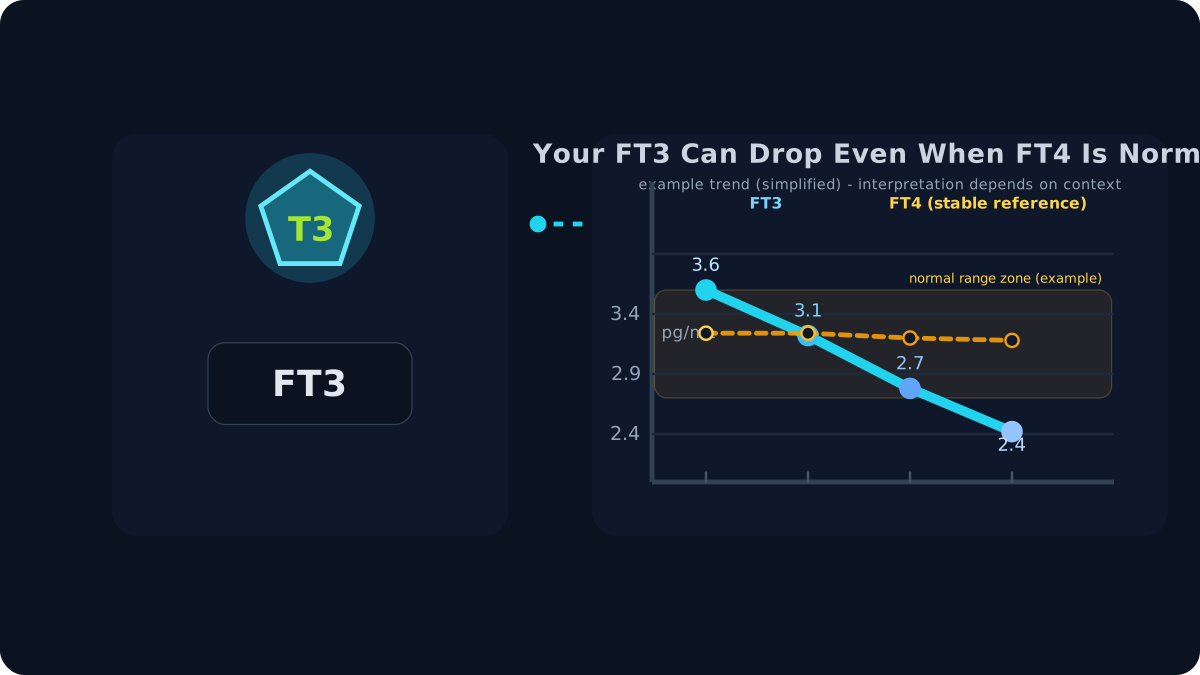
Free T3 (FT3) is where thyroid physiology becomes practical. If TSH is the regulatory signal and FT4 is stored supply, FT3 is the hormone that actually acts in tissues.
FT3 helps regulate metabolic rate, thermogenesis, heart performance, cognition, and day-to-day energy output. Yet in routine workflows, FT3 is often skipped, which can leave an interpretation gap.
Routine care often starts with TSH (and FT4 when indicated). FT3 may add context when conversion factors or persistent symptoms are present — discuss with your clinician.
That gap matters because people can show normal TSH and FT4 while still reporting low energy, cold intolerance, brain fog, and slow recovery. In those cases, thyroid conversion efficiency is often the missing layer.
A pattern like FT3 decline with stable FT4 is a signal, not a diagnosis. Interpretation always depends on context such as stress load, calorie intake, sleep, inflammation, and illness phase.
If you are assembling your first tracking framework, begin with the foundational biomarker set and then add FT3 for thyroid-conversion depth.
Quick summary
- TSH = regulatory signal.
- FT4 = supply reservoir.
- FT3 = active hormone output at the cellular level.
- Normal TSH and FT4 do not always guarantee normal activation.
- Trend direction with context is stronger than one isolated FT3 value.
What does low FT3 mean?
Low free T3 can reflect an underactive thyroid, but it also commonly appears in low T3 syndrome — where the body reduces T3 conversion during illness, stress, calorie restriction, or recovery. In those cases, low FT3 can be an adaptive response, not primary thyroid disease.
That is why low FT3 should be read with TSH, FT4, symptoms, and repeat tests — not as a stand-alone label.
The core model for thyroid interpretation
Think in sequence, not isolated numbers:
- TSH - pituitary request signal
- FT4 - circulating storage and transport pool
- FT3 - active hormone used by tissues
TSH -> FT4 -> FT3 -> cellular effect.
If you only review TSH, you are evaluating the command, not the final biological output.
What FT3 actually does
FT3 binds to intracellular thyroid receptors and influences gene expression. In practice, that affects energy production speed and metabolic intensity.
- higher mitochondrial activity and ATP turnover
- higher oxygen consumption
- higher heat production
- higher heart rate and contractility signals
- stronger cognitive and neurologic activation tone
FT3 may align with symptom context in some people, but TSH and FT4 remain the primary routine pair — full interpretation still requires clinical context.
Why FT3 is often ignored in routine blood tests
- Guidelines prioritize TSH because it is stable and useful for large-scale screening workflows.
- FT3 is more variable and can move with stress, calories, illness, and sleep disruption.
- Many systems are optimized for simple decision trees, not deeper endocrine nuance.
The conversion bottleneck: where interpretation changes
The thyroid mostly releases T4, while much of usable T3 is produced in tissues through deiodinase enzymes.
T4 can be converted in different directions:
- T4 -> T3 (active)
- T4 -> reverse T3 (inactive)
This is the key bottleneck. You can have normal TSH and normal FT4 with low FT3 if conversion is impaired.
If you have normal TSH and FT4 but still feel low energy, cold, or mentally slower than expected, FT3 is often the missing layer worth checking.
When FT3 is low even if other thyroid markers look fine
A common under-recognized pattern is:
- TSH: in range
- FT4: in range
- FT3: low or low-normal
Reported symptoms often include low energy, cold intolerance, brain fog, low motivation, and slow recovery.
Mechanistically this can mean: signal acceptable, supply acceptable, but activation efficiency reduced.
What can impair FT3 conversion
1) Caloric deficit and aggressive dieting
Sustained low energy intake can reduce T4 to T3 conversion as an adaptive energy-conservation response.
2) Chronic stress load
Elevated stress signaling, including cortisol dysregulation, can shift conversion dynamics toward less active output and lower effective thyroid drive at tissue level.
3) Inflammation and acute illness
Inflammatory signaling can reduce deiodinase activity and temporarily lower active hormone conversion.
4) Micronutrient deficits
Selenium, zinc, and iron status can influence conversion efficiency. For iron context, review ferritin alongside thyroid markers.
5) Sleep disruption
Persistent sleep loss can alter endocrine regulation and reduce FT3-supportive conversion conditions.
FT3 vs FT4 vs TSH: practical pattern reading
| Pattern | What the pattern usually means |
|---|---|
| TSH high + FT4 low + FT3 low | Often consistent with overt hypothyroid pattern. |
| TSH high + FT4 normal + FT3 normal | Often described as early or subclinical hypothyroid pattern. |
| TSH normal + FT4 normal + FT3 low | May reflect reduced active output or low T3 patterns during illness or stress (not diagnostic alone). |
| TSH low + FT4 high + FT3 high | Often consistent with hyperthyroid pattern. |
Why TSH alone can be misleading
TSH mainly answers: is pituitary signaling asking for more or less thyroid hormone production?
It does not directly answer whether tissues are receiving enough active hormone output. FT3 adds that final activation layer.
Trends matter more than one FT3 value
One FT3 result can be noisy. Better interpretation comes from direction over time with context on diet, stress, sleep, illness, and medication changes.
| Time | FT3 (report units) | FT4 (report units) | Context |
|---|---|---|---|
| Month 1 | 3.6 | 1.2 | baseline |
| Month 2 | 3.0 | 1.2 | prolonged deficit + stress |
| Month 3 | 2.6 | 1.1 | sleep disruption persists |
A falling FT3 trend with relatively stable FT4 may reflect reduced T4→T3 conversion during stress, illness, or calorie restriction — not always primary thyroid disease. Repeat testing and clinical context are needed.
Practical interpretation framework
- Check TSH: is regulatory signaling high, low, or in range?
- Check FT4: is hormone supply present?
- Check FT3: is active output adequate?
- Ask whether this combined pattern fits symptoms and recent context.
For repeatable longitudinal review, use how to track lab results over time.
What to do when FT3 is low
This is not treatment advice, but common physiological levers include:
- avoid prolonged aggressive calorie restriction
- improve sleep consistency and duration
- reduce chronic stress load where possible
- review nutrient status including selenium and zinc with your clinician before supplementing, plus iron context
- retest in comparable conditions to confirm trend direction
Individual causes vary — discuss persistent symptoms or out-of-range results with a clinician before drawing conclusions.
Final takeaway
FT3 is not just another thyroid marker. It is a practical output signal for how thyroid regulation is landing at tissue level.
High-quality interpretation is usually: TSH -> FT4 -> FT3 -> symptom and context fit. Ignoring FT3 can mean missing the final step where biology actually happens.
Common questions about FT3 blood tests
What is the long form of FT3?
FT3 stands for free triiodothyronine. It is the unbound, biologically available form of T3, the active thyroid hormone used by tissues.
Is FT3 more important than TSH?
They answer different questions: TSH is the primary screening and regulatory marker in routine care; FT3 adds activation context when conversion or symptoms warrant it — not a replacement for guideline-based screening.
Can FT3 be low with normal TSH?
Yes. A normal TSH with normal FT4 can still coexist with low or low-normal FT3 when conversion from T4 to T3 is impaired.
Should FT3 be tested when TSH and FT4 are normal?
FT3 can be useful when symptoms persist despite apparently normal TSH and FT4, especially if conversion-related factors are present. It is not routinely recommended in all guidelines — testing is a clinician decision.
What is a normal FT3 level?
Ranges vary between laboratories. Interpretation is strongest when FT3 is reviewed by position within the lab range, in relation to FT4 and TSH, and across repeated tests.
How does FT3 relate to weight and metabolism?
FT3 is an active metabolic signal, so lower FT3 patterns can align with reduced energy expenditure in some contexts. Weight regulation remains multifactorial, so FT3 should be interpreted alongside nutrition, activity, sleep, and broader thyroid markers.
Can low FT3 be temporary?
Yes. FT3 can fall temporarily during caloric restriction, stress, illness, inflammation, and sleep disruption.
Track FT3, FT4, and TSH in one timeline
Upload your lab results and align FT3 with FT4 and TSH in one structured view, so conversion patterns are visible across repeated tests instead of hidden in separate reports.