
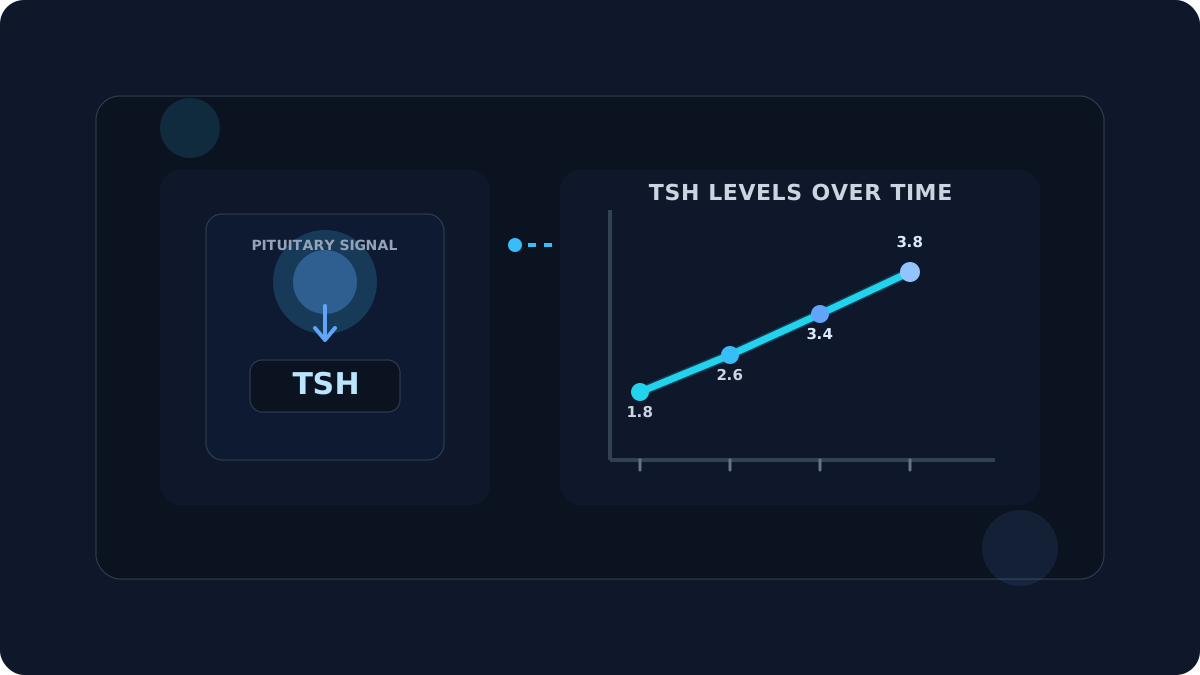
The TSH blood test measures thyroid-stimulating hormone, a central regulator of thyroid activity. TSH is produced by the pituitary gland and signals the thyroid how strongly to produce T4 and T3 hormones.
Because thyroid hormones influence metabolism, energy, temperature regulation, and cardiovascular physiology, TSH is one of the most commonly reviewed endocrine biomarkers in routine lab panels.
In clinical workflows, TSH is often the first screening marker. But useful interpretation requires context: related thyroid markers, current health status, and trend direction across repeated tests.
If you are deciding which markers deserve priority in a monitoring dashboard, use a focused biomarker baseline first, then layer thyroid markers into that system.
Quick summary
- TSH is a regulatory signal, not a stand-alone diagnosis.
- Interpret TSH with FT4, and sometimes FT3, not in isolation.
- Reference ranges are statistical guides, not personal verdicts.
- Trend direction across repeated tests is often more informative than one value.
- Use consistent lab context and sample timing for cleaner comparisons.
What the TSH blood test measures
TSH is part of the hypothalamic-pituitary-thyroid axis. In simplified form, the loop works like this:
- Hypothalamus releases TRH.
- TRH signals pituitary secretion of TSH.
- TSH stimulates thyroid hormone output (T4 and T3).
When circulating thyroid hormones rise, pituitary TSH secretion usually falls. When thyroid hormone availability falls, TSH usually rises. This feedback dynamic is why TSH can act as an early thyroid stress signal in many cases.
TSH normal range
Many laboratories report a TSH interval around 0.4 to 4.0 mIU/L or 0.4 to 4.5 mIU/L, depending on assay method and population calibration.
| TSH zone | General interpretation direction |
|---|---|
| Low TSH | Reduced pituitary stimulation, often linked with higher thyroid activity. |
| In-range TSH | Often compatible with stable regulation when read with context. |
| Elevated TSH | Higher pituitary drive, often linked with lower thyroid hormone availability. |
These are orientation rules only. Always interpret using the specific report interval and your clinical context.
What high TSH may indicate
Elevated TSH often means the pituitary is signaling for more thyroid hormone output. This can appear with hypothyroid patterns, autoimmune thyroid disease, iodine-related issues, recovery after illness, or medication effects.
A common intermediate pattern is elevated TSH with normal FT4, often described as subclinical hypothyroidism. Persistent elevation across repeated tests usually matters more than one isolated high value.
What low TSH may indicate
Low TSH usually reflects reduced pituitary stimulation because circulating thyroid hormone exposure is relatively high. This can appear in hyperthyroid states, Graves’ disease, excessive thyroid medication, toxic nodules, or early thyroiditis contexts.
Temporary suppression can also happen during acute illness or after treatment changes, which is why repeat testing is often used to distinguish transient effects from sustained endocrine patterns.
Why TSH should be read with FT4 and FT3
TSH alone rarely gives a full thyroid picture. More informative interpretation usually combines TSH with FT4 and, when relevant, FT3.
In routine practice, TSH plus FT4 is usually the primary interpretation pair. FT3 is most often reviewed when hyperthyroidism is suspected.
| Pattern | Common interpretation context |
|---|---|
| High TSH + low FT4 | Often consistent with primary hypothyroid pattern. |
| Low TSH + high FT4 or FT3 | Often consistent with hyperthyroid pattern. |
| High TSH + normal FT4 | May indicate subclinical thyroid stress pattern. |
| Low TSH + normal FT4 | May reflect early excess, temporary suppression, or recovery dynamics. |
What does TSH with reflex to FT4 mean?
Some lab reports show "TSH with reflex to FT4," "TSH w/reflex to FT4," or "TSH reflex FT4 if indicated." This means the laboratory automatically adds a free T4 measurement only if TSH falls outside the reference range.
It is a clinical efficiency tool. Rather than ordering both tests separately upfront, the reflex order triggers FT4 testing only when TSH suggests thyroid dysfunction may be present. If your TSH comes back in range, FT4 is usually not added — and many labs do not bill a separate FT4 line item in that case (billing rules vary by lab and insurer).
If your report shows FT4 alongside TSH, it means your TSH result triggered the reflex. Interpret the two together using the pattern table above.
Why TSH trends matter more than one value
TSH can move with sleep disruption, illness, inflammation, medication changes, calorie deficits, training load, and circadian timing. One result can be directionally misleading if testing conditions differ.
Trend analysis helps separate temporary variation from real physiological change.
| Year | TSH (mIU/L) |
|---|---|
| 2019 | 1.8 |
| 2021 | 2.6 |
| 2023 | 3.4 |
| 2025 | 3.8 |
In this example, the latest value approaches the upper boundary of many reference intervals. A repeated upward slope within or near range is worth discussing with your clinician — especially alongside FT4 and symptoms — rather than assuming stability from one in-range value.
Practical steps after a TSH result
- Confirm units and report-specific reference interval.
- Review FT4 and FT3 if available.
- Compare with previous thyroid results in one timeline.
- Document context: illness, medications, stress, and sleep.
- Prepare focused follow-up questions for your clinician.
If your thyroid data is still spread across separate PDFs, use one longitudinal lab workflow so direction is visible before values cross hard thresholds.
Primary thyroid interpretation is based on TSH with FT4 (and sometimes FT3 or thyroid antibodies). Markers such as ferritin or vitamin D may be reviewed separately in broader symptom workups, but they are not primary thyroid function markers.
Common questions about TSH blood tests
What is the long form of TSH?
TSH stands for thyroid-stimulating hormone. It is a pituitary hormone that signals the thyroid gland to produce thyroid hormones.
What is a normal TSH level?
Many labs use an interval around 0.4 to 4.0 mIU/L or 0.4 to 4.5 mIU/L, but interpretation depends on assay method, report standards, and clinical context.
Does high TSH always mean hypothyroidism?
Not always. High TSH is a signal that needs interpretation with FT4, clinical context, and repeated tests.
Does low TSH always mean hyperthyroidism?
Not always. Temporary suppression can occur in non-thyroid contexts, which is why repeat measurement and full panel review are often needed.
Should TSH be tested fasting?
Fasting is usually not required, but consistency in sample timing and routine helps produce cleaner trend comparisons.
What does TSH with reflex to FT4 mean on a lab report?
It means the lab runs free T4 only if TSH is outside the reference range. If TSH is in range, FT4 is usually not added. If both appear on your report, TSH likely triggered the reflex — interpret TSH and FT4 together.
Track thyroid biomarkers over time
Thyroid interpretation improves when TSH, FT4, and related markers stay in one structured timeline. Upload reports, review extracted values, and compare trend direction across years instead of isolated PDFs.