
FT4 (free T4) blood test measures the amount of unbound thyroxine hormone circulating in your blood. It represents the biologically active thyroid hormone fraction available to tissues and is interpreted together with TSH to assess thyroid function.
FT4 is rarely interpreted alone. Its value appears when read together with TSH and, in selected situations, FT3. Without this context, FT4 can be misleading.
This guide provides a practical interpretation framework you can apply to real lab results. If you are mapping your thyroid workflow from scratch, start with the primary biomarker priorities and then layer FT4 + TSH interpretation.
What is FT4 in a blood test?
FT4 (free T4) is the unbound form of thyroxine hormone circulating in your blood. It reflects how much thyroid hormone is immediately available to tissues at a given time and is interpreted together with TSH.
Quick summary
- FT4 blood test measures free thyroxine levels available to tissues.
- FT4 is interpreted together with TSH, not as a standalone marker.
- The TSH + FT4 pair helps identify hypothyroid and hyperthyroid patterns when read together over time.
- Trend direction across repeated tests is usually stronger than one snapshot.
- Context factors (illness, medication, timing) can shift interpretation.
What FT4 actually measures
Thyroxine (T4) is produced by the thyroid gland. Most circulating T4 is protein-bound and inactive. A small fraction circulates freely as FT4.
FT4 acts as a circulating reserve that can be converted into T3:
- it can be converted into T3 (active form)
- it reflects thyroid production capacity
- it stabilizes short-term fluctuations in thyroid output
FT4 often changes more gradually than TSH in stable conditions, which makes it useful for directional tracking when interpreted as part of a sequence.
Reference ranges (orientation only)
Typical FT4 ranges (lab dependent):
- about 9-19 pmol/L
- about 0.7-1.8 ng/dL
These are statistical reference ranges, not universal optimal targets. In-range values do not automatically mean optimal function, and out-of-range values are not diagnosis by themselves.
How to interpret an FT4 blood test correctly (with TSH)
Think in feedback systems: TSH is the signal, FT4 is the response.
You are not reading isolated numbers. You are reading regulation dynamics. TSH often changes more sharply than FT4 because pituitary feedback is highly sensitive.
What does high FT4 mean?
High FT4 usually indicates increased thyroid hormone exposure. The strongest classic pattern is low TSH with high FT4, often seen in hyperthyroid states or thyroid hormone over-replacement.
Interpretation still depends on context. Temporary shifts can appear with acute illness, medication changes, and assay-specific variation, so persistent patterns over repeated tests matter most.
What does low FT4 mean?
Low FT4 usually indicates reduced thyroid hormone availability. With elevated TSH, this often aligns with a primary hypothyroid pattern where pituitary signaling rises to compensate.
Low FT4 with low or in-range TSH is a different clinical pattern and can suggest central regulatory issues, which is why FT4 should always be interpreted as part of the full thyroid axis.
Core interpretation patterns
1) High TSH + Low FT4
Most consistent with a primary hypothyroid pattern where pituitary signaling rises but thyroid hormone output remains low. This is usually a high-signal pattern.
2) High TSH + Normal FT4
Often described as a subclinical hypothyroid pattern. FT4 remains in range, but TSH compensation is already active. Trend direction determines relevance.
This pattern is defined by elevated TSH with FT4 still within reference range.
3) Low TSH + High FT4
Most consistent with a hyperthyroid pattern or excess thyroid hormone exposure. Here, elevated FT4 suppresses TSH through the feedback loop.
4) Low TSH + Normal FT4
This is more ambiguous and can reflect early hyperthyroid phase, temporary suppression, or recovery transitions. Repeat testing and full context are usually required.
It can also be seen in overtreatment with thyroid hormone or transient suppression after illness.
5) Low or normal TSH + Low FT4
This pattern may indicate central (pituitary or hypothalamic) dysfunction rather than primary thyroid disease. It requires clinical evaluation and should not be interpreted as a standard hypothyroid pattern.
When FT4 is normal but TSH is abnormal
This is a common real-world pattern and one of the most misunderstood thyroid scenarios.
A normal FT4 with abnormal TSH should not be dismissed. It often reflects early regulatory stress that becomes clearer over time, especially when the pattern persists across repeated tests.
In practice, this is why thyroid interpretation starts with system behavior, not one isolated in-range result.
Why FT4 alone is not enough
FT4 alone does not show whether pituitary regulation is compensating, whether the system is drifting, or whether a current value is part of a stable pattern versus a transition phase.
The minimum useful interpretation pair is TSH plus FT4, reviewed in sequence over repeated tests rather than as a one-time snapshot.
FT4 vs FT3 (brief but important)
- FT4 = supply signal
- FT3 = active utilization signal
In many real-world panels FT4 appears stable while FT3 varies more. For most users, TSH + FT4 is the minimum viable pair. FT3 becomes especially relevant when FT4 appears stable but regulatory signals or symptoms suggest a mismatch in thyroid activity.
Why trends matter more than single values
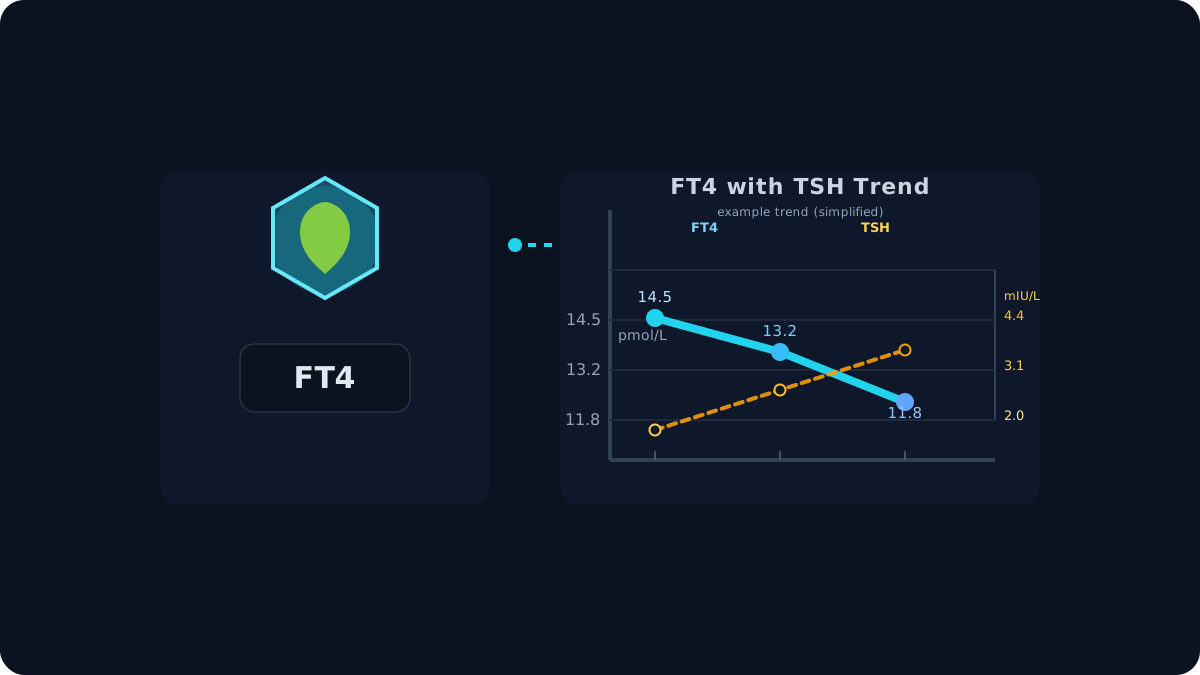
FT4 tends to be relatively stable, so directional trends are especially informative.
| Time | TSH | FT4 |
|---|---|---|
| Year 1 | 2.0 | 14.5 |
| Year 2 | 3.1 | 13.2 |
| Year 3 | 4.4 | 11.8 |
Even if single values still sit in range, rising TSH with falling FT4 is worth discussing with your clinician — especially alongside symptoms — rather than assuming stability from one in-range snapshot.
FT4 can remain within reference range while TSH compensation is already shifting.
This is a simplified example. Real-world thyroid data is often noisier, but direction across repeated tests is what matters most.
In practice, the key signal is often "within range but trending downward" for FT4 while TSH drifts upward.
Common mistakes
- Treating in-range as automatically optimal.
- Ignoring TSH when reviewing FT4.
- Overreacting to one isolated result.
- Ignoring context such as illness, sleep disruption, or medication effects.
- Interpreting temporary changes during acute illness or stress as long-term thyroid dysfunction.
- Mixing units across labs without conversion (for example pmol/L vs ng/dL).
FT4 can shift temporarily during illness or significant physiological stress without reflecting long-term thyroid function.
Practical steps after seeing your FT4
- Confirm unit and laboratory reference interval.
- Review TSH from the same blood draw.
- Compare against your previous 1-3 results.
- Note context factors (illness, sleep, medication, timing).
- Identify direction: stable, rising, or falling.
- Prepare one focused follow-up question for your clinician.
For a repeatable longitudinal workflow, use how to track lab results over time.
Where FT4 fits in a real tracking system
FT4 becomes most useful when stored in a timeline, paired with TSH consistently, and interpreted as sequence behavior rather than isolated snapshots.
Final takeaway
FT4 is not a standalone answer. It is a system output signal that becomes meaningful when paired with TSH, observed over time, and interpreted in real context.
Better thyroid clarity starts when you stop asking what one number means and start asking what direction the system is moving.
Frequently asked questions about FT4 blood tests
What is the long form of FT4?
FT4 stands for free thyroxine. It is the unbound, circulating form of T4 that is available for conversion into the active thyroid hormone T3.
What is a normal FT4 level?
Many labs use roughly 9-19 pmol/L or 0.7-1.8 ng/dL. Interpretation always depends on laboratory method, units, and thyroid context.
Can FT4 be normal if TSH is abnormal?
Yes. This can happen in early or subclinical thyroid imbalance. A normal FT4 with abnormal TSH should be interpreted as a regulatory signal, not automatically ignored.
Does low FT4 always mean hypothyroidism?
Often, but not always. FT4 should be interpreted with TSH and clinical context before conclusions are made.
Can FT4 change quickly?
FT4 is relatively stable compared with TSH, but it can shift with illness, medication changes, and major physiological stress.
Should FT4 be tested fasting?
Fasting is usually not required, but consistent test timing improves comparability when you track trends over time.
Is FT4 enough to assess thyroid health?
No. The minimum useful interpretation pair is TSH plus FT4. FT3 can be added when patterns are unclear or symptoms persist.
Why track FT4 over time?
Direction usually reveals more than one snapshot. Trends show whether thyroid regulation is stable, improving, or drifting.
Track FT4 with TSH in one thyroid timeline
See how FT4 and TSH move together across multiple tests, so thyroid drift becomes visible before symptoms force reactive decisions.