
There is a moment many people experience when reviewing blood test results: a single number appears slightly off, often labeled eGFR (estimated glomerular filtration rate). The reference range is there, the value is highlighted, and suddenly a quiet question emerges:
"Is something wrong with my kidneys?"
What makes eGFR different from many other biomarkers is that it looks precise. It is presented as a clean number, often with thresholds like 90, 60, or 30, suggesting clear categories of normal and abnormal. But beneath that simplicity is something far more complex.
eGFR is not a direct measurement. It is a model. And like all models, it makes assumptions.
Understanding eGFR properly requires stepping away from the idea that it reflects a fixed biological truth, and instead recognizing it as an estimate built on incomplete inputs.
This matters because people interpret eGFR as a direct measurement of kidney function, when in reality it is an assumption layered on top of creatinine.
Early kidney stress can exist while eGFR remains in the normal range, because compensatory mechanisms can preserve filtration until later stages.
eGFR is an estimation, not a measurement
Unlike glucose or hemoglobin, which are directly measured, eGFR is derived from a formula. That distinction alone explains most misinterpretations.
The calculation uses serum creatinine, combined with age and sex, to estimate how much blood your kidneys filter per minute.
eGFR is only as reliable as the creatinine signal it is built on.
This matters because creatinine itself is not a neutral signal.
Creatinine is a breakdown product of muscle metabolism. The more muscle mass you have, the more creatinine your body produces. The less muscle mass, the less creatinine appears in circulation.
The equation assumes an "average body." But real people are not average.
This creates the first major distortion: eGFR reflects not only kidney function, but also how closely your body matches the assumptions of the formula.
Different laboratories may use different equations (for example newer CKD-EPI versus older MDRD). Two labs can report slightly different eGFR values for the same person simply because they use different equations.
Why the same eGFR can mean different things
Two people can have the same eGFR value and exist in completely different physiological states.
A lean, physically active individual with higher muscle mass may have slightly elevated creatinine, which lowers eGFR on paper. In this case, the kidneys may be functioning perfectly well, but the estimate is biased downward.
In contrast, an older individual with low muscle mass may produce very little creatinine. Their eGFR may appear "normal," even if actual filtration capacity is declining.
The number is the same. The meaning is not.
This is one of the most important ideas to understand: eGFR is not a standalone truth. It is context-dependent.
The role of creatinine: signal and distortion
Creatinine sits at the center of the eGFR equation. That makes it both useful and limiting.
It is useful because it reflects clearance - if kidneys filter less effectively, creatinine rises.
But it is limiting because it is influenced by:
- muscle mass
- recent exercise
- protein intake
- hydration status
After intense training, creatinine can transiently rise. After dehydration, concentration increases. After improved hydration, it may fall again.
These shifts can move eGFR up or down without any structural change in kidney function.
This is why interpreting eGFR without context can lead to false conclusions.
Age-related decline: normal vs pathological
eGFR naturally declines with age. This is not inherently a disease process. It is part of biological aging.
A value of 75 may be completely appropriate in one person and concerning in another.
The difference lies in trajectory:
- stable decline over years - often expected
- rapid drop over months - requires attention
The problem arises when static thresholds are applied universally, without considering time and individual baseline.
A single number does not tell you whether a process is stable or changing.
The illusion of clean thresholds
Many reports categorize eGFR into stages:
- above 90 - normal
- 60-89 - mildly reduced
- below 60 — reduced filtration; chronic kidney disease requires persistence over months, not one result
These categories are useful at a population level. But they can be misleading at the individual level.
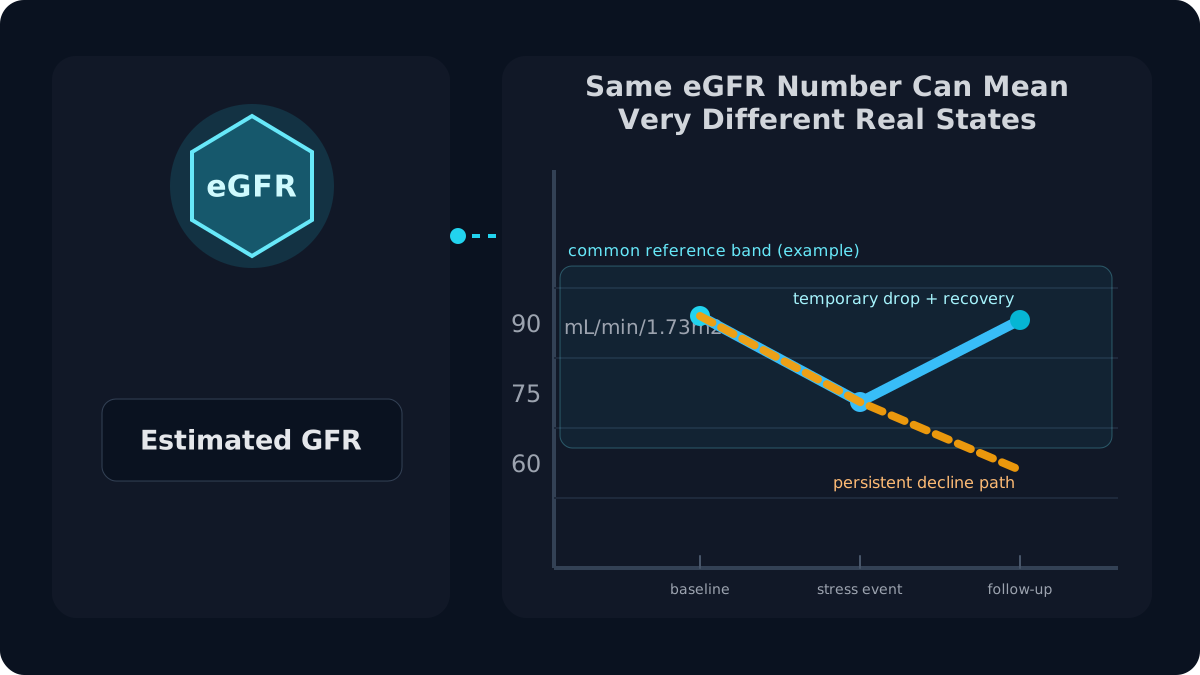
A person with eGFR of 62 that has been stable for years is in a very different situation than someone who dropped from 95 to 62 in six months.
The number is similar. The trajectory is not.
This is where most interpretation errors happen: thresholds replace thinking.
What is a normal eGFR range?
Most adults are described as having normal kidney filtration when eGFR is 90 mL/min/1.73 m² or higher. Below that, categories are often used for orientation — not as a diagnosis on their own.
| eGFR (mL/min/1.73 m²) | General context |
|---|---|
| 90 or above | Normal filtration in most adults |
| 60–89 | Mildly reduced; may be age-related and stable |
| 30–59 | Moderately reduced; trend and symptoms matter |
| Below 30 | Severely reduced; usually needs structured follow-up |
Lab reports and kidney societies may use slightly different cutoffs. Persistent results below 60 for three months or more are often reviewed for chronic kidney disease — always with clinical context, not from one panel alone.
What do specific eGFR numbers mean?
People often search for what a specific eGFR value means — for example eGFR 65, 72, or 79. Here is general context. Interpretation always depends on age, muscle mass, hydration, and trend direction.
- eGFR 90+ — normal filtration in most adults
- eGFR 75–89 — mildly reduced; often age-related and stable when repeated tests agree
- eGFR 60–74 — mildly to moderately reduced; worth tracking the trend over time
- eGFR below 60 — if persistent over three months or more, may indicate chronic kidney disease
A single value of 65 or 72 in isolation says little. The same number can be stable and acceptable for one person, or a meaningful decline for another. Trend direction matters more than the absolute value.
Transient changes vs true decline
Not every drop in eGFR reflects kidney damage.
Short-term fluctuations can occur due to:
- dehydration
- illness
- high training load
- recent dietary changes
These shifts can temporarily alter creatinine and therefore eGFR.
What matters is whether the value returns to baseline when conditions normalize.
Persistent changes carry different weight than temporary deviations.
eGFR as part of a system
eGFR becomes significantly more meaningful when viewed alongside related markers.
Creatinine provides the raw input signal. Inflammatory markers like hs-CRP can reflect broader systemic stress.
Metabolic markers such as insulin or glucose can influence long-term kidney load.
Kidney-related markers such as uric acid can add additional clearance context in metabolic stress patterns.
When filtration declines, BUN, potassium, and sodium often shift — another reason eGFR should not be read in isolation.
Together, these markers help answer a better question:
Is the system stable, or under increasing pressure?
eGFR alone cannot answer that.
Why trends matter more than a single result
A single eGFR value is a snapshot. It tells you where you are, not how you got there.
More useful patterns look like this:
| Time | eGFR | Context |
|---|---|---|
| Month 1 | 92 | baseline |
| Month 2 | 78 | dehydration + illness |
| Month 3 | 91 | recovered |
This pattern suggests temporary fluctuation.
Compare that to:
| Time | eGFR | Context |
|---|---|---|
| Month 1 | 95 | baseline |
| Month 3 | 82 | stable lifestyle |
| Month 6 | 70 | no clear trigger |
This suggests a trend that deserves investigation.
Direction over time is more informative than position at one moment.
The hidden risk of "normal" eGFR
One of the more subtle issues with eGFR is false reassurance.
A value within range can still mask early changes if:
- baseline was significantly higher
- muscle mass has decreased
- systemic stress is increasing
Because the equation depends on creatinine, any factor that lowers creatinine production can artificially inflate eGFR.
This creates a paradox:
The number looks better while the system is not.
Practical interpretation: how to think about eGFR
Instead of asking "is my eGFR normal?", a more useful framework is:
- Is this value consistent with my past results?
- Has anything changed recently that could affect creatinine?
- Does this align with other markers and symptoms?
- Is the trend stable, improving, or declining?
This shifts the focus from static interpretation to dynamic understanding.
Final takeaway
eGFR is not a direct measurement of kidney function. It is an estimate built on creatinine, filtered through assumptions about the human body.
It is useful. But it is not absolute.
The real value of eGFR comes from pattern recognition over time, combined with context.
One number can inform you. Only a trajectory can explain what is happening.
Frequently asked questions about eGFR blood tests
What is the long form of eGFR?
eGFR stands for estimated glomerular filtration rate. It is a calculated estimate of how efficiently the kidneys are filtering blood, usually derived from creatinine, age, sex, and sometimes race-free equations.
What is a normal eGFR level?
Generally, values above 90 are considered normal, but interpretation depends on age, muscle mass, and trend over time.
Can eGFR fluctuate day to day?
Yes. Hydration, exercise, short-term illness, and recent physiological stress can temporarily affect creatinine and therefore eGFR.
Is low eGFR always kidney disease?
No. A single low value does not confirm disease. Persistent reduction and trend direction are more important.
Why does muscle mass affect eGFR?
Because creatinine comes from muscle metabolism. Higher muscle mass increases creatinine, which can lower calculated eGFR.
Should eGFR be tracked over time?
Yes. Trends provide far more meaningful insight than a single measurement.
Can eGFR improve?
Sometimes. If a decline reflects reversible factors such as dehydration or acute illness, eGFR may move back toward baseline. Established chronic kidney disease often stabilizes rather than fully normalizes — follow-up with a clinician is essential.
One uncomfortable question
If your eGFR changes, are you observing a change in kidney function - or a change in the assumptions the model is making about your body?
The answer is not always obvious. And that is exactly why interpretation matters.
Keep eGFR in longitudinal context
Review eGFR with creatinine and surrounding context across repeated tests so temporary noise is separated from persistent drift.