
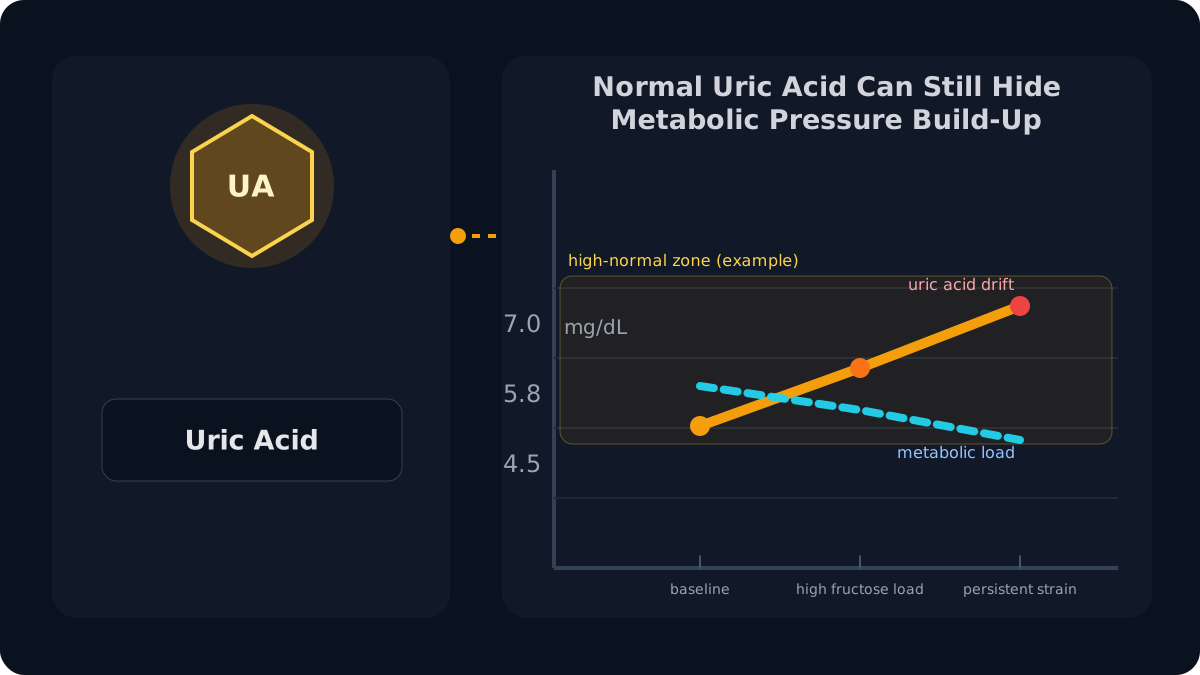
There is a pattern that shows up often in routine blood work.
Energy feels slightly off. Recovery is not as sharp. Maybe there is subtle stiffness in the joints, or a sense that the body is under low-grade tension. Nothing dramatic. Just enough to notice.
Labs come back. Most values look fine.
Uric acid is within range.
The conclusion is usually simple: nothing to worry about.
But uric acid is one of those markers where "in range" does not always mean "in balance."
To understand why, you have to stop thinking of uric acid as just a gout marker, and start seeing it as part of a broader system involving metabolism, kidneys, and cellular stress.
Uric acid is not just waste - it is a signal
Uric acid is the end product of purine metabolism. Purines come from two main sources: your own cells and your diet.
At first glance, it looks like a waste product - something the body produces and then eliminates through the kidneys.
But that framing is incomplete.
Uric acid also behaves as a biologically active molecule. It participates in oxidative balance and can shift from antioxidant to pro-inflammatory behavior depending on concentration and cellular context, while also interacting with endothelial function and reflecting how the body handles energy at a cellular level.
In other words, it is not just something to get rid of. It is something that changes when the system changes.
Why uric acid rises: production vs clearance
Uric acid levels are determined by two forces:
- how much is produced
- how efficiently it is cleared
Production increases when there is higher turnover of nucleotides or increased metabolic flux - especially from fructose metabolism and cellular energy stress.
Clearance depends largely on kidney function.
Kidney handling of uric acid is not just filtration. A large portion is reabsorbed in the renal tubules, which means small physiological shifts can significantly change circulating levels.
This is where things get interesting.
A rise in uric acid does not automatically mean the kidneys are failing. It can also mean the metabolic system is generating more uric acid upstream.
That distinction matters.
Because the same number can reflect very different underlying dynamics.
The metabolic connection most people miss
A major dietary driver of uric acid production is fructose metabolism.
Unlike glucose, fructose is processed in a way that rapidly consumes ATP. This creates a transient energy deficit inside cells, which triggers breakdown pathways that generate uric acid.
This is why higher intake of sugary drinks, processed foods, and high-fructose loads can push uric acid upward even when other markers still look acceptable.
At the same time, uric acid itself can feed back into the system.
Higher uric acid levels are associated with:
- reduced nitric oxide availability
- endothelial dysfunction
- reduced insulin sensitivity
This creates a loop:
metabolic stress → increased uric acid → further metabolic strain
This is why uric acid often sits at the intersection of metabolic and cardiovascular risk - even when it is not dramatically elevated.
Kidney function: the clearance side of the equation
The kidneys are responsible for excreting most uric acid.
That means uric acid is tightly connected to filtration capacity, which is commonly estimated through eGFR and influenced by creatinine levels.
If kidney clearance decreases, uric acid can rise.
But here is the nuance:
A slightly elevated uric acid does not automatically mean impaired kidney function. It may simply reflect a temporary shift in hydration, filtration dynamics, or metabolic load.
Conversely, a "normal" uric acid level does not guarantee that clearance is optimal - especially if production is low at the same time.
Again, the number alone is not enough. Context determines meaning.
Why normal can still be misleading
Reference ranges for uric acid are broad.
A value near the upper end of normal is often treated as acceptable. But physiologically, that position may already reflect increased metabolic pressure.
Think of it this way:
- The reference range defines what is common
- Not necessarily what is optimal
Two individuals can both be "in range," yet one may be closer to a threshold where crystallization risk or metabolic effects begin to increase.
Uric acid becomes clinically more concerning as it approaches its solubility threshold, where crystal formation becomes more likely, especially in joints and cooler peripheral tissues.
This is especially relevant for people with:
- insulin resistance patterns
- higher fructose intake
- reduced kidney clearance
- chronic low-grade inflammation
In these contexts, uric acid becomes a sensitivity marker - not a diagnostic endpoint, but an early signal.
Uric acid and gout: the visible tip of the iceberg
Most people associate uric acid with gout.
Gout occurs when uric acid crystallizes in joints, triggering intense inflammation.
Uric acid becomes clinically critical when it exceeds its solubility threshold, especially in cooler peripheral tissues like joints. This is why crystallization and gout often occur in extremities rather than centrally.
But gout is not the starting point. It is the end point of a longer process.
Before crystals form, uric acid may already be elevated for years, interacting with vascular function, metabolic pathways, and inflammatory signaling.
This is why focusing only on gout misses the broader relevance of the marker.
Uric acid can be elevated without symptoms.
Many individuals live with chronically elevated uric acid for years without symptoms, while metabolic and vascular effects quietly accumulate.
And that asymptomatic phase is often where the most meaningful system-level changes are happening.
Inflammation and oxidative balance
Uric acid plays a dual role.
At physiological levels, it can act as an antioxidant.
At higher concentrations, especially inside cells, it can contribute to oxidative stress and inflammation.
This duality is important.
It explains why uric acid is not simply "good" or "bad," but context-dependent.
Increased uric acid often aligns with higher inflammatory tone, which can also be reflected in markers like hs-CRP.
When these signals move together, they point toward a system under stress rather than a single isolated issue.
Transient vs persistent elevation
Uric acid can fluctuate.
Short-term increases can occur due to:
- dehydration
- alcohol intake
- high-purine meals
- intense exercise
These changes are usually temporary.
What matters more is whether uric acid remains elevated over time under stable conditions.
A persistent elevation suggests a stable shift in either production or clearance - and that is where interpretation becomes clinically meaningful.
How to interpret uric acid properly
The most useful way to think about uric acid is not:
"Is this value normal?"
But:
- Is this value stable over time?
- Is it trending upward or downward?
- Does it align with metabolic markers like insulin or glucose and triglycerides?
- Does it fit with kidney-related signals like eGFR?
- Is there a lifestyle or dietary pattern that explains it?
This approach turns uric acid from a static number into a dynamic signal.
The hidden pattern: early metabolic drift
One of the most interesting patterns is this:
- glucose: in range
- insulin: slightly elevated or high-normal
- uric acid: high-normal
This combination can reflect early metabolic drift before overt dysfunction appears.
In that sense, uric acid can act as a sensitivity marker for metabolic context — not a diagnosis of a specific disease, but a signal worth reviewing with broader labs and trends.
Final takeaway
Uric acid is often misunderstood because it is reduced to one condition: gout.
But in reality, it sits at the intersection of metabolism, kidney function, and inflammation.
It is shaped by how your body produces energy, how your kidneys clear waste, and how your internal environment responds to stress.
The number itself is only part of the story.
What matters is how that number fits into the system - and how it changes over time.
One uncomfortable question
If your uric acid is "normal," but drifting upward alongside subtle changes in energy, recovery, or metabolic markers -
is your system actually stable,
or just compensating quietly?
Frequently asked questions about uric acid blood tests
What is a normal uric acid level?
Typical reference ranges vary by laboratory, but are roughly 200 to 420 umol/L (or 3.4 to 7.0 mg/dL) in men and slightly lower in women. Interpretation depends on context, not just thresholds.
Is high uric acid always gout?
No. Many people have elevated uric acid without symptoms. Gout occurs only when crystals form and trigger inflammation.
Can uric acid be high with normal kidney function?
Yes. Increased production, especially from metabolic factors like fructose intake, can raise uric acid even when kidney function is normal.
Does diet affect uric acid?
Yes. Fructose, alcohol, and high-purine foods can increase uric acid levels, while hydration and balanced metabolism help regulate it.
Is uric acid linked to insulin resistance?
Yes. Elevated uric acid is often associated with reduced insulin sensitivity and may reflect underlying metabolic stress even before glucose becomes abnormal.
Should uric acid be tracked over time?
Yes. Trends provide more meaningful insight than a single measurement, especially when evaluated alongside metabolic and kidney markers.
Can uric acid decrease naturally?
Sometimes. Hydration, dietary changes, and improved metabolic health may lower uric acid over time, but results vary by person and underlying cause. Repeat testing under comparable conditions is the reliable way to see direction.
Keep uric acid in system context
Review uric acid with kidney and metabolic markers over time so high-normal drift becomes visible before symptoms appear.