
Most blood tests tell you what is present in your system. Homocysteine adds a different kind of context: how efficiently one-carbon metabolism pathways appear to be handling demand.
You can have normal-looking labs, enough nutrients on paper, and still feel fatigue, brain fog, or slower recovery. In many cases, the issue is not availability. It is conversion and utilization, and homocysteine sits exactly at that junction.
If you are building your baseline first, use the core biomarker priority framework and then layer homocysteine in as a system-efficiency marker.
From nutrients to function
Most biomarkers are static snapshots: how much glucose is circulating, how much cholesterol is present, how much hormone is released. Homocysteine is different. It is part of a cycle, and its level depends on flow quality inside that cycle.
Methionine from food is continuously used and recycled. Homocysteine appears as an intermediate, and under healthy conditions it should keep moving, not accumulate. It is converted back into methionine or toward cysteine pathways that support antioxidant systems such as glutathione.
When conversion slows, homocysteine rises. That rise is usually not random noise. It is a signal that the system is losing efficiency.
Methylation cycle in practice (simplified but precise)
Homocysteine is not a toxin produced by mistake. It is a required intermediate in methylation, a core process supporting DNA repair, neurotransmitter balance, detox pathways, and cellular signaling.
In simplified form: methionine becomes homocysteine, then homocysteine is either recycled back into methionine or redirected toward cysteine and downstream antioxidant pathways such as glutathione.
The recycle branch depends on active B12 and folate. The transsulfuration branch depends on B6 and broader metabolic stability. If either branch slows, homocysteine accumulates.
Mechanistically, remethylation depends on methionine synthase (B12-dependent) and folate in the 5-MTHF form, while transsulfuration depends on cystathionine beta-synthase (B6-dependent).
That is why homocysteine is better understood as a throughput marker than a storage marker. It reflects how efficiently the system processes and recycles, not just what is present in circulation.
Why B12 alone is not enough
This is where many interpretations break. A normal serum B12 result can look reassuring, but biology is not just presence. It is function.
The conversion of homocysteine back to methionine depends on active B12 and folate. If either is insufficient, poorly absorbed, or not well utilized, the cycle slows and homocysteine can climb even while B12 appears in range.
This often explains the confusing pattern of normal general labs with persistent low energy, slower cognition, and no obvious red flag.
A process marker, not a single-organ marker
Homocysteine does not belong to one organ. It reflects a process spanning vascular, neurological, and metabolic domains.
At the vascular level, elevated homocysteine is associated with endothelial dysfunction, increased oxidative stress, and altered clotting dynamics over time. At the neurological level, methylation pathways influence neurotransmitter balance and myelin maintenance. At the metabolic level, inefficient processing increases background system strain.
It frequently moves with other pressure signals such as hs-CRP or chronic stress physiology reflected through cortisol. Not because they are identical, but because they can describe the same system load from different angles.
The everything-looks-normal problem
One of the most common scenarios is also the most frustrating: standard panels come back in range, yet energy remains low, focus inconsistent, and recovery slower than expected.
Homocysteine can reveal that the system is not broken, but inefficient. Instead of one dramatic failure, you may be seeing reduced throughput in a core biochemical pathway that basic panels do not directly capture.
How to interpret homocysteine in context
A broad reference range (often around 5 to 15 umol/L) includes both efficient and borderline states. Being in range does not automatically mean optimal processing.
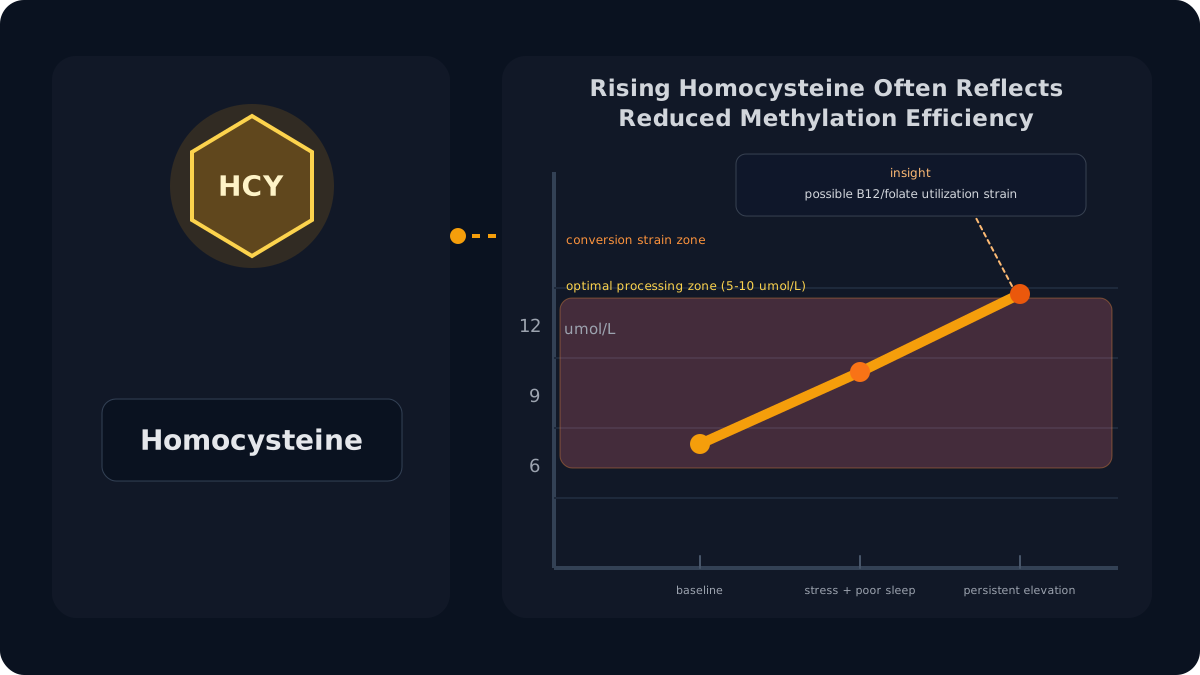
Direction is usually more informative than one snapshot: stable low values suggest efficient flow, gradual rise suggests drift, and persistent elevation suggests sustained pathway strain.
Context still matters. Temporary stress or illness can shift values short term. A sustained rise across months is a different signal from one isolated fluctuation.
Edge cases and common misinterpretations
A common mistake is assuming in-range means optimal. Broad lab ranges can include both efficient and borderline states, so a value near the upper part of range may still reflect weaker conversion dynamics than a lower stable baseline.
Another mistake is over-reading one measurement. Temporary illness, acute stress, or short-term sleep disruption can transiently shift homocysteine without representing long-term pathway drift.
There are also cases where homocysteine appears normal despite underlying pressure, for example after recent supplementation, during temporary compensation, or under testing conditions that do not reflect usual load.
Rarely, unusually low homocysteine can appear and may reflect altered sulfur-amino-acid balance or over-supplementation context. Genetics can also shift baseline conversion efficiency (including folate-pathway variants), but lifestyle and recovery environment usually determine whether those predispositions become clinically relevant.
What actually drives it up
Homocysteine rises when processing demand exceeds conversion capacity. Sometimes that is straightforward nutrient insufficiency (B12, folate, B6). Often it is a layered pattern of absorption friction, poor utilization, sleep disruption, chronic stress load, and inflammatory pressure.
These factors stack over time. The outcome is similar: slower conversion, higher homocysteine, and a system that feels less resilient.
Why this marker matters long-term
Homocysteine is less about immediate diagnosis and more about trajectory. It can shift before louder markers do, which makes it useful for long-horizon strategy.
It helps answer a deeper question: is the system moving in a healthier direction, or quietly compensating while efficiency declines?
A practical way to use it
Instead of treating homocysteine as an isolated target, treat it as a systems indicator. If it is elevated, the priority is understanding why conversion is inefficient.
That usually means reviewing nutrient sufficiency and absorption, sleep consistency, chronic stress load, and inflammatory state, then rechecking over time to see whether the system actually responds.
For repeatable review across uploads and dates, use a consistent workflow with comparable testing conditions.
When to test and retest (practical protocol)
Homocysteine is most useful as a trend marker, not a one-off result. When rechecking after an intervention, many clinicians repeat in weeks to months under comparable conditions, but timing varies by context.
Retest sooner when major context shifts occur (sleep collapse, high stress phases, illness recovery, or significant nutrient strategy changes). Retest later when conditions are stable and directional trend is the main question.
The goal is not chasing one isolated number. The goal is verifying whether conversion efficiency improves when system load and recovery quality improve.
Real-world pattern walkthrough
A common pattern: baseline homocysteine is mid-range, then gradually rises over months while B12 remains in range. During the same period, sleep quality declines, stress load rises, and recovery feels slower.
After improving sleep consistency, reducing stress load, and reviewing B12/folate/B6 adequacy, homocysteine often trends down on follow-up testing. This does not prove one single cause, but it strongly supports a systems-throughput interpretation rather than isolated deficiency thinking.
Final perspective
Homocysteine does not tell you what you have. It tells you how well you are using what you have.
That is why it often explains cases where everything looks normal on paper but does not feel normal in practice. It is a quiet marker, but one of the most informative for system-level interpretation.
Over time, the pattern is often clear: when the system is supported, homocysteine trends down. When the system is strained, it trends up.
One question worth sitting with
If your labs say everything is fine but homocysteine is rising, is your system actually healthy, or just quietly compensating?
If you remember one principle
Homocysteine is not about how much B12 you have. It is about how effectively your system is using B12 and related cofactors over time.
Frequently asked questions about homocysteine blood tests
What is a normal homocysteine level?
Most laboratories define roughly 5 to 15 µmol/L as a reference range, but intervals vary by lab. Interpretation depends on context and trend direction, not one number.
Can homocysteine be high with normal B12?
Yes. It can reflect folate/B6 context, absorption or utilization issues, kidney function, medications, or broader stress/inflammation — a normal serum B12 alone does not rule out a functional mismatch.
Why is homocysteine important?
It reflects one-carbon metabolism context (remethylation and transsulfuration pathways) and is often reviewed with B12 and folate when symptoms or risk patterns are present.
Is high homocysteine dangerous?
It is associated with increased cardiovascular and neurological risk over time, but it is not a diagnosis on its own. It is a signal of underlying inefficiency.
How often should homocysteine be tested?
Periodically, especially when tracking fatigue, cognitive changes, or B12-related concerns over time.
What helps improve homocysteine levels?
Depending on the cause, clinicians may review B12, folate, and B6 status; kidney and thyroid context; diet; and lifestyle factors such as sleep and alcohol. Persistent elevation should be discussed with a clinician before acting on supplementation.
Keep homocysteine in long-term context
Review homocysteine over time alongside sleep, stress, and nutrient context so directional drift is easier to interpret.