
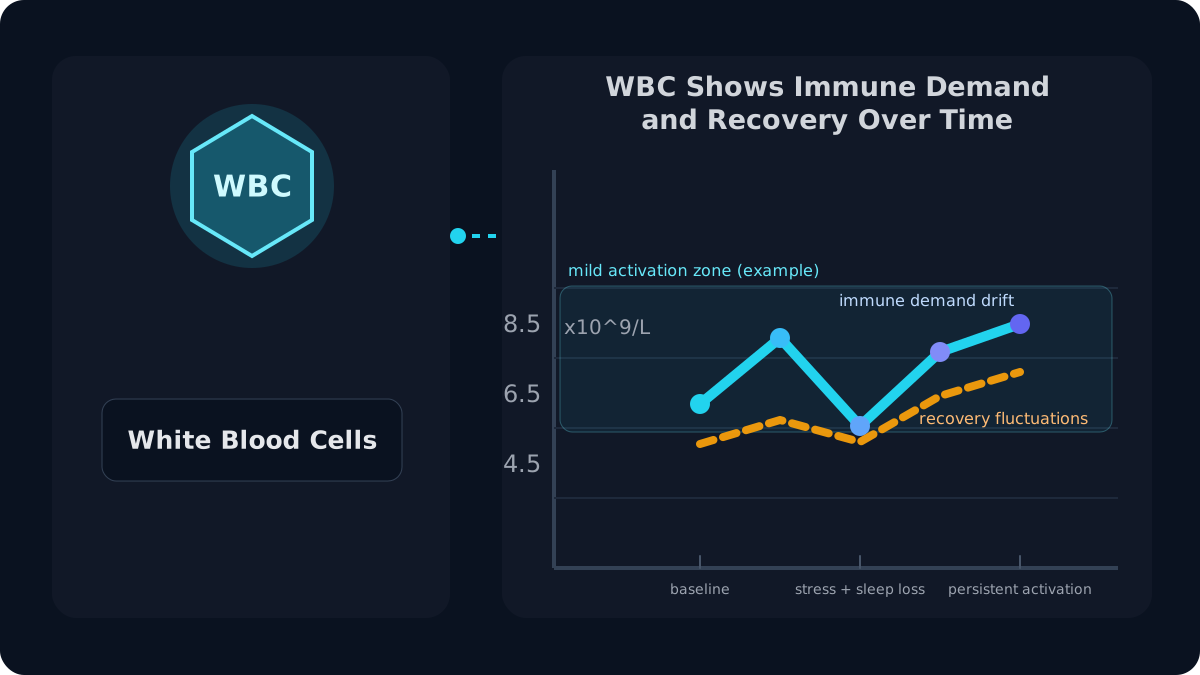
WBC (white blood cell count) is the total number of immune cells in your blood sample. What it means for you depends on the number, the unit, your lab's range, and the differential (neutrophils, lymphocytes, and others).
WBC is reported in ×10^9/L. Many adult labs use about 4.0–11.0 (some 4.5–11.0). Find your number below.
What does my WBC result mean?
| WBC (×10^9/L) | cells/uL | What it usually means |
|---|---|---|
| Below 2.0 | Below 2,000 | Markedly low. Prompt clinician review; same day if fever or infection signs. |
| 2.0–3.9 | 2,000–3,900 | Low. Often repeated; check neutrophils and the differential. Viral illness, meds, B12/folate, normal variation. |
| 4.0–4.4 | 4,000–4,400 | At some labs this is flagged as low; compare with your report's range. |
| 4.5–10.0 | 4,500–10,000 | Typical at most labs (some 4.0–11.0). Compare earlier results. |
| 10.1–11.0 | 10,100–11,000 | Borderline at some labs. Use your report's range. |
| 11.1–15.0 | 11,100–15,000 | Mildly raised. Infection, inflammation, stress, smoking, steroids, exercise. Recheck when well. |
| 15.1–30.0 | 15,100–30,000 | Clearly raised. Clinician review if fever, pain or other symptoms. |
| Above 30.0 | Above 30,000 | Markedly raised. Prompt evaluation; not a fixed cutoff alone. |
For example, 13.7 ×10^9/L (13,700 cells/uL) falls in the mildly raised band; the cause depends on the differential, symptoms and trend.
Ranges: MedlinePlus; adult leukocytosis definition: StatPearls. Bands above 11.0 are orientation groupings, not diagnostic cutoffs; leukocytosis in adults is generally defined as above 11.0.
These bands are for non-pregnant adults. Children, infants and pregnancy use different ranges. WBC rises in pregnancy; third-trimester upper limits can be higher (about 13.2 ×10^9/L in one StatPearls reference).
WBC units explained
×10^9/L is the same scale as ×10^3/uL, K/uL, or "thousand per µL" on some reports. cells/uL = ×10^9/L × 1,000 — for example, 16,000 cells/uL = 16.0 ×10^9/L. Always match the unit on your report before comparing to a band.
What to do with an out-of-range WBC
- Check the unit and the reference interval printed on your lab report.
- Read the differential — especially neutrophils and lymphocytes.
- Compare with your earlier results when you have them.
- Discuss persistent or unexplained changes with a clinician.
Seek urgent medical care if abnormal WBC comes with fever, chills, severe pain, shortness of breath, confusion or unusual bleeding/bruising.
Compare this result with your previous ones
Upload your lab reports and see WBC and the differential on one timeline.
A single WBC is not a yes-or-no health verdict. White blood cells adapt to stress, recovery, and exposure; the number captures one moment, and trends usually matter more than one flag.
For a practical baseline-first approach, start with core blood biomarkers to track first.
What WBC actually measures
WBC, or white blood cell count, reflects the number of immune cells circulating in blood at the time of testing.
These cells are not uniform. They include neutrophils, lymphocytes, monocytes, eosinophils, and basophils.
Each subtype plays a different role, from immediate defense to longer-term immune memory. Standard WBC compresses that complexity into one number.
That number answers one question: how active is your immune system right now? It does not tell you why.
Why WBC exists as a signal
Your immune system is not designed to stay constant. It is designed to respond.
Exposure to infection, inflammation, stress, or tissue damage can increase white cell production. When the system is stable and unchallenged, activity settles.
This makes WBC context-dependent rather than fixed. Higher is not always bad. Lower is not always good. The key is whether the value fits the surrounding pattern.
The mistake: interpreting WBC in isolation
The most common error is treating WBC like a standalone diagnosis.
A value inside range is often ignored. A mildly out-of-range value can create unnecessary concern.
But WBC without context is ambiguous. A value like 7.0 ×10^9/L can mean stable baseline, recovery from recent stress, early immune activation, or normal fluctuation.
The number alone cannot distinguish these states.
What determines your WBC level
White blood cell levels are influenced by overlapping factors.
Infection is the most obvious. Bacterial infections often increase WBC with neutrophil dominance. Viral infections often keep total WBC stable or lower it, while lymphocyte proportion increases.
Inflammation is another layer. Chronic low-grade inflammatory load can keep WBC mildly elevated for long periods without acute illness.
Stress, physical or psychological, can shift immune signaling. Acute stress may transiently increase circulating cells, while chronic stress can dysregulate production.
Sleep quality matters. Poor sleep can destabilize immune regulation and alter WBC behavior.
Training load matters too. Intense exercise can transiently increase WBC, while persistent overload without recovery can suppress immune patterns.
WBC reflects net immune demand and regulation, not one isolated cause.
Normal ranges and what they hide
Landing inside a reference interval does not end the story. Someone drifting from 5.0 to 7.5 may be undergoing a meaningful shift even though both values are often labeled normal.
Another person can remain around 9.5 chronically and still be labeled normal despite sustained immune activation.
WBC is not only about being inside range. It is about position relative to personal baseline and how that position changes over time.
High WBC: what it usually means
Elevated WBC (leukocytosis) reflects increased immune activity.
The most common causes include acute infection, inflammatory states, physiological stress, smoking, and certain medications like corticosteroids.
Pattern determines interpretation. A sharp spike often indicates acute response. A persistent mild elevation can suggest sustained inflammatory load, chronic stress pressure, or lifestyle-linked immune activation.
Low WBC: a different kind of signal
Low WBC (leukopenia) reflects reduced circulating immune cells.
Common contexts include viral suppression phases, nutrient constraints (especially B12 or folate), marrow suppression patterns, chronic stress or overtraining, and medication effects.
A transient drop during or after illness can be part of normal cycling. Persistent downward trends usually carry more concern.
Low WBC is not simply bad. It indicates potential under-resourcing or suppression, and meaning depends on cause.
The pattern most people miss
One high-value pattern is fluctuating WBC without clear illness.
Many people assume this is lab inconsistency, but repeated fluctuation can indicate unstable immune regulation.
Common drivers include inconsistent sleep, variable stress exposure, irregular training load, and ongoing low-grade inflammation.
If inputs are unstable, WBC behavior often reflects that instability.
Differential counts: where WBC becomes more precise
Total WBC is broad. Differential breakdown adds resolution.
Neutrophils often rise with bacterial infections and acute inflammation.
Lymphocytes are more associated with viral response and adaptive immunity.
Monocytes often reflect cleanup and longer-horizon immune processes.
Eosinophils can rise with allergic or parasitic response patterns, and can also increase during some drug reactions.
Looking only at total WBC is like seeing total revenue without knowing product mix. If WBC is headline, the differential is the structure underneath.
What trends in WBC reveal
Repeated measurements reveal trajectory that one result cannot show.
A gradual upward drift may suggest accumulating inflammatory load or stress pressure.
A downward trend can reflect recovery or, in some contexts, suppression.
Repeated spikes followed by drops can reflect recurring challenges or inconsistent recovery cycles.
The key insight: WBC patterns often reflect how immune regulation is interacting with daily behavior, not only abstract biology.
How to interpret WBC properly
WBC should always be interpreted in context.
Start with pattern: stable, rising, falling, or fluctuating.
Then add supporting markers such as CRP for inflammation context and ferritin for iron-immune interaction.
Add behavior context too: sleep quality, stress load, training intensity, and recent illness or exposure.
When signals align, interpretation becomes clearer. When signals conflict, that conflict is often the most informative finding.
What WBC does not tell you
WBC does not diagnose a specific condition on its own.
It does not distinguish all causes of immune activation.
It does not measure immune effectiveness, only activity level.
You can have normal WBC with dysfunction, and elevated WBC with good day-to-day function. It is a signal, not a conclusion.
The real value of WBC
WBC becomes valuable when you stop treating it as a one-time check.
Tracked longitudinally, it becomes a proxy for immune behavior: how often you are challenged, how well you recover, and how stable internal regulation remains.
On its own, it is a number. Over time, it is a pattern. Patterns are where real insight lives.
Frequently asked questions about WBC blood tests
What is the long form of WBC?
WBC stands for white blood cell count. It measures the total number of white blood cells circulating in blood and is used as a broad immune activity marker.
What does high WBC mean in a blood test?
It usually indicates increased immune activity, often due to infection, inflammation, or physiological stress.
Can WBC be high without infection?
Yes. Chronic inflammation, stress, smoking, and certain medications can elevate WBC without an acute infection.
What does low WBC mean?
Low WBC may indicate reduced immune cell production or increased suppression, depending on context and duration.
Should WBC be tracked over time?
Yes. Trends provide far more insight than a single measurement.
Is WBC enough to understand immune health?
No. It should be interpreted alongside differential counts and other markers like CRP and ferritin.
Is a WBC of 13 high?
13 x10^9/L is above the upper limit at most adult labs (often about 10–11). That is usually mildly raised; meaning depends on symptoms, the differential, and whether it persists. Many clinicians recheck when you are well and discuss if it stays elevated.
What is a dangerous WBC level?
There is no single cutoff for everyone. Very low values (often below about 2.0 x10^9/L) or very high values (often above about 30 x10^9/L), or any abnormal value with fever or serious symptoms, commonly need prompt medical review.
How do I convert WBC cells/uL to x10^9/L?
Divide cells/uL by 1,000. For example, 13,700 cells/uL = 13.7 x10^9/L.
The uncomfortable question
If your WBC has been slightly elevated for months but you feel fine, are you truly healthy, or simply adapted to a level of chronic immune activation you no longer notice?
Sources and further reading
- MedlinePlus: WBC count
- MedlinePlus: White Blood Count (WBC) test
- StatPearls: Leukocytosis (NCBI Bookshelf)
This page is educational and does not replace medical advice.
Track WBC as a system, not a number
WBC becomes meaningful when tracked with inflammation markers, nutrient status, and behavior patterns over time, because immune regulation is dynamic.