
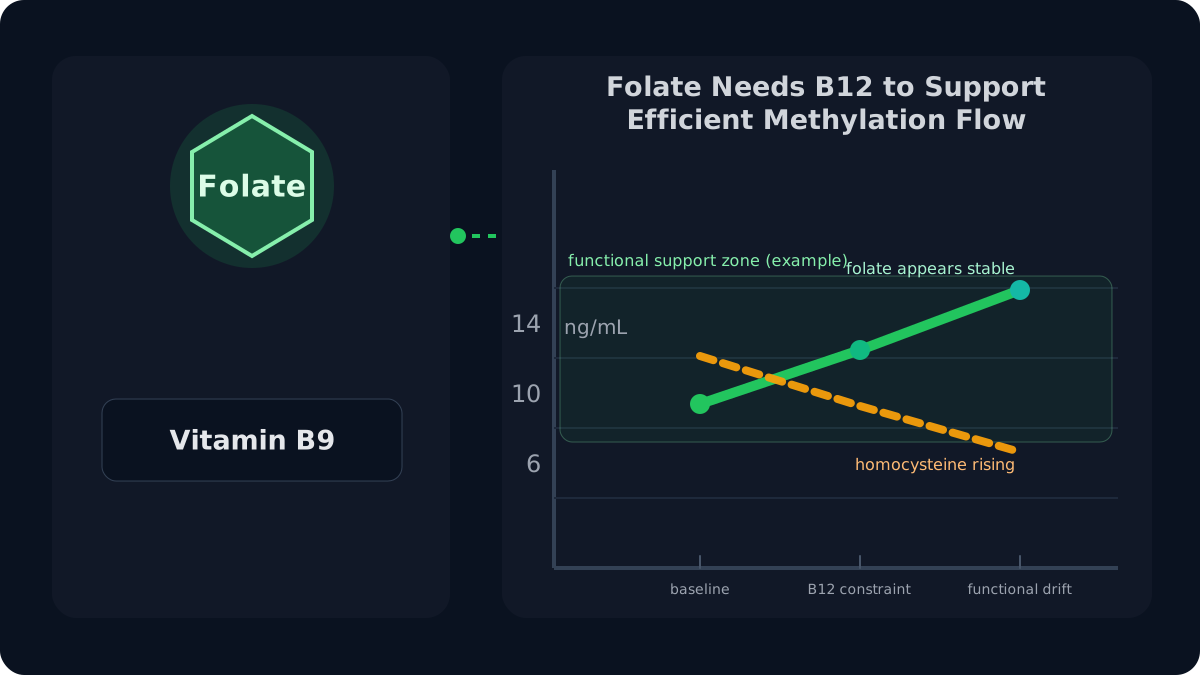
Most people see folate as just another vitamin, something you either have enough of or you do not.
But folate is not just a nutrient level. It is part of a tightly coupled biochemical system that determines how your body builds cells, repairs DNA, and regulates processes like energy production and neurological function.
And that system does not operate in isolation. Folate without B12 is incomplete. B12 without folate is ineffective.
If you are tracking your biology over time, folate is not a standalone marker. It is a signal that only makes sense when viewed in relation to the system it belongs to.
What folate actually is
Folate, also known as vitamin B9, is essential for cellular processes, especially DNA synthesis and cell division. It plays a direct role in red blood cell formation and in biochemical reactions that support tissue maintenance and regeneration.
In blood testing, folate is often measured as serum folate. That number reflects availability, but not always usability.
This is also why people often ask whether serum folate levels or RBC folate are better. In simple terms, serum folate reflects more short-term availability, while RBC folate usually reflects longer-horizon folate status across red-cell turnover.
And that distinction matters, because folate's role is not storage. Its role is participation in a cycle.
Why folate exists as part of a system
Folate operates in the one-carbon methylation cycle, a system that regulates methyl-group transfer needed for gene expression, detoxification, and neurotransmitter balance.
At the center of this system, folate interacts directly with B12 and homocysteine. These are not independent variables. They are interdependent components of the same mechanism.
If one part slows down, the rest cannot compensate indefinitely. System quality degrades as a whole. This is why interpreting folate in isolation often leads to wrong conclusions.
The folate-B12 dependency
One of the most misunderstood aspects of folate is its dependency on B12. Folate must be converted into an active form to fully support methylation flow, and the methionine synthase step specifically depends on B12.
Without adequate B12, folate can become functionally trapped: present in blood, but unavailable for use. This is commonly described as the methyl trap.
From a lab perspective, this creates a dangerous illusion: folate can look normal or even high while system function is already impaired.
Why B12 alone is not enough
The inverse issue is common too. Many people supplement B12 for fatigue or cognitive drift, but if folate is insufficient, the methylation cycle remains incomplete.
Homocysteine may stay elevated, red blood cell production can remain inefficient, and expected benefits may never fully materialize.
The system requires both inputs at the same time, not sequentially and not independently.
How folate connects to your existing biomarkers
This is where longitudinal tracking becomes valuable. Folate is directly linked to homocysteine levels. When folate is insufficient or not functioning well, homocysteine often rises early.
Folate also connects to hemoglobin and hematocrit through red blood cell formation. Over time, low-function folate states can gradually affect oxygen-transport efficiency.
In practice, this may appear as subtle performance drift rather than one dramatic collapse: less endurance, slower recovery, reduced clarity.
The key point is simple: folate rarely speaks alone. It expresses through marker patterns.
What determines your folate level
Folate levels are shaped by multiple layers. Diet is obvious, but intake alone does not guarantee utilization.
Absorption quality, gut integrity, conversion efficiency, and demand all matter. Periods of higher physiological stress can raise folate-dependent demand substantially.
Still, the dominant factor in clinical interpretation is interaction with B12. Without adequate B12, even sufficient folate may remain functionally ineffective.
Supplement form can also matter in practice: folic acid is a synthetic precursor, while methylfolate is an already active form used in supplementation workflows.
Normal ranges and what they hide
Folate reference ranges are often wide, and most values land somewhere inside them. But range position alone does not capture function.
For folate blood test results, laboratories usually report values in either ng/mL or nmol/L, and normal folate levels vary by method and lab reference interval.
Two people can show identical folate values while one has stable homocysteine and efficient methylation, and the other shows clear system stress.
The number alone cannot distinguish those states.
Low folate: what it usually means
True low folate often reflects a combination of reduced intake, impaired absorption, or increased physiological demand.
At system level, this can impair DNA synthesis and red blood cell production efficiency, gradually contributing to fatigue, reduced exercise tolerance, and cognitive slowing.
Progression is usually gradual. Many people do not experience a sharp transition; they adapt downward over time.
High folate: more complex than it seems
High folate is often read as positive by default, but without context it can mislead. Elevated folate with low or borderline B12 can create a masking pattern where blood values look stable while neurological function worsens.
That pattern is not intuitive, and it is not rare. Folate should never be interpreted without B12 context.
Why folate is often misinterpreted
The core problem is isolation. Folate gets measured alone, compared to a range, and labeled sufficient or not sufficient.
This drives two repeated errors: assuming normal means functional, or missing early dysfunction because no threshold has yet been crossed.
What trends in folate reveal
Single measurements are snapshots. Trends reveal direction.
A gradual decline can suggest depletion or increasing demand. Stable folate with rising homocysteine suggests functional inefficiency. Elevated folate with persistent symptoms can indicate a masking scenario that deserves deeper evaluation.
Patterns carry more meaning than points.
How to interpret folate properly
Folate should be interpreted in context: compare with B12, check against homocysteine, and align with red cell markers such as hemoglobin and hematocrit.
Behavioral context also matters. Diet, recovery, sleep, and stress load all influence how the system behaves.
If these markers move together, you are likely seeing real physiology shift. If they diverge, that divergence is often the most important signal.
What folate does not tell you
Folate does not directly measure methylation efficiency. It does not diagnose a condition on its own. It cannot separate all causes of imbalance without supporting markers.
It is not a final answer. It is a signal inside a network.
The real value of folate
Folate becomes meaningful when tracked over time and interpreted alongside interacting markers.
On its own it is just a number. Over time it becomes a directional indicator of cellular turnover support, red blood cell production quality, and methylation system behavior.
The difference between those interpretations is the difference between static testing and real biological insight.
Frequently asked questions about folate blood tests
Is folate the same as folic acid?
No. Folic acid is a synthetic form, while folate refers to naturally occurring and active forms used in the body.
Can folate be normal while B12 is low?
Yes. This is a common mismatch and one reason folate-only interpretation can become misleading.
Should folate always be tested with homocysteine?
If you want functional insight, usually yes. Homocysteine often reveals methylation pressure that folate alone may not show.
Is serum folate enough?
Not always. Serum folate reflects short-term availability more than long-term functional dynamics.
Can high folate hide problems?
Yes, especially when B12 is insufficient. Folate can appear adequate while functional inefficiency persists in the system.
The uncomfortable question
If your folate is normal, but homocysteine is rising and energy is declining, are you truly sufficient or simply measuring the wrong layer of the system?
Track folate in full context
Folate only becomes useful when you stop reading it in isolation. Track it alongside B12, homocysteine, and red blood cell markers over time, and patterns emerge that no single test can reveal. That is where interpretation shifts from guessing to understanding.