
A quiet mismatch happens often: energy drops, endurance fades, recovery slows, and focus becomes harder to sustain. Nothing dramatic, just a persistent sense that something is off.
Blood tests are checked. Hemoglobin is normal. The conclusion is usually immediate: oxygen transport is fine, so the system must be fine. In practice, hemoglobin does not work that way.
Hemoglobin is commonly treated as a simple pass/fail marker. But hemoglobin is not an isolated variable. It is the visible output of a system that must stay supplied, coordinated, and resilient under load.
If you are setting up a clean baseline first, start with a focused biomarker priority set and then read hemoglobin in upstream context.
Hemoglobin is output, not the whole system
Hemoglobin is one of the most commonly measured biomarkers because it reflects oxygen-carrying capacity. That makes it feel straightforward: normal hemoglobin should mean normal energy.
What often gets missed is that hemoglobin is the final output of a multi-layer system including nutrient availability, marrow production quality, signaling balance, and recovery stability. By the time hemoglobin visibly shifts, the system has often been compensating for a while.
A better question than "is hemoglobin normal?" is: are the conditions required to sustain hemoglobin stable over time?
This perspective shift matters clinically. A normal value can reflect true stability, or it can reflect successful short-term compensation. Those are not the same physiological state.
Why early strain stays hidden
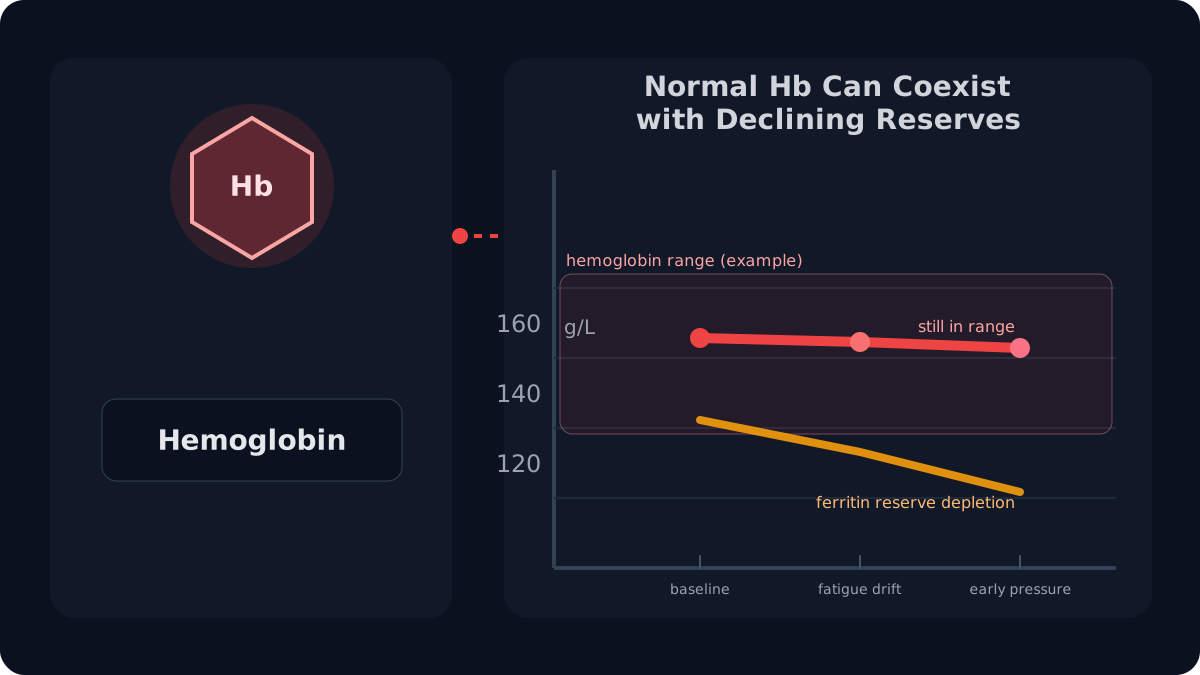
The body prioritizes oxygen transport aggressively. To preserve hemoglobin, it can draw from internal reserves before output changes. A key reserve is iron storage, best reflected by ferritin.
When iron intake, absorption, or availability weakens, ferritin may decline first while hemoglobin still looks stable. Externally this appears normal. Internally the system is no longer in equilibrium.
This creates a common early-pressure phase: hemoglobin in range, but reserves already being consumed.
In real life this is exactly where confusion starts. The report looks reassuring, yet endurance and recovery begin to soften. Nothing appears wrong in isolation, but the system is already paying an internal cost to keep output stable.
B12 and production efficiency
A similar pattern appears with vitamin B12. B12 supports DNA synthesis during red blood cell production. If B12 is insufficient or not well utilized, production quality can drift before hemoglobin clearly falls.
This is one reason people can present with normal hemoglobin and normal-looking broad labs, yet still report lower stamina, slower recovery, and softer cognitive output under load.
CBC indices can add early structure here: lower MCV/MCH often points toward iron-restricted production patterns, while higher MCV can appear with B12-related macrocytic pressure, including phases where hemoglobin is still in range.
In that sense, hemoglobin is often a lagging indicator. Symptoms may reflect real-time system efficiency changes before thresholds are crossed.
This is why normal B12 and normal hemoglobin can still coexist with lower perceived capacity. Presence in blood does not always equal efficient utilization at the tissue-production level.
Range position and sex-specific context
Reference ranges are sex-specific and lab-specific, and this matters in interpretation. Typical adult ranges are often around 120-160 g/L for women and 130-170 g/L for men, but exact cutoffs vary between laboratories.
Position within that range still carries signal. Two people can be technically in-range and function differently under stress load, especially if one is drifting down over time while upstream reserve markers are weakening.
Context turns hemoglobin into a useful marker
Hemoglobin becomes far more informative when paired with upstream and systemic context. Ferritin provides reserve status. B12 reflects production support. Sleep quality, stress load, and inflammatory tone (for example hs-CRP) influence how efficiently oxygen-transport biology is maintained.
Volume context also matters. Pairing hemoglobin with hematocrit and RBC count helps separate red-cell mass changes from plasma-volume effects.
Structural uniformity adds another useful layer. A rising RDW with stable hemoglobin can indicate early production instability before output declines.
Looked at together, these markers form a coherent picture. Looked at in isolation, they often do not.
Hemoglobin answers one important question: how much oxygen can blood carry right now? It does not answer why that level exists, whether it is sustainable, or how much reserve is left behind the current output.
Practical interpretation approach
A practical approach is to treat hemoglobin as part of a system check rather than a binary pass/fail signal: is it stable, drifting, or recovering; are ferritin and B12 aligned; do symptoms match the trend trajectory?
- Check position within sex-specific reference range, not only in-range versus out-of-range.
- Compare trend direction across repeated tests under similar conditions.
- Review ferritin as an upstream reserve signal when hemoglobin still appears stable.
- Check B12 context, and include MCV/MCH when available, to frame production-quality shifts.
- Layer hs-CRP when recovery patterns are unclear and broader system pressure is suspected.
The goal is not chasing higher hemoglobin values. The goal is sustaining the conditions that allow the system to maintain oxygen transport naturally: nutrient sufficiency, stable recovery, balanced stress load, and a resilient internal environment.
One uncomfortable question
If your hemoglobin is stable but your energy is declining, is your system truly stable, or just maintaining output while reserves are being depleted?
Frequently asked questions about hemoglobin blood tests
What is the long form of Hb?
Hb stands for hemoglobin, the oxygen-carrying protein inside red blood cells that helps transport oxygen from the lungs to tissues.
What is a normal hemoglobin level?
Typical ranges vary by sex, age, altitude, and laboratory. Many adult reports use roughly 120-160 g/L for women and 130-170 g/L for men — always compare to your report interval.
Can hemoglobin be normal while iron is low?
Yes. The body can maintain hemoglobin by using stored iron, so ferritin may already be low while hemoglobin still appears normal.
How does B12 affect hemoglobin?
Vitamin B12 supports proper red blood cell production and DNA synthesis. If B12 is insufficient or poorly utilized, oxygen-delivery efficiency can drift even before hemoglobin drops clearly.
Why can symptoms appear before hemoglobin falls?
Because the body compensates to preserve oxygen transport. Symptoms can reflect reduced system efficiency before compensation fails.
Is hemoglobin enough to assess anemia risk?
No. Hemoglobin is important but should be interpreted alongside iron status, B12 context, symptoms, and trend direction.
Should hemoglobin be tracked over time?
Yes. Trends are often more informative than a single value, especially when reviewed with ferritin and related context markers.
Keep hemoglobin in longitudinal context
Review hemoglobin over time alongside ferritin, B12, and symptom context so early drift is visible before overt decline.