
Most people reviewing a blood test look for obvious signals: hemoglobin, hematocrit, maybe red blood cell count.
RDW is usually ignored.
It sits in the same panel, often within range, rarely explained, and almost never tracked over time. On the surface, it looks secondary. But that assumption is misleading.
RDW is not a supporting metric. It can be an early signal of mixed red-cell size when interpreted with MCV, hemoglobin, and trend context.
In practical terms, high RDW meaning is usually simple: your body is producing red blood cells unevenly, even if other CBC values still look acceptable.
If hemoglobin reflects output, how much oxygen your system can carry, RDW reflects something deeper: how stable the system producing that output actually is.
If you are building your baseline first, start with core blood biomarkers to track first.
What RDW actually measures
RDW, or Red Cell Distribution Width, measures how much variation exists in the size of your red blood cells.
In a stable system, red blood cells are produced in a relatively uniform way. They are similar in size, similar in structure, and predictable in behavior. RDW stays low.
When production becomes uneven, the picture changes. Some cells become smaller, others larger. Variability increases. RDW rises.
This shift is subtle, but important. RDW is not telling you how many cells you have. It is telling you how consistent their production has been over time.
What does your RDW number mean?
Use the reference interval printed on your report first. Many labs cite roughly 11.5% to 14.5%, but cutoffs vary by assay — this table orients common bands, not a diagnosis.
| RDW (%) | Common interpretation |
|---|---|
| Below 11.5% | Low — uncommon, rarely significant alone |
| 11.5%–14.5% | Commonly cited normal range (lab-dependent) |
| 14.5%–16% | Mildly elevated — early variability signal |
| Above 16% | More pronounced — review with MCV, ferritin, B12, and folate |
Why RDW exists as a signal
Your physiology is not optimized for perfect numbers. It is optimized for functional balance under changing conditions.
Red blood cells must do more than exist. They must move efficiently, carry oxygen reliably, and maintain flow through the vascular system without excessive resistance.
For that to work, consistency matters. When the system is well-supported nutritionally, metabolically, and hormonally, production remains stable. Cells are uniform. RDW remains low.
When the system is under pressure, that uniformity breaks down. And that breakdown is what RDW captures. It is not measuring failure. It is measuring loss of coordination.
RDW in context: not a standalone marker
One of the biggest mistakes in interpreting RDW is treating it as an isolated number. It only becomes meaningful when placed alongside other red-cell markers, especially hemoglobin and hematocrit.
RDW alone shows variability, but RDW combined with MCV shows the direction of that variability.
Hemoglobin reflects oxygen-carrying capacity. Hematocrit reflects how much of your blood is composed of red cells. RDW reflects how uniform those cells are.
These are not competing signals. They describe different layers of the same system.
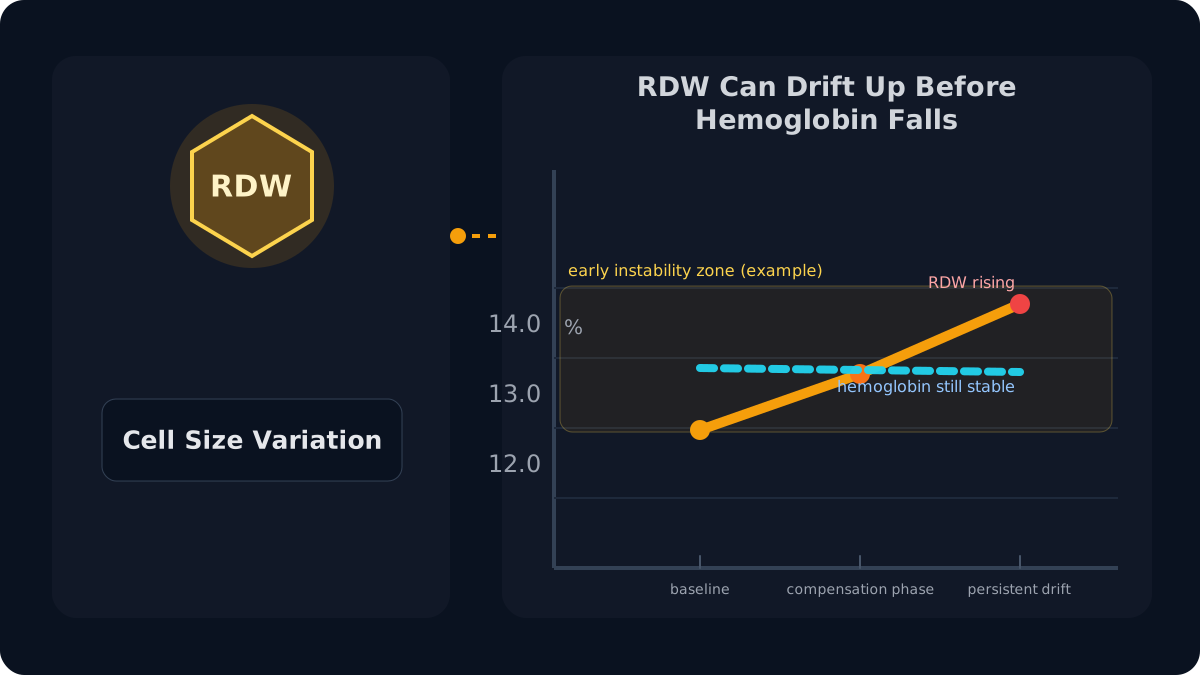
You can have normal hemoglobin and still see RDW rising. In fact, that pattern is common.
When it happens, it usually means the system is still compensating, maintaining output, while underlying stability is already declining.
What drives RDW changes
RDW increases when red blood cell production becomes uneven. That unevenness can come from several directions, but they converge on one mechanism: disrupted erythropoiesis.
Iron availability is one of the most common drivers. When iron becomes limited, the body does not immediately fail to produce cells. It produces them inconsistently. Some become smaller, others remain normal, and RDW rises before hemoglobin falls, often alongside low ferritin or transferrin saturation in iron-restricted erythropoiesis — not instead of them. Ferritin and transferrin saturation usually help frame iron-related workup.
A similar pattern appears with B12 and folate imbalance. These nutrients are essential for proper maturation. When they are insufficient, cells can become larger and structurally inconsistent, again raising RDW before more obvious markers change.
Inflammation adds another layer by disrupting production signaling precision. The system still produces cells, but not with the same coordination.
Even recovery phases can temporarily increase RDW. After illness, blood loss, or nutritional correction, newer cells coexist with older ones. This mixed population can raise RDW without indicating decline.
Across these scenarios, the pattern is consistent: RDW rises when production becomes less uniform, regardless of cause.
Why reference ranges are not enough
A value of 13.5% can represent a stable system or a system drifting upward for months. The number is the same; the physiology is not.
RDW is a directional marker, not only a positional one.
High RDW: what it usually means
Elevated RDW reflects a more heterogeneous red-cell population. That variability often points toward early imbalance, not necessarily a diagnosis, but a system under strain.
If you are asking what causes high RDW, common buckets include iron-related constraints, B12 or folate imbalance, inflammatory pressure, mixed-cell recovery after physiological stress, and — in other contexts — hemolysis, liver disease, alcohol-related effects, or bone-marrow disorders. Cause is not defined by RDW alone.
What it does not do is identify exact cause. RDW is not specific. It is sensitive.
It tells you something in system operation has changed, but not yet why.
The pattern most people miss
One of the most important and most overlooked patterns is normal hemoglobin with rising RDW.
In other words, high RDW but hemoglobin normal often means compensation is still preserving output while production quality is already drifting.
At first glance, everything looks fine. Oxygen-carrying capacity remains intact. No clear anemia.
But RDW is moving. This is often the compensation phase: output is preserved while production quality declines.
This pattern may be worth discussing with a clinician while other CBC markers are still near normal — not because RDW alone defines treatment.
What trends in RDW reveal
Single measurements are snapshots. RDW becomes useful as a sequence.
A gradual increase often suggests developing constraint: nutritional, inflammatory, or systemic.
A rise alongside falling hemoglobin suggests progression toward anemia.
A temporary spike may reflect rebuilding, where mixed cell populations appear during recovery.
The key is not the value itself. It is the pattern over time. Patterns reveal direction, and direction reveals process.
| RDW | MCV | Common interpretation pattern |
|---|---|---|
| High | Low | Most commonly associated with iron-restricted erythropoiesis. |
| High | High | Most commonly associated with B12 or folate-related maturation constraints. |
| High | Normal | Most commonly associated with mixed or early-stage instability requiring trend context. |
How to interpret RDW properly
RDW should always be interpreted in context. Compare with hemoglobin and hematocrit to separate output from structure.
Add ferritin, B12, and folate to assess production inputs. Then layer behavior context: diet, recovery, stress, and recent illness.
RDW also becomes more specific when interpreted with MCV, because MCV reflects average red blood cell size while RDW reflects spread. Together they distinguish common production-pattern directions.
When inflammatory pressure is suspected, adding WBC helps separate immune-driven instability from primarily nutrient-driven production drift.
When multiple markers move together, interpretation is often straightforward. When RDW moves alone, that divergence is often the signal.
It can indicate shift before the rest of the panel reflects it.
What RDW does not tell you
RDW does not diagnose disease. It does not directly measure oxygen delivery. It does not identify specific cause by itself.
It is not a conclusion. It is an early signal that system stability has become less coordinated.
The real value of RDW
RDW may shift before hemoglobin or MCV change in some nutrient- or inflammation-related patterns.
It reflects how coordinated internal production is and how resilient red-cell biology remains under stress.
On its own, it is easy to ignore. Tracked over time with paired CBC markers, it may help flag changing red-cell production patterns worth clinician review.
That is where its value lies.
Frequently asked questions about RDW blood tests
What is the long form of RDW?
RDW stands for red cell distribution width. It describes how much red blood cells vary in size and may rise when red-cell populations become more mixed — best interpreted with MCV, hemoglobin, and trends.
What does high RDW mean in a blood test?
It indicates increased variation in red blood cell size, often reflecting early imbalance in production processes such as nutrient deficiency or inflammation.
Can RDW be high while hemoglobin is normal?
Yes. This is a common early-stage pattern where the system is compensating but losing stability.
Is RDW linked to iron deficiency?
Yes. RDW often rises before hemoglobin drops in iron deficiency.
Does RDW relate to B12 and folate?
Yes. Disruptions in these nutrients affect red blood cell maturation and can increase RDW.
Should RDW be tracked over time?
Yes. Trends provide significantly more insight than a single measurement.
The uncomfortable question
If your hemoglobin still looks normal, but your RDW has been rising quietly over time, are you actually healthy, or just compensating well enough to hide the problem?
Track RDW in full blood context
RDW becomes meaningful when tracked with hemoglobin, ferritin, B12, and folate over time, so changing patterns are easier to review with your clinician in full CBC context.