
Most people only pay attention to liver markers when something is already wrong. A slightly elevated ALT triggers concern. A high AST raises questions. At that point, the conversation usually shifts toward damage.
But there is another marker, often present in the same blood panel, that can shift earlier or on a different timeline than ALT and AST: GGT.
It is rarely explained in plain language. It is often dismissed as just another liver enzyme. Because of that, many people miss a gradual context signal that their system may be under pressure.
If you are building your baseline from first principles, start with core blood biomarkers to track first.
What GGT actually measures
Gamma-glutamyl transferase (GGT) is an enzyme involved in glutathione metabolism, one of the body's key antioxidant systems.
It is found in multiple tissues, but clinically it is most relevant in the liver and bile ducts. When these tissues are stressed, not necessarily structurally damaged, GGT is released into the bloodstream.
That distinction matters. Many people interpret elevated enzymes as direct damage. GGT often reflects something different: load. Chemical load. Metabolic load. Oxidative load.
Why GGT behaves differently from ALT and AST
GGT sits in a different category from ALT and AST. ALT is relatively liver-specific and often reflects hepatocellular injury. AST is less specific and can come from liver, muscle, and other tissues.
GGT is better viewed as a biological response marker, showing how liver and biliary pathways react to stressors over time.
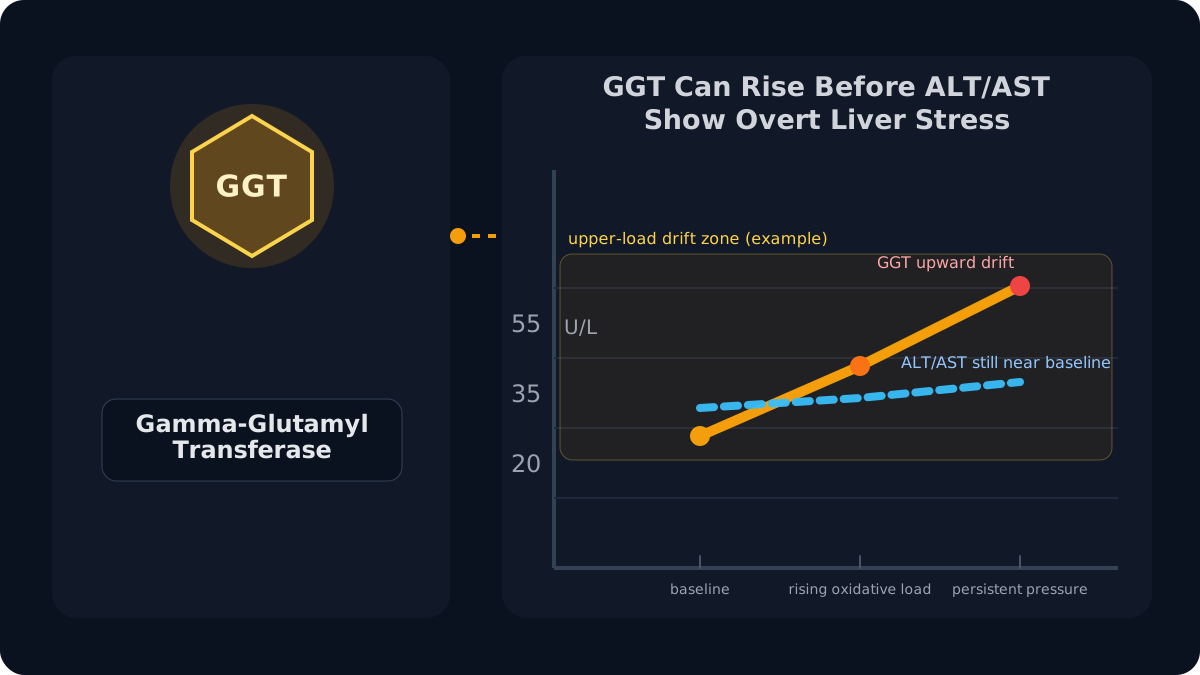
This is why you can often see GGT rising while ALT and AST still look normal. At that stage, nothing appears broken, but something is clearly changing.
The hidden role of GGT: oxidative stress and detoxification
GGT plays a central role in glutathione recycling, which links it directly to oxidative-stress handling. This connects GGT with toxin processing, alcohol metabolism, inflammatory load, and metabolic dysfunction.
When repeated stressors accumulate, from diet, alcohol, environmental exposure, or internal metabolic imbalance, GGT activity often increases. This is not random noise. It is the system adapting to sustained pressure.
That is why GGT is often more useful as a system-pressure indicator than as a pure liver-damage marker.
Alcohol and GGT: the most sensitive relationship
Among standard liver enzymes, GGT is usually the most responsive to alcohol intake. Even moderate but regular consumption can elevate it, sometimes without visible ALT or AST changes.
This creates a common pattern in routine blood work: ALT normal, AST normal, GGT elevated. Many people ignore this because no threshold alarm appears.
Physiologically, the liver is often increasing enzymatic activity to handle repeated oxidative stress from alcohol metabolism. Important nuance: GGT alone does not prove alcohol exposure, but in the right context it is a useful context signal in standard panels, not proof of alcohol use by itself.
GGT and metabolic health: the underestimated connection
One of the most overlooked aspects of GGT is its relationship with metabolic health. Elevated GGT is associated with insulin resistance, visceral fat accumulation, non-alcoholic fatty liver patterns, and higher long-term cardiovascular risk.
This can remain true even when values are still inside laboratory reference ranges.
In practice, GGT becomes especially useful when viewed with metabolic markers such as HbA1c and lipid signals like LDL cholesterol. If those markers suggest metabolic pressure and GGT is trending upward, the signal becomes harder to dismiss.
Biliary system: where GGT becomes highly specific
GGT is also tightly connected to bile-duct physiology. When bile flow is impaired, such as with gallstone burden, inflammatory irritation, or early cholestatic patterns, GGT can rise alongside ALP.
In that setting, ALT may be only mildly affected while GGT and ALP are both elevated. This is a different pattern from dominant hepatocellular injury, and pairing with bilirubin can help clarify where flow is slowing.
Here, GGT is not only a stress signal. It can also help localize signal direction toward the biliary system.
Why trends matter more than single values
A single GGT value is easy to misread. It can be influenced by recent alcohol intake, medication exposure, short-term illness, or heavy training load.
But trajectory changes interpretation. If GGT moves like this:
| Date | GGT (U/L) | Context |
|---|---|---|
| Jan | 18 | Baseline |
| May | 28 | Increased alcohol, lower sleep |
| Sep | 41 | Weight gain, metabolic drift |
Direction is clear even before threshold flags appear.
This is a common interpretation error: relying on cutoffs while ignoring movement. GGT is especially sensitive to that mistake because it often drifts gradually and stays technically normal while heading the wrong direction.
When elevated GGT is actually meaningful
Not every increase is clinically meaningful, but some patterns are high signal.
An elevation carries more weight when it persists across multiple tests.
It also becomes stronger when it aligns with lifestyle factors or correlates with metabolic or biliary data.
A single spike can be noise. A consistent upward trend is usually signal.
What actually lowers GGT
There is no shortcut. GGT responds to real inputs over time.
The strongest interventions are usually predictable: reducing alcohol load, improving insulin sensitivity, lowering chronic inflammatory pressure, and supporting antioxidant systems through adequate nutrition.
In many alcohol-load patterns, GGT may improve over weeks to months after intake is reduced, though timing varies by person and baseline load.
What matters most is consistency. GGT usually reflects cumulative load, not one isolated event.
What GGT cannot tell you
GGT is powerful, but limited.
It cannot diagnose a specific disease, separate all causes of elevation, or replace imaging and clinical evaluation.
It is not a conclusion. It is a signal that requires context.
Why GGT is often ignored and why that is a mistake
In routine practice, GGT is often treated as secondary. If ALT and AST are normal, no further questions are asked.
But that approach can miss gradual change. GGT may drift upward while ALT and AST are still normal, which makes trend review useful — not as proof of damage, but as context for load and direction.
The real value of tracking GGT over time
GGT becomes high value when tracked longitudinally, interpreted alongside related markers, and connected to real lifestyle changes.
Without that, it is just another number.
With that, it becomes a directional context marker, not just position.
Not only where you are, but where you are going.
Frequently asked questions about GGT blood tests
What is the long form of GGT?
GGT stands for gamma-glutamyl transferase, an enzyme involved in glutathione metabolism and commonly used as a liver, biliary, and oxidative-load context marker.
Is high GGT always caused by alcohol?
No. Alcohol is one of the most common causes, but GGT can also rise due to medications, metabolic dysfunction, bile duct issues, and broader oxidative stress.
Can GGT be elevated while other liver enzymes are normal?
Yes. GGT can rise while ALT and AST are still normal, especially with alcohol exposure, medications, bile-duct stress, or metabolic load — but timing varies and one normal enzyme panel does not rule out follow-up.
What is a normal GGT level?
Reference ranges vary by laboratory, and being within range does not guarantee optimal status. Trend direction over time is usually more informative than one value.
How quickly can GGT change?
GGT can shift within weeks after changes in alcohol intake or metabolic load, but clinically meaningful interpretation is usually based on repeated trends over months.
Should I worry about slightly elevated GGT?
Not necessarily. One value alone is rarely enough. Focus on persistence, context, and trend direction across repeated tests before drawing conclusions.
Do GGT reference ranges differ between men and women?
Yes. Typical reference ranges are lower for women (approximately 7-35 U/L) and higher for men (approximately 10-71 U/L), although exact values vary by laboratory. This is another reason why trends over time are more informative than a single result.
The uncomfortable question
If your GGT has been slowly increasing for the past year but still sits inside normal range, would you even notice?
Or would you react only after it crosses a threshold and gets labeled as a problem? By then, the signal may have been present for a long time.
Track GGT as direction, not noise
Upload your blood panel and see GGT trend alongside ALT, AST, and metabolic context in one timeline - so direction is visible before thresholds are crossed.