
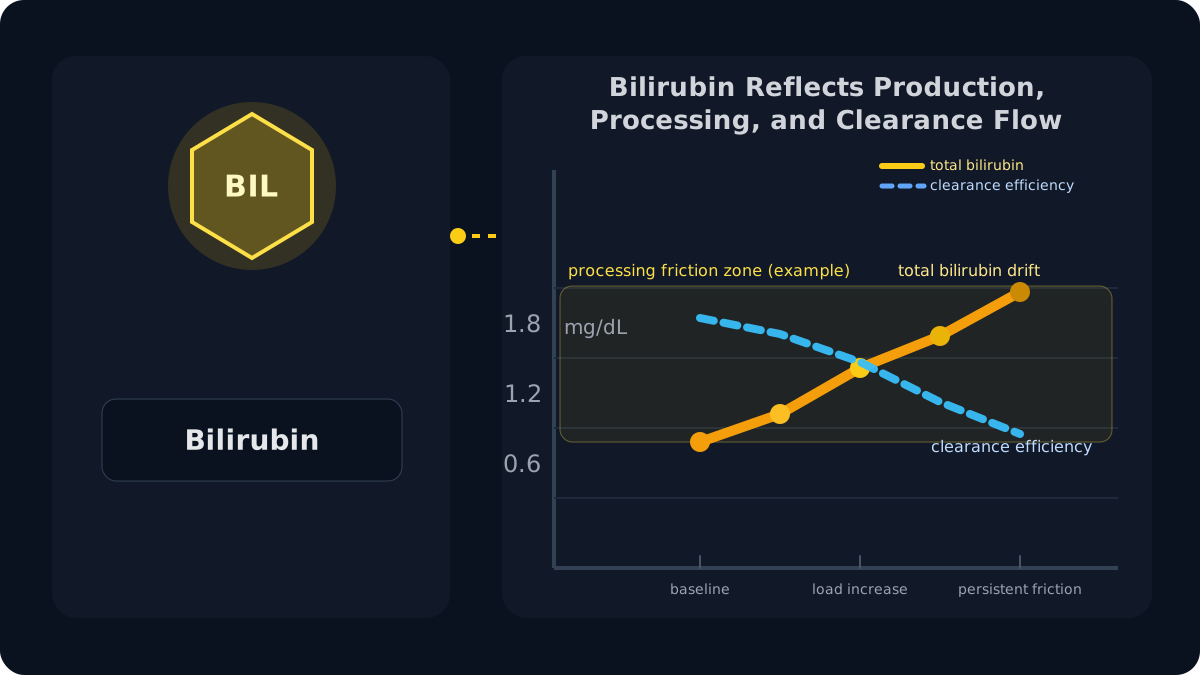
Most people think of bilirubin as a liver number.
If it is high, something must be wrong. If it is normal, everything seems fine. That interpretation is simple, but it collapses a more complex system into one assumption.
Bilirubin is not just a liver marker. It is the visible output of a continuous internal process: your body breaking down old cells, transforming what is no longer needed, and clearing it efficiently.
If you read bilirubin as one value, it feels vague. If you understand where it comes from and how it moves, it becomes a high-signal marker of internal turnover and clearance efficiency.
If you are building your core panel first, start with important blood biomarkers to track, then layer bilirubin into liver and hematology context.
What bilirubin actually is
Bilirubin begins not in the liver, but in red blood cell breakdown. As aging or damaged cells are recycled, hemoglobin is dismantled, and bilirubin is produced as part of that sequence.
In this initial form, bilirubin is unconjugated (indirect) and cannot yet be excreted efficiently. It then travels to the liver, where it is transformed into conjugated (direct) bilirubin, a water-soluble form prepared for elimination through bile.
The liver does not create bilirubin. It processes it. Without that processing step, clearance slows substantially.
Even at baseline, bilirubin reflects a sequence: production, processing, and clearance. The blood-test value is a trace of that moving sequence, not a static isolated quantity.
Why bilirubin reflects a system, not a point
Bilirubin is useful because it does not belong to one organ. It sits between systems: red-cell turnover, liver processing, and biliary excretion.
If any step in that chain accelerates or slows, bilirubin can shift. That is why the same elevated value can come from different mechanisms in different people.
One person may be producing more bilirubin due to higher cell turnover. Another may process it less efficiently. A third may process it correctly but clear it more slowly through biliary pathways.
Same bilirubin. Different bottleneck.
The importance of direct and indirect bilirubin
Splitting bilirubin into direct and indirect fractions is where interpretation becomes substantially more precise.
Indirect bilirubin reflects what has been produced but not yet conjugated. Direct bilirubin reflects what has passed through liver processing and is ready for elimination.
If indirect bilirubin dominates, the system may be generating more than it can process, or converting less efficiently. If direct bilirubin rises, friction is often further downstream in clearance dynamics.
Predominantly indirect bilirubin elevation may suggest increased production or reduced conjugation (context matters — Gilbert syndrome is one example), while predominantly direct bilirubin elevation more often suggests impaired clearance through the biliary system.
Total bilirubin alone provides limited localization. Fraction split helps identify where in the flow resistance may be building.
What high bilirubin actually means
Elevated bilirubin is often immediately interpreted as liver dysfunction. That can be true, but it is only one possible explanation.
A stronger framing is this: something in the bilirubin flow has shifted relative to baseline.
When people search for high bilirubin causes, they are usually asking which step in this flow is being disrupted.
In some cases, production increases through higher red blood cell turnover, such as during physiological stress or recovery from blood loss. In other cases, processing slows due to metabolic load, genetic patterns, fasting-related states, or broader liver stress.
There is also a clearance layer. Even when production and processing are functioning, impaired bile flow can still allow conjugated bilirubin to accumulate.
Common high bilirubin patterns include increased red blood cell breakdown (hemolysis), reduced hepatic conjugation efficiency (including benign inherited patterns such as Gilbert syndrome — usually mild, often predominantly indirect, and not the same as hemolysis or bile obstruction), and impaired bile flow (cholestasis or obstruction).
When bilirubin rises significantly, it can lead to visible yellowing of skin or eyes (jaundice), reflecting accumulation beyond normal clearance capacity.
High bilirubin is not a diagnosis by itself. It signals imbalance between production, processing, and excretion steps.
Low bilirubin: the quiet side of the signal
Low bilirubin is rarely flagged and often ignored. Clinically, it is usually less urgent than elevated bilirubin.
Still, bilirubin is not only waste. It also participates in antioxidant balance. Very low levels can sometimes reflect shifts in turnover dynamics or broader metabolic context.
In longitudinal review, low bilirubin can still add useful context around how actively the system is cycling and clearing internal byproducts.
Why bilirubin should never be read alone
Bilirubin becomes informative when interpreted with markers representing adjacent steps in the sequence.
If bilirubin rises together with ALT or GGT, interpretation leans toward liver or biliary pressure patterns.
If bilirubin changes while albumin is drifting lower, the pattern may deserve broader liver synthesis, inflammation, or protein-loss context rather than a bilirubin-only explanation.
If bilirubin rises while red blood cell markers, especially RDW, are shifting, turnover dynamics become more plausible.
When markers move together, the story often becomes coherent. When they diverge, the mismatch itself is often the signal.
What shapes bilirubin over time
Bilirubin can respond faster than many chronic markers. Fasting can transiently raise bilirubin through lower hepatic uptake efficiency. Intense training can increase red-cell turnover and raise production pressure.
Alcohol exposure and cumulative liver load can affect processing and clearance performance. Sleep and recovery influence the system more indirectly via stress and metabolic regulation.
Some people also run naturally higher bilirubin due to inherited patterns. In those cases, trend stability is usually more informative than absolute value alone.
Why reference ranges are not enough
Bilirubin reference ranges are broad, which can create false clarity. Values at the lower and upper ends of range can represent very different internal dynamics.
Typical total bilirubin ranges are roughly 0.2 to 1.2 mg/dL in many laboratories, but bilirubin levels meaning depends more on direction across time than one absolute threshold.
Direction within range still matters. Upward drift over repeated tests may indicate increasing friction in processing or clearance even before threshold flags appear.
Bilirubin is often more useful as a directional system marker than a single-threshold pass/fail metric.
What trends in bilirubin reveal
A single result shows position. Repeated results show movement.
Gradual increase can reflect rising load or reduced efficiency. Stable mild elevation can reflect a personal baseline pattern. Fluctuations often mirror behavior cycles such as fasting, training blocks, stress load, or recovery quality.
Over time, bilirubin trends can reveal whether internal turnover and clearance are flowing efficiently or encountering repeated resistance.
How to interpret bilirubin properly
Treat bilirubin as a sequence marker rather than a standalone number. First check whether the shift is temporary or persistent.
Then examine direct and indirect fractions to localize probable friction. Next compare with liver enzymes and red-cell markers to anchor mechanism.
Finally layer behavior context: recent fasting, training intensity, alcohol exposure, and recovery quality can all meaningfully alter bilirubin interpretation.
When these layers align, interpretation becomes clearer. When they conflict, that conflict often indicates where deeper review is needed.
What bilirubin does not tell you
Bilirubin does not diagnose specific conditions on its own.
It does not isolate one exact cause without context.
It is also not a full standalone liver performance test. It is a signal that flow has shifted somewhere in production, processing, or clearance.
The real value of bilirubin
Bilirubin reflects how efficiently your body handles internal turnover.
It captures how well cells are recycled, how effectively liver processing keeps pace, and how smoothly excretion pathways clear what is no longer needed.
On isolated review, bilirubin is easy to misread. In trends, it becomes a practical system-efficiency signal.
Frequently asked questions about bilirubin blood tests
What does high bilirubin mean?
It usually reflects a shift in production, liver processing, or clearance. Context from direct and indirect fractions plus related markers is needed to identify likely direction.
Is bilirubin always related to the liver?
No. Bilirubin is partly a red blood cell turnover signal and partly a liver-processing and biliary-clearance signal.
What is the difference between direct and indirect bilirubin?
Indirect bilirubin is unprocessed bilirubin before liver conjugation. Direct bilirubin has been processed by the liver and is ready for excretion.
Can fasting increase bilirubin?
Yes. Temporary increases can occur during fasting due to reduced hepatic uptake and processing efficiency.
Should bilirubin be tracked over time?
Yes. Trends across repeated tests are usually more informative than one isolated measurement.
Can Gilbert syndrome cause high bilirubin?
Yes. Gilbert syndrome is a common inherited pattern of mild unconjugated (indirect) hyperbilirubinemia, often triggered by fasting, illness, or stress. It is usually benign but should be distinguished from hemolysis, liver disease, or bile-flow problems through fraction pattern, history, and clinical review.
The uncomfortable question
If your bilirubin is slowly rising over time while still inside range, are you truly stable, or gradually losing efficiency in how your body processes and clears what it no longer needs?
Track bilirubin as a full flow signal
Upload your blood panel and review bilirubin alongside liver enzymes and red blood cell context in one timeline, so direction is visible before confusion sets in.