
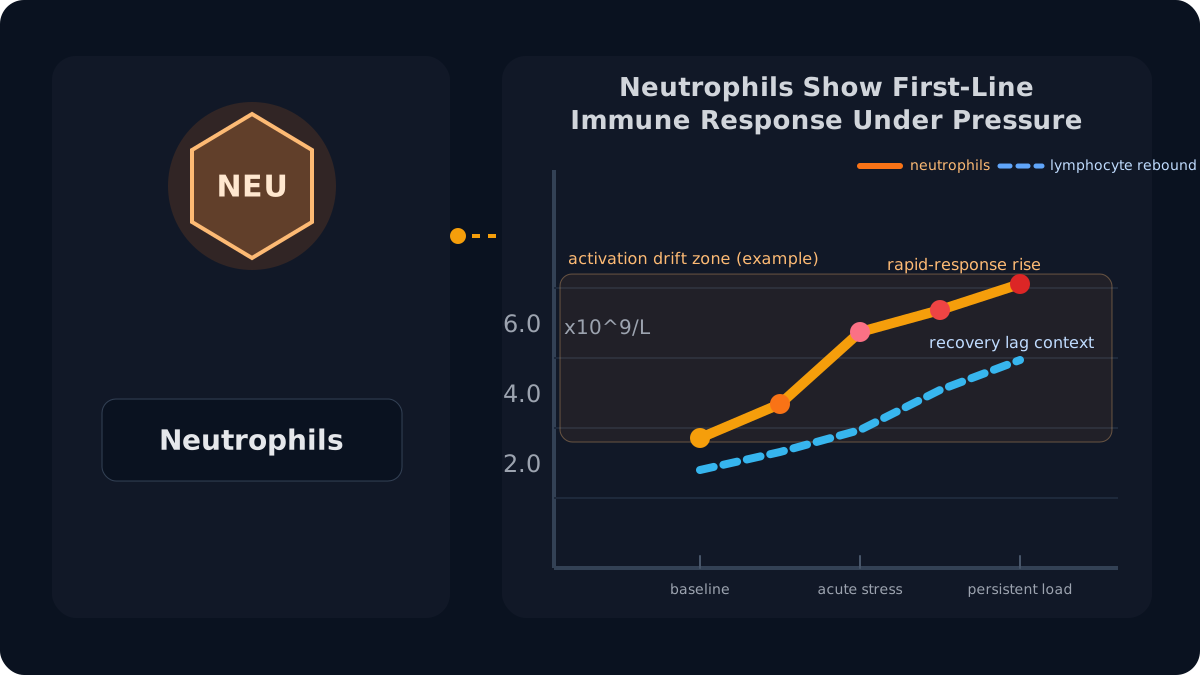
Neutrophils are the rapid-response white blood cells on a CBC differential. They are reported as a percentage of WBC or as absolute neutrophil count (ANC). Use your number below first, then read on for trends and context.
What does my neutrophil result mean?
Absolute neutrophil count (ANC, ×10^9/L, non-pregnant adults)
| ANC (×10^9/L) | What it usually means |
|---|---|
| Below 0.5 | Severe neutropenia. Urgent same-day review, especially with fever. |
| 0.5–0.99 | Moderate neutropenia. Prompt review; higher infection risk. |
| 1.0–1.49 | Mildly low. Often post-viral. Benign ethnic neutropenia (African, Middle Eastern, West Indian descent) may be ~0.8–2.0; clinician confirms. Usually rechecked. |
| 1.5–7.5 | Typical at many labs (lower ~1.5–2.0, upper ~7–8, lab-dependent). |
| 7.6–10.0 | Mildly raised. Infection, inflammation, stress, smoking, steroids, exercise, pregnancy. Recheck when well. |
| Above 10.0 | Clearly raised. Clinician review if fever or symptoms. |
ANC 7.62 ×10^9/L vs an upper limit of 7.5 is marginally above range; a single value this close is common and is usually rechecked. ANC 1.47 ×10^9/L vs a lower limit of 1.8 is slightly low; that pattern is commonly seen after viral illness or as a normal variant and is usually rechecked.
Severity bands: Cleveland Clinic and NHS Highland.
Percentage vs absolute count
ANC (×10^9/L) = WBC × (neutrophil % ÷ 100). Example: WBC 8.0 ×10^9/L with 75% neutrophils → ANC 6.0 ×10^9/L. A high percentage can still mean a normal ANC — for example, 80% of WBC 4.0 = 3.2 ×10^9/L. Read ANC and percentage together with total WBC and lymphocytes.
These bands are for non-pregnant adults. Children, infants and pregnancy use different ranges.
Seek urgent medical care if abnormal counts come with fever, chills, severe pain, shortness of breath, confusion or unusual bleeding/bruising. Fever (38 °C / 100.4 °F or higher) together with a low neutrophil count (below about 1.0 ×10^9/L) needs same-day medical care.
Compare this result with your previous ones
Upload your lab reports and see neutrophils, WBC and the differential on one timeline.
Among white blood cells, neutrophils are the fastest responders — immediate defense, not long-term immune memory. High or low values usually reflect activation or suppression in context, not a diagnosis on their own.
What neutrophils actually are
Neutrophils are a white blood cell subtype that acts as a rapid-response defense layer. They are produced in bone marrow and released into circulation in large numbers, ready to respond when internal stability is disrupted.
Their role is simple in principle: detect, move, attack, and clear. When bacteria enter tissue, cells are damaged, or inflammatory signals rise, neutrophils are among the first cells recruited to the site.
They do not wait for precision. They act on urgency. That is why neutrophils are part of innate immunity, the fast layer that responds before the body fully identifies the exact threat.
Why neutrophils exist as a system
Your body is constantly exposed to potential threats, including external triggers such as bacteria and internal triggers such as tissue damage or metabolic stress.
A delayed response would be inefficient and often dangerous. Neutrophils exist to solve that problem through speed.
Within hours of a trigger, neutrophils can increase in circulation, migrate into tissue, begin pathogen clearance, and release signaling molecules that recruit additional immune cells.
This early response does not need to be perfect. It needs to be fast enough to prevent escalation. That tradeoff defines neutrophil behavior.
What a neutrophil blood test measures
In routine blood work, neutrophils are reported either as absolute neutrophil count (ANC) or as a percentage of total white blood cells.
Both are useful, but they answer different questions. Absolute count reflects how many neutrophils are available in circulation, while percentage reflects how dominant neutrophils are relative to other immune cells.
This distinction matters. A high percentage does not always mean high absolute numbers, and a normal total WBC can still hide a meaningful shift in immune balance.
Neutrophils are best interpreted alongside total white blood cell count (WBC) and the full differential pattern.
Neutrophils as a pattern, not a number
One common mistake is treating neutrophils as a single-value signal. Slightly above range can trigger concern, while in-range results are often ignored.
But neutrophils are dynamic. They can shift quickly with infection, inflammation, physical stress, sleep disruption, training load, and medication exposure.
Because of that, interpretation depends on pattern. A one-time elevation after poor sleep or intense training is not the same as a sustained upward drift across multiple tests.
The number alone cannot separate those scenarios. The pattern can.
High neutrophils: what it usually means
Elevated neutrophils (neutrophilia) most often reflect acute immune activation. The classic pattern is bacterial infection, where neutrophils rise rapidly to control threat and often dominate the differential.
Infection is not the only driver. Neutrophils can also rise with systemic inflammation, physical stress, trauma, smoking, corticosteroid exposure, and heavy training load.
In these cases, the immune system is not necessarily fighting a pathogen. It is responding to demand. High neutrophils do not automatically mean infection. They indicate activation.
Low neutrophils: a different kind of signal
Low neutrophils (neutropenia) reflect reduced immediate immune capacity.
Viral infections can temporarily suppress neutrophil production. Bone marrow constraints can reduce output more persistently. Nutrient constraints, especially in vitamin B12 and folate, can reduce production quality.
Chronic stress, overtraining, and certain medications can also suppress neutrophil levels. The key difference from high neutrophils is direction of risk: high often means active pressure, while low can mean reduced ability to respond.
Again, context determines meaning.
Neutrophils vs lymphocytes: the ratio that matters
Looking at neutrophils alone is incomplete.
One high-value signal is the relationship between neutrophils and lymphocytes. Neutrophils represent rapid, non-specific defense. Lymphocytes represent more targeted, adaptive response.
When neutrophils rise and lymphocytes fall, the pattern often reflects acute stress or bacterial-driven activation. When lymphocytes dominate with stable or lower neutrophils, viral processes or recovery phases become more likely.
This balance is often summarized as the neutrophil-to-lymphocyte ratio (NLR). Even without complex calculation, a visible shift in dominance can be more informative than either number alone.
What drives neutrophil behavior over time
Neutrophils respond to immediate demands, but those demands are shaped by daily behavior. Sleep quality is a major regulator. Poor sleep can elevate inflammatory signaling and neutrophil counts.
Training load is another driver. Short-term post-exercise increases can be normal, while chronic overload without recovery can destabilize patterns.
Nutrition supports production capacity. Iron status, B12, and folate contribute to stable output over time. Inflammation acts as a background driver and can keep neutrophils mildly elevated without obvious symptoms.
When you track neutrophils longitudinally, you are not only tracking immune events. You are tracking how the system handles stress, recovery, and internal balance.
Why reference ranges are not enough
Typical neutrophil reference ranges vary by laboratory, and most people fall inside them.
That can create false clarity. A value inside range can still reflect upward drift. A value near the upper boundary can persist for months without being flagged.
Reference ranges define distribution, not personal stability. Two people can both be in range while one shows steady behavior and the other shows repeated activation spikes.
The number may look similar. The physiology is not.
What trends in neutrophils reveal
Single measurements are snapshots. Trends reveal direction.
A gradual increase can suggest accumulating inflammatory load or repeated stress exposure. Spikes followed by recovery can reflect cyclical stress, intense training blocks, or intermittent illness. A gradual decline can indicate recovery, but in some contexts it may indicate suppression.
Interpretation becomes stronger when neutrophils are reviewed relative to total WBC, lymphocyte proportion, and inflammatory markers such as hs-CRP.
Patterns across these signals provide more meaning than any isolated value.
How to interpret neutrophils properly
Start with structure: total WBC first, then neutrophils in absolute and relative terms. Next, compare with lymphocytes to understand balance.
Then layer supporting context: inflammation markers, nutrient status, recent illness, and stress load. Finally, add behavior data such as sleep quality, training intensity, and recovery quality.
When signals align, interpretation becomes clear. When they diverge, that divergence is often the most informative part.
What neutrophils do not tell you
Neutrophils do not diagnose a specific condition and do not identify exact causes of immune activation.
You can see elevated neutrophils without infection, and normal neutrophils while other systems are drifting. They reflect response intensity, not immune precision.
The real value of neutrophils
Neutrophils are among the fastest-moving markers in routine blood work.
They respond quickly, adjust rapidly, and reflect immediate system demand. On their own, they are easy to over-interpret. Tracked over time, they show when your immune system is reacting, when it is recovering, and when pressure may be sustained.
That is where their practical value lives.
Frequently asked questions about neutrophils
What does high neutrophils mean?
It usually reflects increased immune activation, commonly due to bacterial infection, inflammation, or physiological stress.
Can neutrophils be high without infection?
Yes. Stress, smoking, medications such as corticosteroids, and inflammatory load can elevate neutrophils without active infection.
What does low neutrophils mean?
It may indicate reduced rapid-response immune capacity, often linked to viral suppression, nutrient constraints, medication effects, or bone-marrow-related factors.
Are neutrophils part of WBC?
Yes. Neutrophils are one of the main components of total white blood cell count and are reported in standard differential panels.
Should neutrophils be tracked over time?
Yes. Repeated patterns are more informative than a single result, especially when interpreted with WBC, lymphocyte proportion, and inflammation context.
What is a normal neutrophil count?
Many adult reports show about 40–70% of total WBC, or an absolute neutrophil count (ANC) of about 1.5–7.5 ×10^9/L. Lower limits are often about 1.5–2.0 and upper limits about 7–8, depending on the lab.
Is neutrophil count of 7.6 high?
7.6 ×10^9/L is marginally above the upper limit at many labs (often about 7.5). A single value this close to the range is common and is usually rechecked when you are well, especially if you feel fine.
How do I calculate absolute neutrophil count?
ANC (×10^9/L) = WBC × (neutrophil % ÷ 100). Example: WBC 8.0 ×10^9/L with 75% neutrophils → ANC 6.0 ×10^9/L.
The uncomfortable question
If your neutrophils are repeatedly elevated across multiple tests but you feel fine, are you actually healthy, or simply operating in a state of chronic low-level activation that no longer feels abnormal?
Sources and further reading
- Cleveland Clinic: Neutropenia
- NHS Highland: Neutropenia guideline
- StatPearls: Leukocytosis (WBC/differential context)
- MedlinePlus: WBC count
This page is educational and does not replace medical advice.
Track neutrophils in full immune context
Upload your CBC panel and see neutrophils tracked alongside WBC, lymphocyte balance, and hs-CRP in one timeline, so immune patterns become visible before they become concerning.