
Calcium is one of the most tightly regulated minerals in the body. Most people associate it with bone health, and that association is correct — but it captures only a fraction of what calcium actually does.
Calcium governs muscle contraction, nerve signal transmission, cardiac rhythm, blood clotting, and enzyme activation. It is not a static structural mineral. It is an active signaling ion running continuously across every excitable tissue in the body.
Because calcium regulation is so tightly controlled, serum calcium often stays within range even when underlying regulation is strained. Understanding what drives that stability — and what breaks it — is what makes calcium interpretation clinically useful.
If you are building your electrolyte baseline first, start with core blood biomarkers to track first, then layer calcium alongside vitamin D and magnesium as part of your mineral regulation context.
Quick summary
- Calcium is also known as Ca or Ca2+ on laboratory reports — same electrolyte, different notation.
- Serum calcium is tightly regulated by parathyroid hormone and vitamin D — it can appear normal while regulation is under significant strain.
- Total serum calcium must be interpreted with albumin levels — low albumin can artificially lower total calcium without true calcium deficiency.
- Bone is the body's calcium reservoir — chronic serum maintenance can come at the cost of bone mineral density.
- Magnesium is required for parathyroid hormone function — low magnesium can impair calcium regulation independently.
- Trend direction alongside vitamin D and parathyroid context is more informative than one isolated value.
What calcium actually does
Calcium (Ca2+) is the most abundant mineral in the human body. Approximately 99% is stored in bone and teeth as calcium phosphate crystals. The remaining 1% circulates in blood and operates inside cells — and that 1% is responsible for most of calcium's active physiological roles.
In muscle tissue, calcium triggers contraction by binding to troponin and enabling actin-myosin interaction. Relaxation requires calcium to be pumped back out. Every heartbeat depends on this cycle functioning correctly.
In nerve tissue, calcium governs neurotransmitter release at synaptic junctions. Without adequate calcium signaling, nerve conduction becomes erratic — which is why hypocalcemia can cause tingling, muscle spasms, and in severe cases, seizures.
Calcium also participates in blood clotting cascade activation, enzyme regulation, and intracellular second messenger signaling. It is not a passive mineral. It is active biochemical infrastructure running continuously.
Why serum calcium can mislead
The body maintains serum calcium within a narrow band at almost any cost. If dietary intake or absorption falls, parathyroid hormone (PTH) mobilizes calcium from bone to restore serum levels. If serum calcium rises too high, calcitonin can contribute modestly to lowering levels — but in adults, PTH is the dominant regulator; calcitonin plays a much smaller day-to-day role.
This tight regulation means serum calcium can appear normal while the underlying system is under significant strain — for example, when bone is being progressively demineralized to maintain circulating levels.
One result in range does not confirm that calcium balance is stable. It confirms that the regulatory system is still compensating. Those are not the same physiological state.
Total calcium versus corrected calcium
This is one of the most practically important distinctions in calcium interpretation.
Approximately 40% of serum calcium is bound to albumin — a carrier protein. Standard total calcium measurements include both bound and free calcium. When albumin is low — as in malnutrition, liver disease, or critical illness — total calcium appears artificially low even if ionized (active) calcium is normal.
Corrected calcium adjusts for this: it estimates what total calcium would be if albumin were at a standard reference level. One widely taught formula adds 0.8 mg/dL to total calcium for every 1 g/dL that albumin falls below 4.0 g/dL — but laboratories and calculators may use different versions (including Payne-based adjustments). Use corrected calcium as orientation; when decisions are high-stakes, ionized calcium or clinician review is more reliable than any single formula.
Practically: if you see low calcium alongside low albumin, corrected calcium is essential before concluding true hypocalcemia exists.
The parathyroid hormone axis: calcium's primary regulator
Parathyroid hormone (PTH) is the primary short-term regulator of serum calcium. When calcium drops, PTH rises to restore it through three mechanisms simultaneously: increasing bone calcium resorption, increasing renal calcium reabsorption, and stimulating vitamin D activation in the kidney to improve gut absorption.
When calcium is adequate or elevated, PTH is suppressed. This feedback loop is why abnormal PTH — either too high or too low — can cause persistent calcium dysregulation.
Primary hyperparathyroidism — excess PTH from overactive parathyroid glands — is one of the most common causes of chronically elevated serum calcium. It is often detected incidentally on routine panels, sometimes years before symptoms become obvious.
Calcium and vitamin D: the absorption dependency
Vitamin D is required for calcium absorption in the small intestine. Without adequate vitamin D, gut calcium absorption falls significantly regardless of dietary intake.
When vitamin D is deficient, the body compensates by increasing PTH to mobilize bone calcium and maintain serum levels. This PTH-driven compensation can sustain normal serum calcium for extended periods — while bone mineral density declines in the background.
This is why vitamin D deficiency can exist with normal serum calcium for a long time. The serum value is being maintained at the expense of bone reserve.
Interpreting calcium without vitamin D context is like reading one side of a balance sheet.
Calcium and magnesium: the dependency most panels miss
Magnesium is required for PTH secretion and for PTH receptor function at target organs. When magnesium is significantly depleted, PTH secretion becomes impaired — even when calcium is low and the system needs PTH to respond.
The practical consequence: hypocalcemia that does not respond to calcium supplementation often reflects concurrent magnesium deficiency. Replacing calcium alone does not restore PTH function. Magnesium must be corrected first.
This interaction is frequently missed on standard panels. Calcium, magnesium, and vitamin D form a regulatory triangle — none of the three can be fully understood without the others.
Low calcium: causes and interpretation
Hypocalcemia — serum calcium below 8.5 mg/dL — reflects either reduced calcium supply, impaired absorption, increased loss, or regulatory failure.
Vitamin D deficiency
The most common underlying driver globally. Reduced gut absorption forces PTH compensation, which sustains serum calcium temporarily at the cost of bone reserve.
Hypoparathyroidism
Insufficient PTH — from surgical removal, autoimmune damage, or magnesium deficiency — removes the primary regulatory mechanism and allows serum calcium to fall.
Kidney disease
Impaired kidneys reduce vitamin D activation and increase phosphate retention, both of which suppress calcium availability. Hypocalcemia is common in advanced kidney disease. Reviewing eGFR alongside calcium adds important context.
Magnesium deficiency
As described above — impaired PTH function creates functional hypocalcemia even when calcium intake is adequate.
Symptoms of low calcium
Mild hypocalcemia often produces tingling in fingers and around the mouth, muscle cramps, and fatigue. Moderate deficiency can cause muscle spasms (tetany). Severe hypocalcemia is uncommon but can lead to seizures and dangerous heart rhythm changes — urgent medical evaluation applies at that stage.
High calcium: less common but more significant
Hypercalcemia — serum calcium above 10.5 mg/dL — is less common than hypocalcemia but often carries more immediate clinical significance.
The two most common causes account for the majority of cases: primary hyperparathyroidism (excess PTH from overactive glands, usually benign) and malignancy-related hypercalcemia (cancer cells producing PTH-related peptide or causing bone destruction).
Less common causes include vitamin D toxicity from excessive supplementation, prolonged immobilization causing bone resorption, and certain granulomatous diseases like sarcoidosis.
Mild, chronic hypercalcemia is often asymptomatic and detected on routine panels. Symptoms when present include fatigue, confusion, excessive thirst, frequent urination, constipation, and kidney stone formation. Severe hypercalcemia can cause cardiac arrhythmias.
An important practical note: dietary calcium excess alone rarely causes hypercalcemia in people with normal kidney function — the gut and kidneys regulate absorption and excretion efficiently. Persistent elevation almost always reflects a regulatory problem, not diet.
Why reference ranges are not enough
The standard calcium range of 8.5 to 10.5 mg/dL is narrow by design — but interpretation within that range still depends heavily on albumin, vitamin D status, PTH, and kidney function context.
Two people can have identical calcium values with completely different physiological states. One may have stable calcium with adequate vitamin D and normal PTH. Another may have the same calcium value being maintained by elevated PTH drawing from bone reserves.
The number is the same. The regulatory burden is not.
Why trends matter more than single values
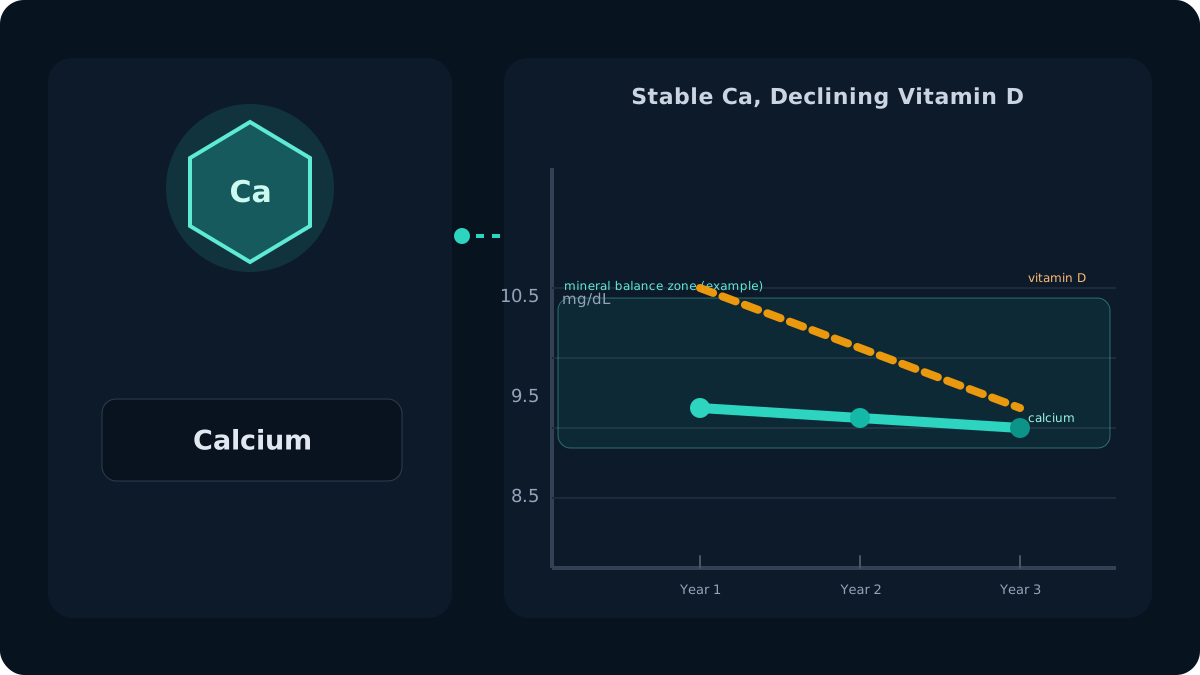
A single calcium result is a snapshot. Direction over time reveals system trajectory.
| Time | Calcium (mg/dL) | Vitamin D (ng/mL) | Context |
|---|---|---|---|
| Year 1 | 9.4 | 38 | Baseline, stable |
| Year 2 | 9.2 | 24 | Vitamin D declining, PTH rising |
| Year 3 | 9.1 | 18 | Calcium maintained — by bone resorption |
Calcium remains within range across all three years. But declining vitamin D with stable calcium suggests the regulatory system is increasingly compensating — maintaining serum calcium at a physiological cost that the number alone does not reveal.
Practical interpretation framework
- Always check albumin alongside total calcium. Low albumin requires corrected calcium calculation before concluding hypocalcemia.
- Review vitamin D — the most common upstream driver of calcium dysregulation globally.
- Check magnesium — low magnesium impairs PTH function and can cause calcium to fall regardless of intake.
- Review kidney function: eGFR declining significantly alters calcium regulation through vitamin D activation and phosphate retention.
- Evaluate trend direction under comparable conditions — not just position within range.
- For persistent elevation above 10.5 mg/dL, PTH measurement is usually the next clinical step to distinguish hyperparathyroidism from other causes.
For repeatable longitudinal review across electrolytes and mineral markers, use a structured lab tracking workflow.
What calcium does not tell you
Serum calcium does not measure bone density or skeletal reserve. Bone can be progressively losing mineral while serum calcium remains perfectly normal — because the bone loss is what is maintaining the serum level.
It does not identify the cause of dysregulation without supporting markers. Hypocalcemia from vitamin D deficiency, hypoparathyroidism, and magnesium depletion all look identical on a standard panel. Context separates them.
It also does not reflect ionized calcium directly — the biologically active fraction — unless specifically ordered. Total calcium is the standard test; ionized calcium requires a separate measurement.
The real value of tracking calcium
Calcium becomes genuinely informative when read as part of a mineral regulation system rather than as an isolated number.
Alongside vitamin D, magnesium, albumin, and kidney function, calcium reveals whether mineral balance is stable, compensated, or drifting in ways that serum values alone cannot show.
One result in range is reassuring. A trend in range with declining vitamin D and rising compensation pressure tells a different story — one worth understanding before it crosses a threshold.
Frequently asked questions about calcium blood tests
What is a normal calcium level in a blood test?
Most laboratories define normal serum calcium between 8.5 and 10.5 mg/dL (2.12 to 2.62 mmol/L). Values vary by laboratory method and albumin levels. Corrected calcium interpretation is often more meaningful than total calcium alone.
What does high calcium mean?
Elevated calcium (hypercalcemia) most commonly reflects excess parathyroid hormone activity, vitamin D toxicity, or certain malignancies. It is rarely caused by dietary calcium excess alone in people with normal kidney function.
What does low calcium mean?
Low calcium (hypocalcemia) can reflect low parathyroid hormone, vitamin D deficiency, magnesium deficiency, or impaired kidney function. Symptoms range from muscle cramps and tingling to cardiac arrhythmias in severe cases.
What is corrected calcium?
Corrected calcium adjusts measured total calcium for albumin levels. Because calcium is partially protein-bound, low albumin can artificially lower total calcium. Labs may use different correction formulas (for example Payne or other variants), so treat corrected values as orientation, not a substitute for clinical judgment or ionized calcium when accuracy matters.
What is calcium on a European lab report?
European panels often list calcium as Ca, Ca2+, or Ca++ — the same serum electrolyte as on US reports. Units may appear as mg/dL or mmol/L depending on the laboratory. Interpretation still depends on albumin context, vitamin D, magnesium, and kidney function.
Does calcium relate to vitamin D?
Yes. Vitamin D is required for calcium absorption in the gut. Low vitamin D consistently impairs calcium uptake, which can trigger parathyroid hormone release and accelerate bone calcium mobilization.
Should calcium be tracked over time?
Yes. Single values can be affected by albumin levels, hydration, and laboratory variation. Trends alongside vitamin D, parathyroid hormone context, and magnesium are more informative than one isolated result.
One uncomfortable question
If your serum calcium has been stable for years but your vitamin D has been quietly declining, are you truly in calcium balance — or is your skeleton compensating for a deficiency your blood test cannot see?
Track calcium alongside vitamin D, magnesium, and kidney markers
Upload your blood panel and review calcium with vitamin D, magnesium, albumin, and eGFR in one timeline — so mineral regulation patterns become visible before serum values shift.