
You open your blood test results and notice one value slightly out of place: AST is elevated. There are no clear symptoms and nothing feels obviously wrong, yet that one marker creates uncertainty. The usual reaction is to narrow the question quickly: is this a liver problem?
In many cases, that is the wrong starting point. AST is not liver-specific. It is a signal of cellular stress across multiple tissues.
The mistake is not that AST is inaccurate. The mistake is expecting a single multi-tissue signal to answer a single-organ question.
If you are building your core panel first, start with the core biomarker priority framework and then interpret AST as a system pattern, not an isolated number.
What AST actually represents
AST (aspartate aminotransferase) exists inside cells, not in bloodstream. It is present in liver, skeletal muscle, cardiac tissue, and other cell systems. Under stable conditions, AST remains contained.
When cells are stressed, damaged, or turning over at a higher rate, AST leaks into circulation. Elevated AST is therefore not a diagnosis. It is a release signal.
It tells you that some part of the system is under increased load or disruption. It does not tell you which tissue is responsible by itself.
Why AST alone creates confusion
AST answers a broad question: is there cellular stress somewhere in the body? The limitation is that the same value can come from very different sources, including muscle load, liver stress, or systemic strain, so the number alone is inherently ambiguous.
This is why AST rarely stands alone in high-quality interpretation. It needs context, and the most important context layer is its relationship with ALT.
The role of ALT: turning AST into a directional signal
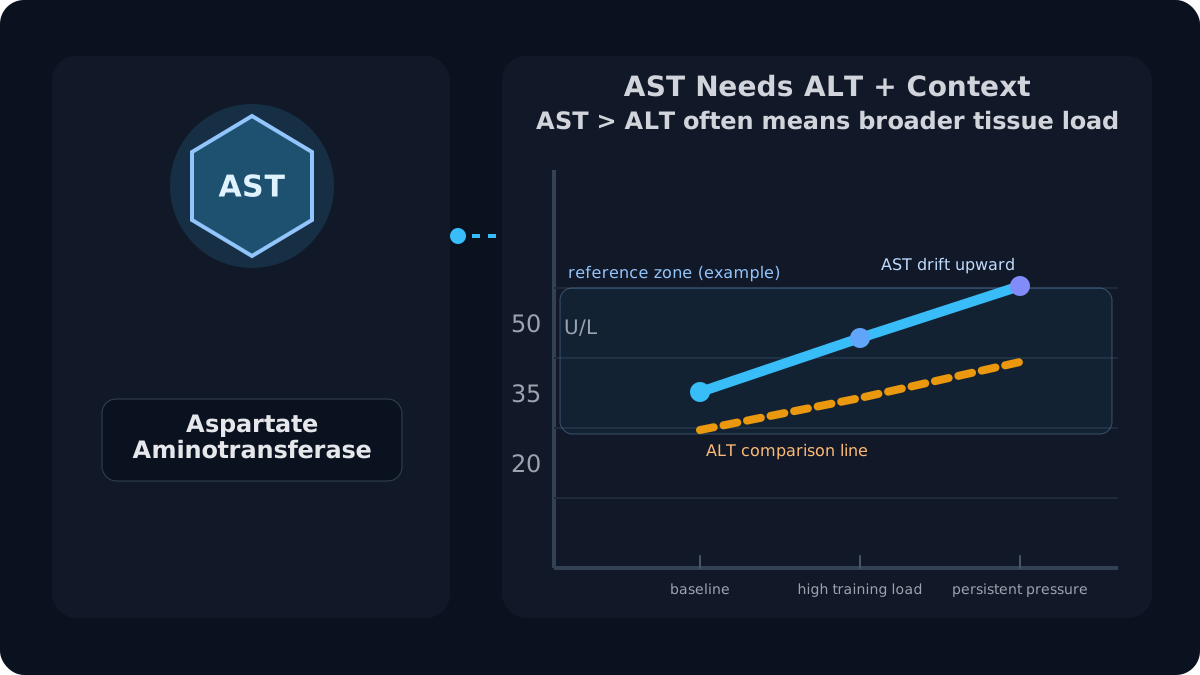
ALT is more concentrated in liver tissue, so pairing ALT with AST helps orient the pattern. If ALT is clearly higher, interpretation leans more toward liver-dominant stress. If AST is equal to or higher than ALT, the signal becomes less liver-specific and more suggestive of broader tissue contribution.
A simple way to think about it: ALT asks, "Is the liver under stress?" AST asks, "Is the body under stress?" The relationship between them helps decide where to look first.
In practice, certain patterns repeat: AST higher than ALT after intense training often reflects muscle-driven stress, while ALT-dominant elevation more often points toward liver-centered load.
In selected clinical contexts, an AST:ALT ratio above ~2 may appear with alcohol-associated liver injury — but the ratio is neither sensitive nor specific on its own. Heavy exercise, muscle injury, NASH, medications, and other liver patterns can shift it. Pair with GGT, alcohol history, symptoms, and repeat testing; never use the ratio as a standalone diagnosis.
This is not a rigid rule, but it changes the clinical question from "is AST high?" to "what stress pattern does this combination suggest?" That shift prevents a large share of misinterpretation.
Add metabolic and inflammatory context early
Patterns become much clearer when metabolic context is added. Elevated AST alongside rising insulin and triglycerides suggests systemic metabolic pressure, while alignment with hs-CRP points toward inflammatory load contributing to tissue stress.
The role of physical stress: a common blind spot
One of the most frequent and overlooked drivers of AST elevation is training load. AST is present in skeletal muscle, so intense or unfamiliar training can increase AST as part of micro-damage and repair.
Biologically this is often adaptation, not dysfunction. In lab review, however, it can look similar to more concerning patterns if context is missing.
This is why AST should always be interpreted against recent behavior: training intensity, recovery quality, and cumulative stress exposure.
When the liver is actually part of the picture
AST can absolutely reflect liver-related stress. The key is that liver involvement usually does not appear as AST in isolation.
When AST elevation aligns with ALT drift and broader context, liver contribution becomes more likely. The meaning comes from pattern alignment, not one standalone value.
In alcohol-linked or oxidative-load patterns, adding GGT can add context because it may rise with alcohol- or oxidative-load patterns, sometimes before or independently of larger ALT/AST shifts.
Why symptoms are often absent
People expect abnormal lab markers to match how they feel, but AST often breaks that expectation. The body can maintain functional output while internal load rises.
This creates a mismatch: the system still works, but not effortlessly. AST can rise before obvious declines in energy, performance, or day-to-day resilience become clear.
Most AST elevations are discovered on routine testing rather than through symptoms.
The limitation of normal ranges
Reference ranges are useful but often overinterpreted. They describe statistical commonality, not necessarily stability for a specific person.
Two people can be in-range with opposite trajectories: one stable, one rising each cycle. Physiologically those are different states.
AST is most useful as a trajectory marker rather than a single-position marker.
Time as the missing variable
AST is dynamic and can shift within days based on training, recovery, alcohol exposure, illness, and broader stress load.
A rising sequence suggests accumulating pressure. A falling sequence suggests recovery. Without time context, both can look similar in one snapshot.
Transient versus persistent patterns
Some AST elevations are temporary and resolve after acute load normalizes. Others persist, indicating that underlying stress remains unresolved.
The difference cannot be established from one test. Repetition under comparable conditions is what separates temporary noise from persistent signal.
Putting AST into a usable framework
AST becomes useful only when interpreted as part of a decision sequence:
First, confirm the signal: is AST elevated or drifting upward?
Second, compare with ALT to understand whether the pattern is more liver-weighted or systemic.
Third, check recent context: training load, recovery, alcohol exposure, and illness.
Finally, observe direction over time to determine whether the system is resolving or accumulating stress.
Without this sequence, AST remains a number. With it, AST becomes a directional signal.
Final takeaway
AST is not a marker of one organ. It reflects how the body handles load across tissues. An elevated value does not automatically mean pathology, and a normal value does not guarantee optimal conditions.
AST does not tell you where the problem is. It tells you that the system is under pressure. ALT helps localize that pressure. Time reveals whether it is resolving or accumulating.
Frequently asked questions about AST blood tests
What is the long form of AST?
AST stands for aspartate aminotransferase, an enzyme found in the liver, muscle, heart, and other tissues that can rise when cells are stressed or injured.
What is a normal AST level?
Typical adult ranges are often around 10 to 40 U/L, depending on the laboratory. Trend direction and context are usually more informative than one isolated value.
Is AST specific to the liver?
No. AST is found in multiple tissues including liver and skeletal muscle, so it should be interpreted with ALT and clinical context.
Can exercise increase AST?
Yes. Intense or unfamiliar training can elevate AST because muscle tissue stress and repair increase enzyme release.
What does AST higher than ALT mean?
It can suggest less liver-specific contribution and more broader tissue involvement, but interpretation depends on the full pattern and time context.
How quickly can AST change?
AST can shift within days depending on training load, illness, alcohol exposure, and recovery quality.
Should AST be retested?
Yes. Repeat testing under similar conditions is often needed to separate transient shifts from persistent stress patterns.
One uncomfortable question
If your AST is elevated, are you seeing one isolated problem, or a system that is operating closer to its limits than you realize?
Keep AST in system context
Review AST over time with ALT and behavior context so temporary stress and persistent strain are easier to separate.