
Most people look at testosterone and assume they understand their hormonal state.
If total testosterone is high, things should be fine. If it is low, something must be wrong.
But that interpretation skips a core layer of endocrine physiology: testosterone does not act freely by default. A large fraction is carried, buffered, and regulated before it becomes biologically active.
SHBG sits at the center of that control.
If you ignore SHBG, you are not measuring how much hormone you have. You are guessing how much is actually usable.
What SHBG actually is
Sex Hormone Binding Globulin (SHBG) is a protein produced primarily in the liver.
It binds mainly to testosterone and estradiol, and regulates how much remains free and biologically active.
Once a hormone is tightly bound to SHBG, it is not readily available to interact with receptors. It is effectively parked in circulation.
SHBG is not just transport. It is availability control.
Why SHBG exists as a system, not just a transport protein
If hormones were always fully active, signaling would become noisy and unstable.
SHBG works as a buffering layer, smoothing sharp swings in active hormone exposure and supporting more stable endocrine signaling.
But regulation has tradeoffs. Too much SHBG can lock too much hormone away. Too little SHBG can leave too much hormone freely active and less controlled.
SHBG is less about quantity and more about calibrated availability.
What a SHBG blood test measures
A SHBG blood test reports concentration of sex hormone-binding globulin in circulation.
Typical reference ranges vary by laboratory and sex. In men, SHBG often falls around 10-57 nmol/L. In women, ranges are generally wider - often around 18-144 nmol/L - and shift further depending on cycle phase, contraceptive use, and menopausal status.
These intervals are broad by design. SHBG interpretation depends less on where a value sits in the population distribution and more on what it means for your specific hormonal environment.
SHBG gains clinical meaning only when interpreted with related markers:
- total testosterone
- free testosterone (direct or calculated)
- estradiol
- albumin
Albumin matters because it weakly binds a meaningful share of testosterone, while SHBG binds more tightly. That difference helps explain why calculated free testosterone uses both SHBG and albumin.
Without this layer, SHBG is just a number. With this layer, it explains hormone usability.
Why total testosterone can mislead without SHBG
This is one of the most common interpretation errors in hormone testing.
Two people can have identical total testosterone values, yet one feels stable and high-functioning while the other feels low-energy, low-libido, or mentally flat.
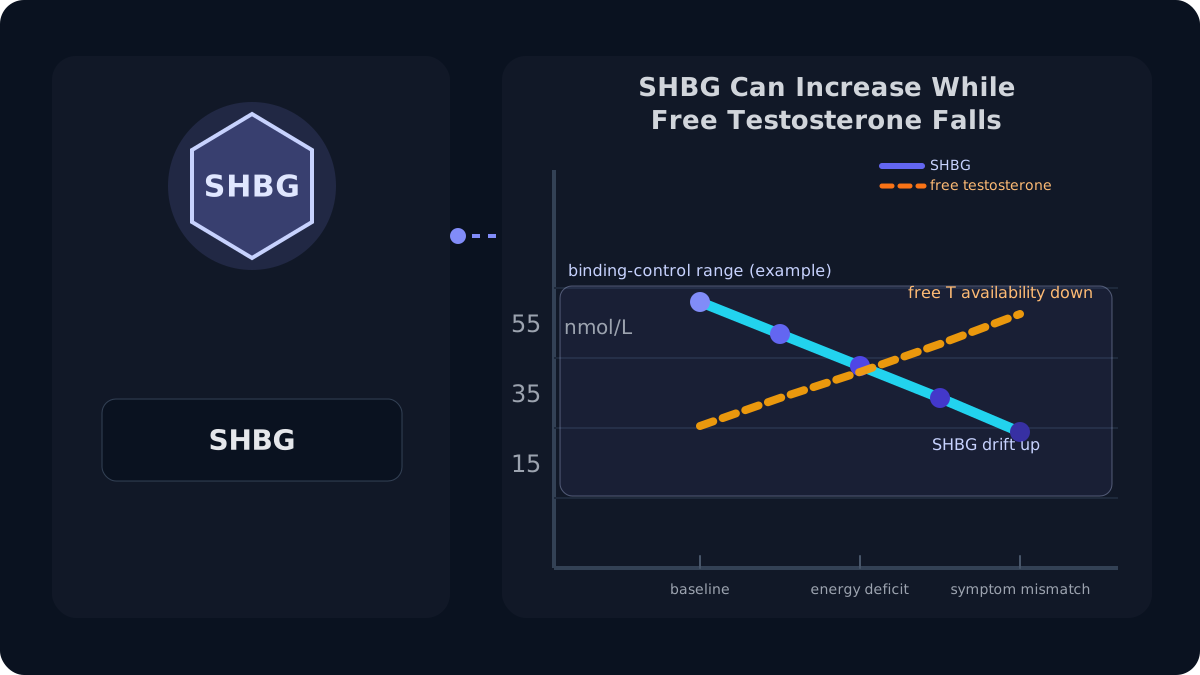
The difference is often SHBG. Higher SHBG usually means less free testosterone. Lower SHBG usually means more free testosterone.
Same total testosterone. Different biological effect.
High SHBG: what it often means
Higher SHBG reduces free availability of testosterone and estradiol.
In men, this can align with lower free testosterone despite normal total levels.
Common patterns associated with higher SHBG include:
- lower insulin signaling, often with calorie or carbohydrate restriction
- higher estrogen influence
- increased liver SHBG production
- hyperthyroid physiology
- chronic energy deficit
High SHBG is often seen in people who look metabolically clean on paper but still report hormonal symptoms.
Low SHBG and low testosterone: what the combination means
When both SHBG and testosterone are low, two mechanisms are often at work simultaneously.
Low SHBG increases free hormone fraction, meaning more testosterone is technically available. But when total testosterone is also low, a higher free fraction can still mean low absolute availability.
This pattern is frequently associated with insulin resistance, higher visceral fat, and metabolic strain. The combination can coexist with symptoms despite total testosterone appearing borderline rather than clearly low.
Common associations include:
- insulin resistance
- higher body fat
- metabolic syndrome patterns
- inflammatory load
- hypothyroid physiology
Interpreting this pattern requires free testosterone calculation alongside metabolic context markers.
SHBG and estradiol: the overlooked connection
SHBG does not only shape testosterone availability. It also shifts free estradiol availability.
This means SHBG can move androgen and estrogen signaling simultaneously.
High SHBG often lowers both free testosterone and free estradiol. Low SHBG can raise exposure to both. SHBG is therefore a full endocrine-balance signal, not a single-hormone helper.
What drives SHBG levels over time
SHBG is highly responsive to systemic inputs, especially liver, metabolic, and endocrine signals.
- Insulin: higher insulin suppresses SHBG, lower insulin usually increases it.
- Body composition: higher fat mass often lowers SHBG.
- Thyroid state: hyperthyroid patterns raise SHBG; hypothyroid patterns lower it.
- Liver function: hepatic context influences SHBG production; markers such as ALT and GGT can help frame this layer.
- Hormonal environment: estrogen tends to increase SHBG, androgens tend to suppress it.
- Energy availability: chronic deficits can elevate SHBG.
Why reference ranges are not enough
SHBG ranges are broad and highly context-dependent.
A value can be inside range and still misaligned for your hormonal environment. In-range status is a distribution statement, not a function statement.
What trends in SHBG reveal
SHBG is dynamic, and trend direction often reveals more than one isolated result.
An upward trend may reflect better insulin sensitivity, but can also reflect chronic energy deficit.
A downward trend may reflect increasing insulin resistance, rising metabolic strain, or inflammatory load.
Direction over time tells you whether regulatory control is stabilizing or drifting.
How to interpret SHBG properly
Start with structure and sequence:
- Review total testosterone.
- Review SHBG.
- Derive or measure free testosterone.
- Add estradiol and albumin context.
- Layer insulin-glucose, thyroid, liver, and body-composition context.
- Evaluate trend direction across repeated tests.
Interpretation improves when signals are aligned as a system, not judged one by one.
What SHBG does not tell you
SHBG does not diagnose a specific condition on its own.
It does not directly measure hormone production rate.
It tells you something subtler and often more actionable: how available hormone signaling is.
The real value of SHBG
SHBG reveals the gap between hormone quantity and hormone function.
It explains why a normal total testosterone value can coexist with clear symptoms.
Without SHBG, hormone interpretation is incomplete. With SHBG, endocrine patterns become coherent.
Frequently asked questions about SHBG blood tests
What is the long form of SHBG?
SHBG stands for sex hormone-binding globulin, a liver-produced protein that binds sex hormones such as testosterone and estradiol and helps regulate how much remains biologically available.
What does high SHBG mean?
High SHBG usually means a larger share of testosterone and estradiol is bound, which lowers free hormone availability.
What does low SHBG mean?
Low SHBG often means more free hormone in circulation, but it is frequently associated with insulin resistance and broader metabolic imbalance.
Is SHBG important for men?
Yes. SHBG is essential for interpreting testosterone biology because total testosterone without SHBG often misses hormone availability.
Can SHBG levels change?
Yes. SHBG responds to insulin signaling, body composition, thyroid state, liver function, estrogen-androgen balance, and energy availability.
Should SHBG always be tested with testosterone?
Yes. Testosterone interpretation is significantly stronger when SHBG is measured, especially when symptoms and total testosterone do not match.
The uncomfortable question
If your testosterone is "normal" but your energy, libido, or drive are not, are you hormonally balanced, or are you measuring quantity while ignoring availability?
See what your hormones are actually doing
Upload your lab results and track testosterone, estradiol, and SHBG together, so you can see not just how much hormone you have, but how much is actually active.