
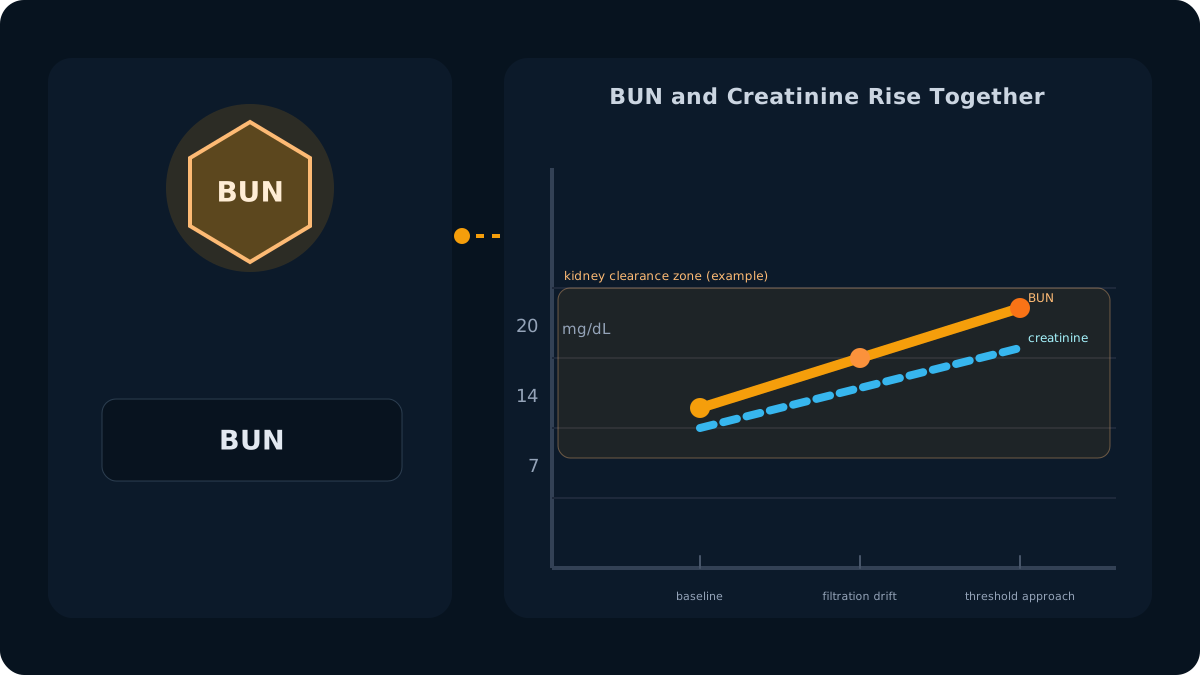
BUN appears on nearly every routine blood panel, usually listed alongside creatinine. Most people glance at it, see it in range, and move on.
That is often the right response — BUN fluctuates more than almost any other kidney marker, and single values frequently reflect diet and hydration more than kidney function. But that variability is also what makes it useful when interpreted correctly.
BUN is not a standalone kidney test. It is a window into the intersection of protein metabolism, liver function, hydration status, and kidney filtration — all at once. Understanding what it actually measures changes how you read it.
If you are building your kidney baseline first, start with core blood biomarkers to track first, then layer BUN alongside creatinine and eGFR as part of your renal context.
Quick summary
- BUN measures urea nitrogen in blood — a byproduct of protein breakdown processed by the liver and cleared by the kidneys.
- BUN fluctuates significantly with protein intake, hydration, and metabolic state — more so than creatinine.
- Neither BUN nor creatinine alone is sufficient for kidney interpretation — they should be read as a pair.
- The BUN-to-creatinine ratio helps separate kidney causes from non-kidney causes of elevated BUN.
- Low BUN can signal liver dysfunction or very low protein intake — often overlooked.
- Trend direction under comparable conditions is more reliable than any single measurement.
What BUN actually measures
BUN stands for blood urea nitrogen. To understand it, you need to follow the sequence that produces it.
When the body breaks down protein — from food or from tissue turnover — amino acids are metabolized and their nitrogen component is released as ammonia. Ammonia is toxic, so the liver converts it into urea through the urea cycle. Urea enters the bloodstream and is filtered and excreted by the kidneys in urine.
BUN measures the nitrogen fraction of that urea circulating in blood. It is a downstream marker of two simultaneous processes: how much protein the body is breaking down, and how efficiently the kidneys are clearing the resulting waste.
This dual origin is what makes BUN both useful and easy to misinterpret. A high BUN can mean the kidneys are struggling — or it can simply mean you ate a large protein meal yesterday or are mildly dehydrated. The number looks identical in both scenarios.
BUN versus creatinine: why you need both
BUN and creatinine are both kidney markers, but they measure different things and behave differently.
Creatinine comes from muscle metabolism and is produced at a relatively constant rate for a given person. It is influenced by muscle mass and hydration but is largely independent of diet on a day-to-day basis. This stability makes creatinine a more reliable marker of true filtration change over time.
BUN is far more variable. Protein intake, hydration, gastrointestinal bleeding, metabolic stress, and liver function all influence BUN independently of kidney function. A high-protein meal can raise BUN noticeably within 24 hours without any kidney change.
Neither is superior. They are complementary. BUN adds context that creatinine cannot provide — and the relationship between the two, expressed as the BUN-to-creatinine ratio, is often where the most useful clinical signal lives.
The BUN-to-creatinine ratio: localizing the problem
The BUN-to-creatinine ratio (calculated by dividing BUN in mg/dL by creatinine in mg/dL) is one of the most practical tools for interpreting an elevated BUN result.
Ratio above 20:1 — prerenal pattern
When BUN rises disproportionately relative to creatinine, the cause is often upstream of the kidney — dehydration reducing blood flow to kidneys, gastrointestinal bleeding releasing large amounts of protein into the gut for absorption, or high catabolic states from surgery, trauma, or prolonged illness.
In dehydration, kidneys reabsorb more urea passively as they try to conserve water — raising BUN without a true filtration decline. Creatinine rises too but less dramatically, driving the ratio upward.
Ratio 10:1 to 20:1 with both elevated — intrinsic kidney pattern
When both BUN and creatinine rise proportionally, the pattern more likely reflects true reduction in glomerular filtration. Both waste products accumulate because the kidneys are not clearing either efficiently.
Ratio below 10:1 — low BUN relative to creatinine
A low ratio with normal or elevated creatinine can suggest reduced urea production — often reflecting low protein intake or impaired liver synthesis. This pattern sometimes appears in severe malnutrition or advanced liver disease where the urea cycle is compromised.
The ratio is a directional tool, not a diagnostic rule. It adds localization context that neither marker provides alone.
What actually drives BUN up or down
Causes of high BUN
- Dehydration — the most common non-kidney cause. Reduced blood flow to kidneys increases passive urea reabsorption. BUN rises faster than creatinine, producing a high ratio.
- High protein intake — more protein metabolism produces more urea. BUN can rise meaningfully after a day of high meat or protein supplement intake.
- Gastrointestinal bleeding — blood in the GI tract is digested as protein, rapidly increasing urea production. This is one of the classic causes of a very high BUN-to-creatinine ratio.
- Increased catabolism — surgery, trauma, prolonged illness, and severe stress all accelerate protein breakdown, raising urea production independent of intake.
- Reduced kidney filtration — true filtration decline raises BUN as urea accumulates. When this is the cause, creatinine and eGFR typically move in the same direction.
Causes of low BUN
- Low protein intake — less protein available for breakdown means less urea produced. Very low-protein diets can suppress BUN significantly.
- Liver dysfunction — the liver produces urea through the urea cycle. When liver synthetic function is severely impaired, urea production falls and BUN drops even when protein intake is adequate.
- Overhydration — excess fluid dilutes BUN concentration in blood, lowering measured values without changing actual urea production.
- Pregnancy — increased glomerular filtration rate during pregnancy can lower both BUN and creatinine.
BUN and kidney function: what it can and cannot tell you
BUN is a kidney marker — but an indirect and noisy one. It reflects filtration only when other variables are held relatively stable.
For assessing true filtration trends, creatinine and eGFR are more reliable because they are less sensitive to protein intake and metabolic state. BUN adds complementary context — particularly for identifying dehydration, GI bleeding, or catabolic stress as contributors to an elevated result.
In chronic kidney disease monitoring, BUN tends to rise as eGFR falls — but the relationship is not linear and is modified by protein intake. Someone eating very little protein may have a BUN that appears deceptively reassuring despite significant filtration decline.
This is why kidney function assessment requires the full picture: BUN, creatinine, eGFR, and context — not any one marker in isolation.
BUN and uric acid: a related clearance signal
Both BUN and uric acid are metabolic waste products cleared by the kidneys. When kidney filtration declines, both often rise together — though through different metabolic pathways.
Uric acid comes from purine metabolism rather than protein metabolism, so the two markers reflect different production pathways arriving at the same clearance bottleneck. Reviewing them together can strengthen the pattern when kidney involvement is suspected.
Why BUN fluctuates more than creatinine
This is the most practical thing to understand about BUN for day-to-day interpretation.
Creatinine production is tied to muscle mass, which is stable day to day. BUN production is tied to protein breakdown, which varies enormously based on meals, hydration, stress, and illness.
A single high BUN with normal creatinine and a high ratio is more likely dehydration or high protein intake than kidney disease. A persistent BUN elevation across multiple tests under controlled conditions — same hydration, similar diet, not during acute illness — carries more weight.
This is why testing conditions matter for BUN more than for most other biomarkers. Results should be interpreted with knowledge of recent protein intake, hydration status, and whether any acute illness or stress was present near the draw date.
Why reference ranges are not enough
Most laboratories anchor near 7 to 20 mg/dL, though reference bands of 6–20 or 8–25 mg/dL also appear. That window is wide by design — it accommodates substantial normal variation driven by diet and hydration. But within whichever band your lab uses, position still carries signal.
BUN at 8 in someone who eats very little protein may reflect inadequate intake rather than good kidney function. BUN at 19 in someone who is chronically mildly dehydrated may be hiding impending true elevation. The number fits the range in both cases. The physiology does not.
More importantly, trend direction under comparable conditions is more informative than absolute position. BUN drifting from 12 to 15 to 18 across repeated tests with stable diet and hydration deserves more attention than BUN sitting at 18 on one test after a high-protein day.
Why trends matter more than single values
A single BUN result is a snapshot. Direction over time reveals system trajectory.
| Time | BUN (mg/dL) | Creatinine (mg/dL) | Context |
|---|---|---|---|
| Month 1 | 12 | 0.95 | Baseline, stable diet |
| Month 6 | 16 | 1.05 | Mild fatigue, reduced fluid intake |
| Month 12 | 19 | 1.14 | Both rising — kidney context warrants review |
All values remain within typical reference ranges. The parallel rise in both BUN and creatinine across twelve months, under stable dietary conditions, suggests a filtration trend worth investigating rather than dismissing as normal variation.
Practical interpretation framework
- Read BUN with creatinine — never in isolation. Calculate the BUN-to-creatinine ratio to help localize the likely mechanism.
- Check eGFR — if BUN and creatinine are both rising while eGFR is falling, filtration decline is more likely than a dietary or hydration artifact.
- Assess hydration and recent protein intake at the time of testing — high BUN with normal creatinine and a ratio above 20 often resolves with adequate hydration and dietary normalization.
- Consider whether any acute illness, GI symptoms, or increased catabolism was present near the draw date — these can transiently elevate BUN without representing chronic kidney change.
- Evaluate trend direction across repeated tests under comparable conditions — single values fluctuate too much to be relied upon alone.
For longitudinal review across the full kidney marker set, use a structured lab tracking workflow.
What BUN does not tell you
BUN does not directly measure kidney filtration rate. That is what eGFR is calculated to estimate. BUN measures a downstream byproduct that is influenced by too many upstream variables to serve as a reliable filtration marker on its own.
It does not identify the cause of kidney dysfunction. Whether filtration is declining due to chronic kidney disease, acute injury, or medication effects — BUN cannot separate these without additional context and markers.
It also does not directly assess liver function, despite being sensitive to liver synthetic capacity. A full liver panel including ALT, AST, and albumin is needed for that.
The real value of tracking BUN
BUN becomes genuinely useful when it is read as part of a system rather than as a standalone number. Alongside creatinine and eGFR, it helps build a richer picture of kidney filtration — identifying whether an elevated result is driven by dehydration, dietary factors, or true filtration decline.
Its sensitivity to protein intake and hydration is often treated as a weakness. In well-controlled testing conditions, that sensitivity becomes a strength — it can reveal patterns in protein metabolism, catabolic state, and fluid balance that creatinine alone cannot detect.
Tracked over time with consistent conditions, BUN helps complete the kidney picture that creatinine and eGFR begin.
Frequently asked questions about BUN blood tests
What is urea on a European lab report?
In many European laboratories, BUN is reported as urea rather than BUN. Urea and BUN measure related but different values: urea is the whole molecule, while BUN measures only the nitrogen component. To convert urea (mmol/L) to BUN (mg/dL): multiply by 2.8. For example, urea of 7.0 mmol/L equals approximately BUN of 19.6 mg/dL.
What is BUN in a blood test?
BUN stands for blood urea nitrogen. It measures the amount of nitrogen in urea circulating in blood — a waste product produced when the liver breaks down protein. BUN is used as one indicator of kidney filtration and protein metabolism.
What is a normal BUN level?
Most laboratories define normal BUN between 7 and 20 mg/dL (roughly 2.5 to 7.1 mmol/L when reported as urea and converted). Some labs use 6–20 or 8–25 mg/dL depending on method and population. Trend direction and ratio to creatinine are usually more informative than one isolated value.
What does high BUN mean?
Elevated BUN can reflect reduced kidney filtration, dehydration, high protein intake, gastrointestinal bleeding, or increased protein breakdown from stress or illness. Context is required to distinguish cause.
What does low BUN mean?
Low BUN often reflects low protein intake, liver dysfunction (reduced urea production), or overhydration. It is less commonly flagged but can carry clinical significance in certain contexts.
What is the BUN-to-creatinine ratio?
The BUN-to-creatinine ratio (when BUN and creatinine are both reported in mg/dL) helps distinguish kidney-related from non-kidney patterns. A ratio above ~20:1 often suggests prerenal contributors such as dehydration or GI bleeding, but it is not diagnostic alone. When both markers are elevated with a ratio near 10:1 to 20:1, intrinsic kidney disease is more often considered alongside clinical context.
Should BUN be tracked over time?
Yes. BUN fluctuates more than creatinine because it is influenced by protein intake, hydration, and metabolic state. Trends across repeated tests under comparable conditions are more reliable than single measurements.
One uncomfortable question
If both your BUN and creatinine have been quietly rising across the last year — each still within range — are you watching a trend that matters, or are you waiting for a number to cross a threshold before deciding it does?
Track BUN alongside creatinine and eGFR in one kidney timeline
Upload your blood panel and review BUN with creatinine, eGFR, and uric acid in one timeline — so kidney filtration patterns become visible before individual values cross thresholds.