
Most people think of the immune system in terms of attack.
Something enters the body. The immune system reacts. The problem is solved. But that framing misses a critical phase: what happens after the initial response.
Monocytes belong to that phase. They are not the fastest responders and not the most precise. They operate in the transition between immediate defense and longer-term regulation.
If neutrophils represent urgency and lymphocytes represent adaptation, monocytes represent resolution, cleanup, and coordination over time.
If you are building your baseline first, start with important blood biomarkers to track, then add monocytes as the immune-resolution layer.
What monocytes actually are
Monocytes are a white blood cell subtype produced in bone marrow and released into circulation. Unlike neutrophils, which react rapidly and locally, monocytes are more versatile and longer-horizon in role.
They circulate briefly, then migrate into tissues where they differentiate into macrophages or dendritic cells. At that stage, their job expands to debris removal, damaged-cell clearance, pathogen processing, and immune information transfer.
In practical terms, they help the body understand what just happened and coordinate what should happen next. That is why monocytes are not only defensive cells. They are regulators of transition and recovery.
What does your monocyte number mean?
Monocytes appear in two formats on CBC reports: percentage of total WBC (for example 7.7% or 8.3%) or absolute count in ×10^9/L (often ~0.2–0.8). These are not interchangeable — check which unit your report uses. Always compare to your lab's reference interval.
| Monocytes (% of WBC) | Common interpretation |
|---|---|
| Below 2% | Low — uncommon, rarely significant alone |
| 2%–8% | Commonly cited normal range (lab-dependent) |
| 8%–12% | Mildly elevated — often recovery or chronic inflammation context |
| Above 12% | More pronounced — review with WBC differential and trend |
Absolute counts use a different scale: 0.7 ×10^9/L is not the same as 7%. Values like 7.7% or 8.3% usually mean percentage — at the upper end of many reference intervals, worth interpreting with WBC and the full differential, not as a standalone diagnosis.
Why monocytes exist as a system
A purely reactive immune system would be inefficient. If the body only attacked and never coordinated resolution, inflammation would persist and tissue recovery would remain incomplete.
Monocytes exist to prevent that outcome. They become more relevant after the acute phase, helping remove what is no longer needed and shaping signaling toward recovery.
This is why monocytes are often most informative after peak symptoms are already fading: they reflect whether the system is actually returning to baseline or still processing residual load.
What a monocyte blood test measures
In standard CBC differentials, monocytes are reported either as absolute monocyte count or as percentage of total white blood cells.
Absolute count reflects how many monocytes are circulating. Percentage reflects relative dominance compared with other immune populations.
Monocytes gain meaning when interpreted with white blood cell count (WBC), neutrophils, and lymphocytes.
Together these markers describe not only whether the immune system is active, but how response timing is structured.
Monocytes as a timing signal
One high-value way to interpret monocytes is as a timing marker across immune phases.
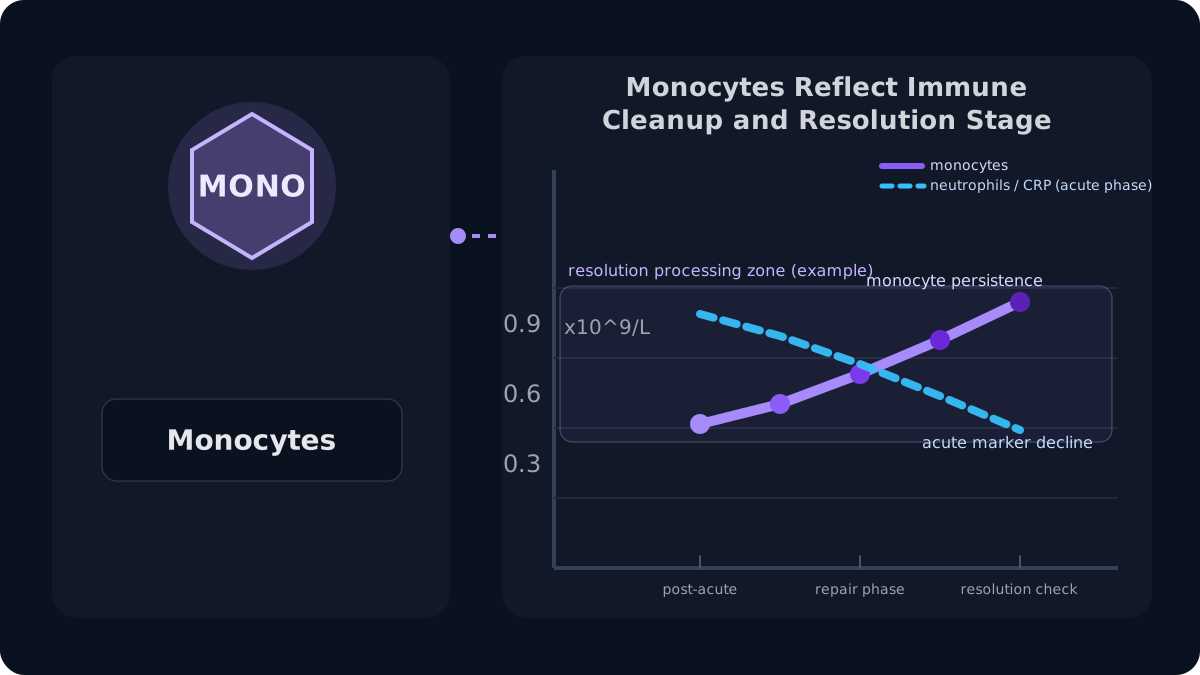
Neutrophils often rise early during acute stress. Lymphocytes become more prominent during adaptive response. Monocytes often rise later while the system is processing aftermath, repairing, and normalizing.
This timing pattern is common, but not universal, and depends on underlying physiology.
A single test captures one frame from that sequence. Without stage context, it is easy to misread what phase the system is currently in.
High monocytes: causes and interpretation
Elevated monocytes (monocytosis) often reflect ongoing or recent immune activity in post-acute phases.
High monocytes in a blood test are most commonly associated with recovery from infection, chronic inflammation, or prolonged immune activation.
Unlike neutrophils, which can spike quickly, monocytes often show steadier and more sustained elevation, consistent with longer-horizon cleanup and regulation roles.
In many cases, elevated monocytes suggest the system is still processing and adapting, even when acute symptoms have improved.
Low monocytes: what it means
Low monocyte values are discussed less often, but can still be meaningful depending on pattern and context.
Low monocytes in blood tests can reflect reduced immune engagement, temporary suppression, or altered production dynamics depending on the wider clinical picture.
In some cases, persistently low monocytes can also reflect bone marrow suppression or medication effects. Transient reductions are often less concerning than repeated low trends.
When monocytes should concern you
Persistent elevation across multiple tests, especially with higher hs-CRP or ferritin, can suggest unresolved inflammatory activity that deserves closer follow-up.
In contrast, one mild increase after recent illness is often part of normal recovery rather than a red flag.
The key distinction is persistence, not presence.
Monocytes and chronic inflammation
Monocytes are particularly relevant in chronic low-grade inflammation, where activity is sustained but less dramatic than acute infection.
Because they participate in tissue remodeling and longer-term immune signaling, monocytes can stay mildly elevated across repeated tests when inflammatory load is not fully resolving.
If this pattern appears alongside hs-CRP or ferritin, it can support interpretation of persistent systemic load rather than full baseline recovery.
What drives monocyte behavior over time
Monocyte behavior reflects both acute triggers and recovery quality. Post-infection cleanup can keep monocytes elevated even after symptoms improve.
Chronic stress can alter immune signaling and prolong activation. Sleep disruption can weaken resolution efficiency and extend inflammatory dynamics. Prolonged training stress can similarly increase immune turnover demand.
Because monocytes operate on a slower timeline than neutrophils, they are often more informative about whether recovery is actually complete.
Why reference ranges are not enough
A value inside range can still represent meaningful drift from personal baseline. Movement from lower to higher values over time may indicate sustained immune activity even without out-of-range flags.
For monocytes, direction across time is often more informative than one position within a reference interval.
What trends in monocytes reveal
Monocytes are especially valuable in longitudinal interpretation.
Gradual increase may suggest unresolved immune processing. Stable mild elevation may represent a persistent background state. Fluctuation may reflect cycles of stress, recovery, and reactivation.
Combined with neutrophils and lymphocytes, these patterns help reconstruct immune timeline stages: when load started, how it was handled, and whether closure actually occurred.
How to interpret monocytes properly
Start with broad context: total WBC first, then monocyte behavior relative to neutrophils and lymphocytes.
If recurring respiratory, skin, or gut sensitivity is present, adding eosinophils can help separate resolution-phase activity from reactivity-driven persistence.
Add supporting markers and real-world context, including recent illness, stress exposure, sleep quality, training load, and recovery pattern.
Then evaluate trend direction across repeated tests. When markers and timeline align, interpretation becomes clearer. When they conflict, the mismatch often indicates where deeper attention is needed.
What monocytes do not tell you
Monocytes do not diagnose specific conditions on their own.
They do not isolate exact causes of immune activation and cannot fully distinguish mechanisms without additional clinical context or testing.
They also do not directly measure immune effectiveness. A system can be active without being efficient, and quieter patterns are not always optimal.
Monocytes are not a conclusion. They are a timing-and-resolution signal inside a wider system.
The real value of monocytes
Monocytes reflect what happens after the obvious phase of immune response.
They help indicate whether cleanup is complete, whether inflammation is resolving, and whether the system has actually returned to baseline.
On one test, monocytes can look vague. Over time, they become one of the clearest signals of whether the immune loop is closing or remaining partially active.
You may feel recovered. Your immune system may disagree.
Frequently asked questions about monocytes
What does high monocytes mean in a blood test?
It often reflects ongoing or recent immune activity, especially in recovery phases or chronic inflammatory contexts.
Can monocytes be high without infection?
Yes. Chronic inflammation, stress load, and post-illness recovery can elevate monocytes even without active infection.
What does low monocytes mean?
It may indicate reduced immune engagement or altered production patterns, depending on context and duration.
Are monocytes part of WBC?
Yes. Monocytes are one of the main components of the white blood cell differential in routine CBC testing.
Should monocytes be tracked over time?
Yes. Trends across repeated tests are usually much more informative than one isolated monocyte value.
The uncomfortable question
If your monocytes stay elevated across multiple tests even after you feel recovered, are you truly back to baseline, or is your immune system still finishing a process you no longer notice?
Track monocytes as part of the full immune timeline
Upload your CBC panel and see whether your immune system has fully resolved or is still active beneath the surface by tracking monocytes with neutrophils, lymphocytes, and hs-CRP in one timeline.