
Most people associate low potassium with muscle cramps. That association is correct but incomplete.
Potassium is not primarily a muscle mineral. It is an electrical mineral. It governs the voltage difference across cell membranes — the signal that allows nerve cells to fire, heart cells to contract rhythmically, and muscle cells to relax properly after activation.
When potassium drifts out of balance, the first system to show it is often not muscle. It is signaling.
If you are building your baseline first, start with core blood biomarkers to track first, then layer potassium as part of your electrolyte context.
Quick summary
- Potassium is the primary intracellular cation — it governs membrane electrical potential.
- Normal serum levels can mask intracellular depletion under chronic stress or poor intake.
- Low potassium affects nerve signaling, heart rhythm, and smooth muscle function — not just skeletal muscle.
- Kidneys regulate potassium tightly; disruption usually reflects upstream input or output imbalance.
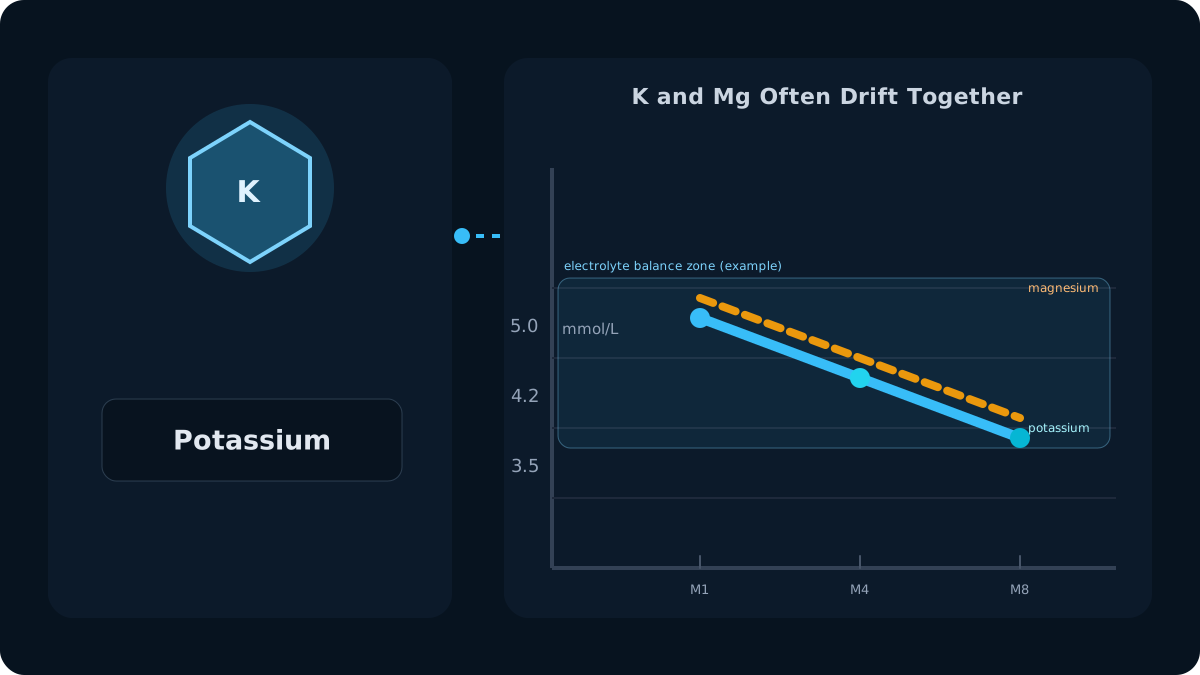
- Magnesium status directly affects potassium retention — interpret the two together.
- Trend direction matters more than one snapshot.
What potassium actually does
Potassium is also known as kalium — the name used in most European laboratory reports, derived from the Latin kalium. On blood test panels it commonly appears as K or K+. All refer to the same electrolyte.
Potassium (K+) is the dominant cation inside cells. Roughly 98% of total body potassium is intracellular. Only 2% circulates in blood — and that 2% is what standard serum tests measure. Extracellular balance is governed by sodium; the two should be read together.
This ratio is not incidental. The difference in potassium concentration between the inside and outside of cells creates the resting membrane potential — the electrical voltage that every excitable cell depends on.
When that gradient is maintained, nerve impulses transmit cleanly, the heart contracts with regular timing, and muscles activate and relax in sequence. When it shifts, electrical instability follows.
In practical terms: potassium is not a passive mineral. It is active infrastructure for every system that runs on electrical signals.
Why serum potassium can mislead
Because only 2% of body potassium is in blood, serum values can appear acceptable while total body stores are declining.
The body defends serum potassium tightly — shifting it from intracellular reserves when needed. This means a person can be depleting internal potassium stores while lab values still appear within reference range.
Clinically, this matters most in people with chronically poor dietary intake, high sweat output, persistent gastrointestinal losses, or diuretic use. The serum number looks acceptable. The physiological reserve does not.
As with magnesium, serum potassium is a window into one compartment of a much larger system. Context is what makes it interpretable.
The kidney connection: potassium regulation
Kidneys are the primary regulator of potassium balance. They filter potassium continuously and adjust excretion based on aldosterone signaling, acid-base status, and sodium balance.
When potassium intake drops, kidneys can reduce urinary excretion — but not to zero. There is a minimum obligatory potassium loss even with very low intake. This is why prolonged dietary deficiency can lead to depletion even in otherwise healthy people.
On the other side, if kidney function is impaired — as reflected by declining eGFR — potassium excretion can fail and serum levels rise. Hyperkalemia is a known risk in chronic kidney disease precisely because the regulatory system that clears potassium is damaged.
Potassium and kidney function are not separate conversations. They are the same conversation.
Potassium and magnesium: the dependency most panels miss
One of the most underappreciated interactions in electrolyte physiology is the magnesium-potassium dependency.
Magnesium is required for the function of the sodium-potassium ATPase pump — the cellular mechanism that actively maintains potassium inside cells. When magnesium is insufficient, this pump underperforms, and potassium leaks out of cells more easily.
The practical consequence: potassium repletion may be less effective or harder to sustain when magnesium is also low — serum potassium can still rise with supplementation, but correcting magnesium deficiency is often part of the clinical workup when hypokalemia persists.
This is why checking magnesium alongside potassium is standard in hypokalemia evaluation, not optional.
Low potassium: what it actually means
Hypokalemia — serum potassium below 3.5 mmol/L — can range from subclinical to life-threatening depending on severity, rate of decline, and individual sensitivity.
Mild hypokalemia (3.0–3.5 mmol/L)
Often asymptomatic or producing only subtle fatigue, mild weakness, and occasional muscle cramping. Many people are unaware until routine testing reveals it.
Moderate hypokalemia (2.5–3.0 mmol/L)
More consistent muscle weakness, fatigue, and constipation. Heart rhythm can begin to show changes on ECG, including flattened T-waves and the appearance of U-waves.
Severe hypokalemia (below 2.5 mmol/L)
Significant risk of dangerous arrhythmias. Requires urgent clinical evaluation and usually intravenous or closely monitored oral replacement.
Common causes of low potassium include insufficient dietary intake, chronic diarrhea or vomiting, excessive sweating, diuretic medication use, and aldosterone-related hormonal imbalance.
High potassium: less common but more urgent
Hyperkalemia — serum potassium above 5.0 mmol/L — is less commonly caused by dietary excess alone. Healthy kidneys efficiently clear excess potassium in most people.
The more clinically significant causes are impaired kidney excretion (chronic kidney disease, acute kidney injury), medications that interfere with potassium excretion (ACE inhibitors, potassium-sparing diuretics), and cellular potassium shift out of cells during acidosis.
At levels above 6.0 mmol/L, cardiac conduction can be seriously disrupted. Peaked T-waves on ECG progress to widened QRS complexes and, in severe cases, ventricular fibrillation.
One important technical note: potassium results can be falsely elevated due to hemolysis during blood collection — when red cells rupture and release their intracellular potassium into the sample. A hemolyzed sample should always prompt repeat testing before clinical action.
Potassium and heart rhythm: the most important relationship
The heart depends on precise potassium gradients to maintain its electrical conduction cycle. The action potential of cardiac cells — depolarization, repolarization, and rest — is tightly coupled to potassium movement across membranes.
Both low and high potassium disrupt this cycle. Low potassium prolongs repolarization, creating vulnerability to reentrant arrhythmias. High potassium blunts the membrane potential and can halt conduction entirely.
This is why potassium is one of the few electrolytes where both ends of the spectrum carry serious cardiac risk. Most biomarkers have one direction of concern. Potassium has two.
Potassium and acid-base balance
Potassium and pH are interrelated through a mechanism most people never see on a standard lab panel.
In acidosis (low blood pH), hydrogen ions move into cells and potassium moves out — raising serum levels even when total body potassium is unchanged or low. In alkalosis (high blood pH), the reverse occurs: potassium moves into cells, and serum levels can drop.
This means a potassium value must be interpreted alongside acid-base context in clinical settings. A seemingly normal potassium in someone with acidosis may actually represent significant total body depletion once pH corrects.
What drives potassium levels over time
Several factors influence potassium in ways that are not always obvious:
- Dietary intake — fruit, vegetables, legumes, and potatoes are primary sources. Highly processed diets are typically low in potassium and high in sodium, which further stresses potassium retention.
- Sweat losses — significant in endurance athletes or people in hot environments. Repeated large sweat losses without adequate replacement can produce gradual depletion.
- Gastrointestinal losses — diarrhea and vomiting are among the most common causes of acute hypokalemia because GI secretions are potassium-rich.
- Medication effects — loop and thiazide diuretics increase renal potassium excretion. This is a known and frequently monitored consequence of long-term diuretic therapy.
- Aldosterone and related hormones — aldosterone is the primary driver of renal potassium excretion; excess mineralocorticoid activity (including some cortisol-related pathways) can increase urinary potassium loss.
- Magnesium status — as described above, low magnesium directly impairs potassium retention at the cellular level.
Why reference ranges are not enough
The standard serum potassium range is typically 3.5 to 5.0 mmol/L. That window is relatively narrow compared to most biomarkers — which reflects how tightly the body tries to regulate it and how quickly values outside that range become clinically significant.
But within that range, position still matters. A potassium of 3.6 and a potassium of 4.8 are both "normal." In someone with cardiac history, known kidney disease, or diuretic use, those two values have very different clinical weight.
More importantly, trend direction often reveals more than one snapshot. Potassium drifting from 4.2 to 3.7 to 3.5 across repeated tests under stable conditions — even while staying inside a typical reference band — is worth understanding before it crosses a threshold.
Why trends matter more than single values
A single potassium result is a snapshot. Direction over time reveals system trajectory.
| Time | Potassium (mmol/L) | Context |
|---|---|---|
| Month 1 | 4.2 | Baseline |
| Month 4 | 3.7 | Increased training, reduced vegetable intake |
| Month 8 | 3.5 | Fatigue onset, muscle tension, poor sleep |
Each value can still fall within a typical laboratory reference band while the downward direction already suggests depletion worth addressing before symptoms escalate.
Practical interpretation framework
- Check potassium position within range — not just in or out, but where within the 3.5–5.0 window.
- Review trend direction across repeated tests under comparable conditions.
- Check magnesium — especially when potassium stays low despite repletion. Persistent hypokalemia may reflect concurrent magnesium deficiency.
- Review kidney context: eGFR and creatinine help frame whether kidney regulation is intact.
- Consider cortisol and aldosterone context when diuretic use or hormonal disruption is suspected.
- Rule out sample hemolysis if potassium appears unexpectedly elevated without clinical explanation.
For repeatable longitudinal review across multiple electrolytes and related markers, use a structured lab tracking workflow.
What potassium does not tell you
Serum potassium does not measure intracellular stores directly. It reflects the circulating fraction only.
It also does not explain cause. Low potassium from a poor diet, from diuretic use, from GI losses, and from kidney disease all look identical on a standard panel. Context is what separates them.
It cannot assess cardiac risk directly — ECG findings are needed for that. And it cannot detect intracellular depletion when serum values are still maintained through compensatory mechanisms.
The real value of tracking potassium
Potassium is one of the most clinically significant electrolytes on a routine blood panel — and one of the most underinterpreted in non-clinical contexts.
Most people look at a potassium result, see it in range, and move on. But potassium tells a more complete story when read alongside magnesium, kidney function markers, acid-base context, and lifestyle factors.
It is not a flashy marker. It does not carry the name recognition of testosterone or cortisol. But it governs the electrical infrastructure that everything else depends on. That makes it worth understanding properly.
Frequently asked questions about potassium blood tests
What is a normal potassium level?
Most laboratories define normal serum potassium between 3.5 and 5.0 mmol/L. Levels below 3.5 are typically considered low (hypokalemia), and above 5.0 are considered high (hyperkalemia). Interpretation depends on trend direction, clinical context, and related markers.
What are the symptoms of low potassium?
Common symptoms of low potassium include muscle weakness, fatigue, cramps, constipation, and heart palpitations. Severe deficiency can cause dangerous heart rhythm abnormalities.
Can potassium be low without obvious symptoms?
Yes. Mild hypokalemia often produces no clear symptoms, especially when the decline is gradual. The body can compensate quietly, which is why trend tracking matters more than one isolated result.
What causes low potassium?
Common causes include inadequate dietary intake, chronic diarrhea or vomiting, excessive sweating, diuretic medication use, and conditions affecting kidney regulation. Magnesium deficiency can also impair potassium retention.
Is high potassium dangerous?
Yes. Hyperkalemia above 6.0 mmol/L can disrupt cardiac conduction and in severe cases cause life-threatening arrhythmias. It requires prompt clinical evaluation.
Should potassium be tracked over time?
Yes. Single values can be affected by sample handling, hemolysis, and acute physiological state. Trends across repeated tests under comparable conditions are more informative than one measurement.
One uncomfortable question
If your potassium has been slowly declining across repeated tests — still in range, no dramatic symptoms — are you confident the trend does not matter, or are you waiting for a threshold to tell you it does?
Track potassium alongside magnesium and kidney markers
Upload your blood panel and review potassium with magnesium, eGFR, and electrolyte context in one timeline — so gradual drift is visible before it becomes a clinical problem.