
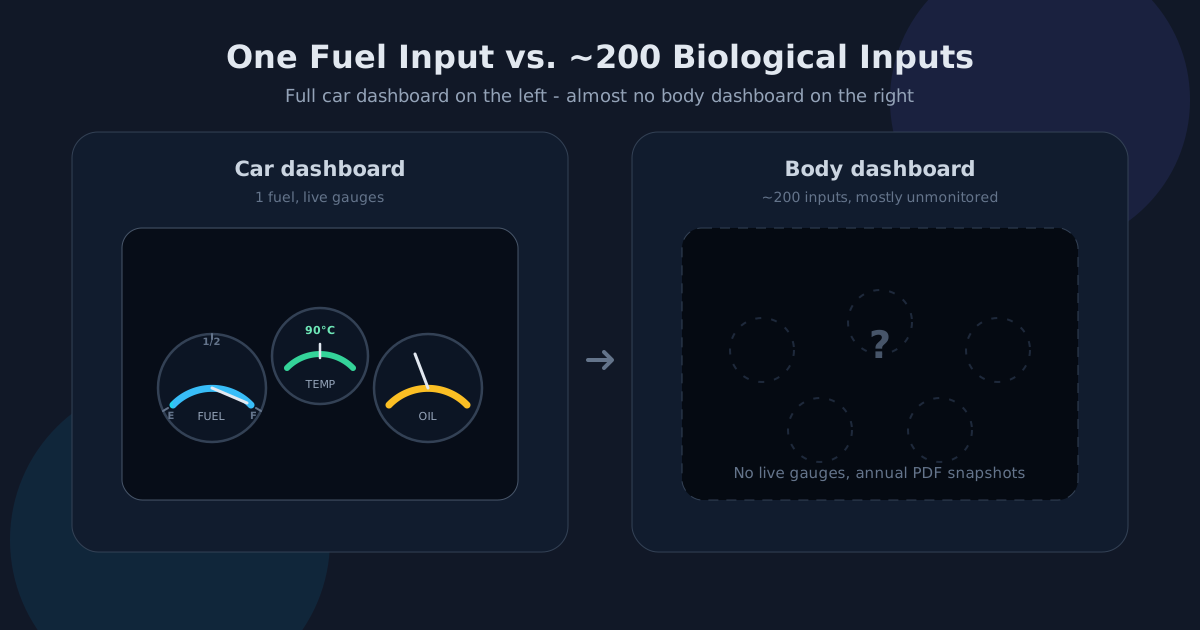
A car needs one fuel. Maybe you also glance at the oil level a few times a year. That's essentially the entire input list for keeping a car running.
And yet every car built in the last few decades comes with a full dashboard for this genuinely simple system: a live fuel gauge, an oil pressure light, a temperature gauge, a battery indicator, and a check engine light that watches dozens of sensors you'll never think about. Manufacturers built an entire monitoring system for something that only needs one input to function.
Your body runs on roughly 200 different inputs — vitamins, minerals, electrolytes, and hormonal signals, each doing a specific and often non-negotiable job. It is, by any reasonable measure, a dramatically more complex system than a car's fuel line.
And almost nobody has a dashboard for it at all. This guide is part of our lab tracking guides collection — a practical set of workflows for reading, organizing, and following blood results over time.
The asymmetry
This is the part worth sitting with: we built comprehensive, real-time monitoring for the simple system, and left the complex one almost entirely unmonitored.
Most people find out about a problem with one of their roughly 200 biological inputs the same way you'd find out about a car problem if someone had removed every gauge and warning light from the dashboard — you wait until something actually breaks down, and by then you've usually been running in a degraded state for a while.
A yearly blood test is the closest thing most people have to a dashboard check — and even that is closer to popping the hood once a year and glancing at the engine for ten seconds, rather than anything resembling continuous monitoring.
What a real dashboard would actually track
If your body did have a dashboard, these are some of the gauges that would be on it — not because they're the only ones that matter, but because they're representative of the different systems a real dashboard would need to cover.
Energy metabolism
Glucose is the closest thing your body has to a literal fuel gauge — it's the primary molecule your cells burn for energy, and your brain depends on it heavily. A commonly cited fasting range is roughly 70–99 mg/dL, though exact cutoffs are lab-dependent. A value trending upward across repeated tests is worth reviewing with a clinician rather than reading as one isolated number.
Reserves
Ferritin reflects stored iron — not what's actively circulating, but what's held in reserve for later use. Reference ranges vary by lab and sex, but values are often flagged as low somewhere under 20–30 ng/mL. This is one of the few markers on this list where a genuinely depleted reserve can produce real, noticeable fatigue.
Electrolyte balance
Sodium, potassium, and magnesium regulate fluid balance and the electrical signaling that drives every muscle contraction and heartbeat. Their reference ranges are comparatively narrow — commonly cited around 135–145 mEq/L for sodium, 3.5–5.0 mEq/L for potassium, and 1.7–2.2 mg/dL for magnesium — which is part of why even modest deviations tend to get clinical attention.
Structural and nervous system maintenance
Vitamin D supports bone metabolism and immune signaling, with many labs treating roughly 30–50 ng/mL as an adequate zone, though optimal targets are debated. Vitamin B12 supports nerve function, with values sometimes flagged as low below roughly 200–300 pg/mL. Both are common enough to run low quietly, often without symptoms in the early stages — which is exactly why nobody notices until the deficit has been present for a while.
Regulatory signaling
TSH doesn't do metabolic work directly — it's the signal that tells the thyroid how much hormone to produce, which in turn paces a large share of overall metabolism. A commonly cited range is roughly 0.4–4.0 mIU/L, though this is meaningfully lab-dependent, and it's usually interpreted alongside FT4 rather than in isolation.
System-wide alert
hs-CRP is the closest thing on this list to an actual warning light rather than a fuel level. It rises when something in the system is inflamed, without specifying what — many labs describe below roughly 1 mg/L as a low-inflammation signal. Like any warning light, a single elevated reading is a prompt to look closer, not a diagnosis on its own.
Why a dashboard has to be continuous, not annual
The reason a car dashboard works is that it's live. You don't check your fuel gauge once a year and extrapolate — you glance at it regularly, and the trend (how fast it's dropping this week versus last week) tells you more than any single reading.
Most people's health data doesn't work this way. It exists as a series of disconnected PDFs from different clinics and years, each one a single snapshot with no connection to the ones before or after it. That structure can catch a genuinely empty tank. It rarely catches a tank that's been slowly draining for eighteen months while every individual reading still looked technically fine.
None of the markers above are especially useful as one-time checks. They become useful when they're gauges you actually look at over time — which is a tracking problem, not a testing problem.
Build the dashboard your body doesn't come with
Labs are the gauges. Keep the rest of your medical history, from visit notes to any other medical document, in the same place.
Frequently asked questions
Do I need to test all 200 inputs my body uses to function?
No. Most people benefit from tracking a focused core panel rather than everything at once. The markers in this guide are a reasonable starting point — a clinician can help decide which additional markers make sense for your specific situation.
What counts as a normal level for these markers?
Reference ranges vary by laboratory, assay method, age, and sex — there is no single universal number for most of these markers. Always compare your result to the range printed on your own lab report rather than a generic figure found online.
How often should I actually check these numbers?
There's no universal schedule. Many people find that two to three tests a year, tracked consistently, reveal far more than one test per year, because direction becomes visible instead of a single snapshot. Frequency should reflect your personal health context, ideally discussed with a clinician.
Can a mild deviation in one of these markers actually cause symptoms?
Sometimes — very low iron stores or very low vitamin D, for example, can produce real, noticeable effects. But mild deviations are common and not automatically meaningful on their own. Persistent or significant abnormal results are worth discussing with a clinician rather than self-interpreting.
Build the dashboard your body doesn't come with
Upload your blood panels and see glucose, ferritin, electrolytes, vitamin D, B12, TSH, and hs-CRP in one timeline — so you can watch the gauges move instead of finding out when something finally breaks.