
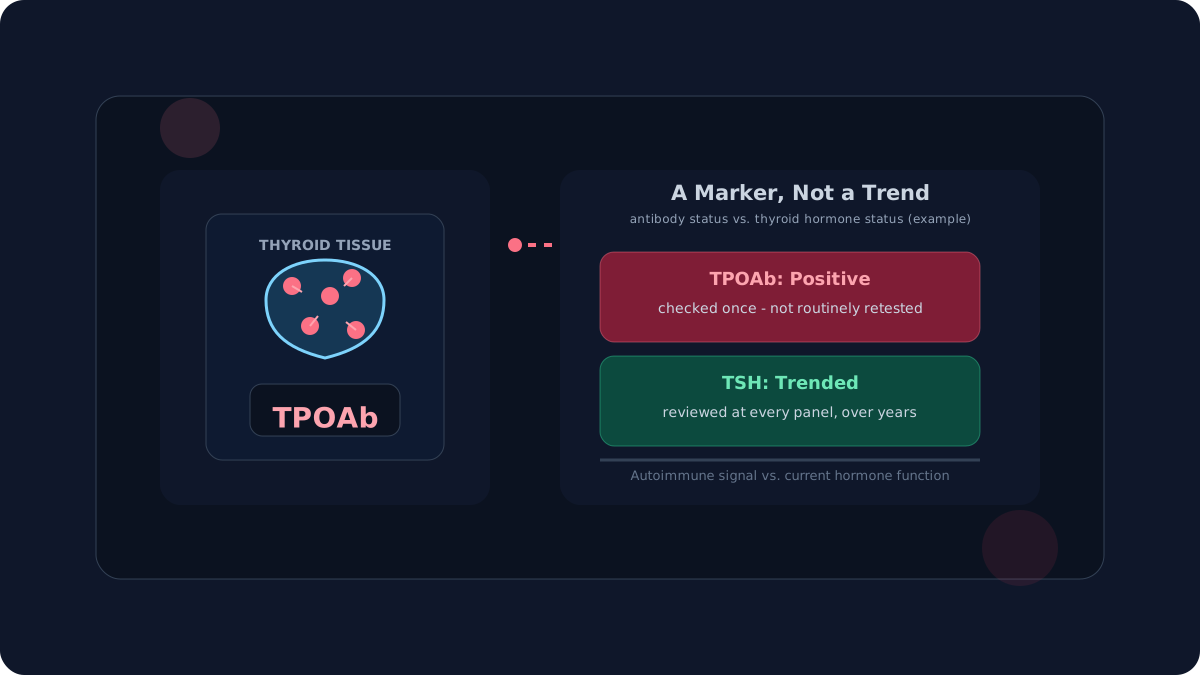
Most thyroid testing starts with TSH. TPOAb answers a different question: not how much thyroid hormone is being produced, but whether the immune system is actively targeting the thyroid gland itself.
That distinction matters. TSH and FT4 describe current thyroid function. TPOAb describes a mechanism — autoimmunity — that can explain why thyroid function is changing, or predict that it might change later even when today's numbers still look normal.
If you are building a thyroid baseline, start with a focused biomarker priority set and add TPOAb when autoimmune thyroid disease is a specific concern, not as a default screening marker for everyone.
Quick summary
- TPOAb (thyroid peroxidase antibodies) is an autoimmune marker, not a thyroid function marker.
- It is most associated with Hashimoto's thyroiditis and is also seen in Graves' disease.
- Positive TPOAb is common in the general population and does not by itself mean disease is present.
- Interpretation depends on pairing TPOAb with TSH and FT4, not reading it in isolation.
- Unlike TSH, TPOAb is not typically retested on a regular schedule once positivity is established.
What TPOAb actually measures
Thyroid peroxidase is an enzyme inside thyroid follicular cells that is essential for producing thyroid hormone — it helps iodinate thyroglobulin as part of the hormone synthesis pathway. TPOAb are antibodies the immune system produces against this enzyme.
Their presence signals that the immune system has identified thyroid tissue as a target. Over time, this autoimmune activity can contribute to gradual destruction of thyroid follicular cells, which is the underlying process in Hashimoto's thyroiditis — the most common cause of hypothyroidism in regions with adequate iodine intake.
TPOAb is also frequently positive in Graves' disease, an autoimmune condition that causes hyperthyroidism, although the more specific marker for Graves' is TRAb (TSH receptor antibodies).
TPOAb reference ranges: why a positive result is not a single number
Unlike TSH, which is usually read as a continuous value against a reference interval, TPOAb is often reported as positive or negative against a lab-specific cutoff — commonly somewhere between 9 and 34 IU/mL, though assay methods vary meaningfully between laboratories.
Titer magnitude (how far above the cutoff a result sits) is sometimes used as supporting context, but a very high titer does not necessarily mean more severe current thyroid dysfunction — TSH and FT4 remain the markers that describe actual hormone status.
Positive TPOAb with normal TSH and FT4: what it means
This is one of the most common — and most misunderstood — patterns. Studies estimate that a meaningful share of the general population, more common in women and increasing with age, carries positive TPOAb without ever developing overt thyroid dysfunction.
A positive TPOAb result with normal TSH and FT4 generally means the immune system has identified thyroid tissue, but current hormone production is still adequate. This pattern is sometimes described as euthyroid autoimmune thyroiditis. It is not a diagnosis of Hashimoto's disease on its own — it is a risk marker worth discussing with a clinician, particularly regarding monitoring frequency for TSH going forward.
TPOAb with subclinical or overt hypothyroidism
The clinical picture changes when TPOAb positivity appears alongside elevated TSH. Research has associated positive TPOAb with a higher rate of progression from subclinical hypothyroidism (elevated TSH with normal FT4) to overt hypothyroidism (elevated TSH with low FT4) over time compared to people with elevated TSH but negative TPOAb.
This is why TPOAb is sometimes checked once, at the time subclinical hypothyroidism is first identified — it helps a clinician gauge trajectory risk, even though the antibody result itself does not need to be repeated on every subsequent visit.
| Pattern | Common interpretation context |
|---|---|
| Normal TSH/FT4 + positive TPOAb | Euthyroid autoimmune pattern; often monitored, not treated. |
| High TSH, normal FT4 + positive TPOAb | Subclinical hypothyroidism with higher progression likelihood. |
| High TSH, low FT4 + positive TPOAb | Consistent with autoimmune (Hashimoto's) hypothyroidism. |
| Low TSH, high FT4/FT3 + positive TPOAb | Can appear in Graves' disease; TRAb adds specificity. |
TPOAb, TgAb, and TRAb: three different antibodies
These names get confused often because they all sound similar and all relate to thyroid autoimmunity — but they target different structures.
- TPOAb targets thyroid peroxidase — most associated with Hashimoto's thyroiditis.
- TgAb (thyroglobulin antibodies) targets thyroglobulin — also common in Hashimoto's, and separately used as a tumor marker context in some thyroid cancer follow-up (a different clinical use case entirely).
- TRAb (TSH receptor antibodies) targets the TSH receptor itself — the more specific marker for Graves' disease, since these antibodies can directly stimulate the receptor.
A clinician may order one, two, or all three depending on whether the clinical question is “is this autoimmune” versus “which specific autoimmune thyroid condition is this.”
How antibodies fit with TSH and FT4: thyroid panel guide.
Why TPOAb is not tracked like TSH
TSH and FT4 are reviewed as trends because they reflect current, physiologically dynamic hormone status — values that can shift with treatment, illness, or disease progression, and are worth comparing across tests over time in a longitudinal lab workflow.
TPOAb behaves differently. Once positivity is established, repeated testing adds little clinical value in most cases, because the presence of autoimmunity — not the exact titer — is what carries the clinical signal. Some research even suggests titers can decline over years as thyroid tissue is progressively affected, which is the opposite of what a rising-trend marker like TSH would suggest as “worse.” This is one of the few thyroid markers where more frequent testing is not automatically better.
What does get rechecked, and when: Hashimoto's blood tests.
TPOAb and pregnancy
TPOAb positivity has been studied in the context of pregnancy planning and early pregnancy, with research associating it with higher rates of miscarriage and postpartum thyroiditis in some populations. Because thyroid hormone demand changes during pregnancy and TSH reference ranges shift by trimester, TPOAb status can factor into how closely TSH is monitored during this period.
This is an area with active clinical debate about screening and treatment thresholds — decisions here belong with an obstetric or endocrine clinician, not a self-directed response to one antibody result.
The 2026 American Thyroid Association guideline changed several recommendations for antibody-positive women; see what the 2026 guideline says.
Practical steps after a TPOAb result
- Confirm the assay-specific cutoff printed on your report — a "positive" label alone is less informative than the number relative to that cutoff.
- Review it alongside TSH and FT4 rather than in isolation.
- Do not expect or request frequent TPOAb retesting — TSH is the marker worth trending over time.
- If TPOAb is positive with normal thyroid function, ask your clinician about a reasonable TSH monitoring interval going forward.
- Mention pregnancy planning to your clinician if relevant, since it changes how this result may be used.
What TPOAb does not tell you
TPOAb does not measure current thyroid hormone levels and cannot diagnose hypothyroidism or hyperthyroidism on its own. It also does not predict timing — a positive result does not mean thyroid dysfunction will definitely occur, or say when.
It is a risk and mechanism marker, best used to add context to TSH and FT4 trends, not to replace them.
Frequently asked questions about TPOAb blood tests
What is the long form of TPOAb?
TPOAb stands for thyroid peroxidase antibodies, also called anti-TPO antibodies. They are autoantibodies directed against thyroid peroxidase, an enzyme the thyroid gland uses to produce thyroid hormone.
What is a normal TPOAb level?
Reference cutoffs vary substantially by lab and assay — many report a negative result below roughly 9 to 34 IU/mL. Always compare your result to the cutoff printed on your own report rather than a generic number.
Does a positive TPOAb result mean I have a thyroid disease?
Not by itself. TPOAb positivity is common in the general population, and many people with positive TPOAb have normal TSH and FT4 and no thyroid dysfunction. A positive result identifies an autoimmune tendency, not a diagnosis on its own — it should be interpreted alongside TSH and FT4 with a clinician.
Does TPOAb need to be retested regularly like TSH?
Not usually in the same way. Once TPOAb positivity is established, many clinicians do not repeat it routinely, since it does not track short-term thyroid function the way TSH and FT4 do. TSH remains the primary marker to monitor over time.
Is TPOAb the same as TRAb or TgAb?
No. TPOAb targets thyroid peroxidase and is most associated with Hashimoto's thyroiditis. TgAb targets thyroglobulin and is also seen in Hashimoto's. TRAb (TSH receptor antibodies) is a different antibody most associated with Graves' disease. A clinician may order more than one depending on the clinical picture.
Does TPOAb matter during pregnancy?
TPOAb positivity has been associated with increased risk of pregnancy complications and postpartum thyroiditis in research literature, which is why some clinicians check it during pregnancy planning or early pregnancy. Management decisions in this context should be made with an obstetric or endocrine clinician, not from a single lab value.
One uncomfortable question
If your TPOAb came back positive years ago and nobody mentioned it since — do you actually know whether your TSH monitoring schedule ever changed because of it, or did that result just get filed away as a curiosity?
Track TPOAb alongside TSH and FT4
Upload your thyroid panels and review TPOAb results next to TSH and FT4 in one timeline — so autoimmune context and hormone trend stay connected instead of scattered across separate reports.