
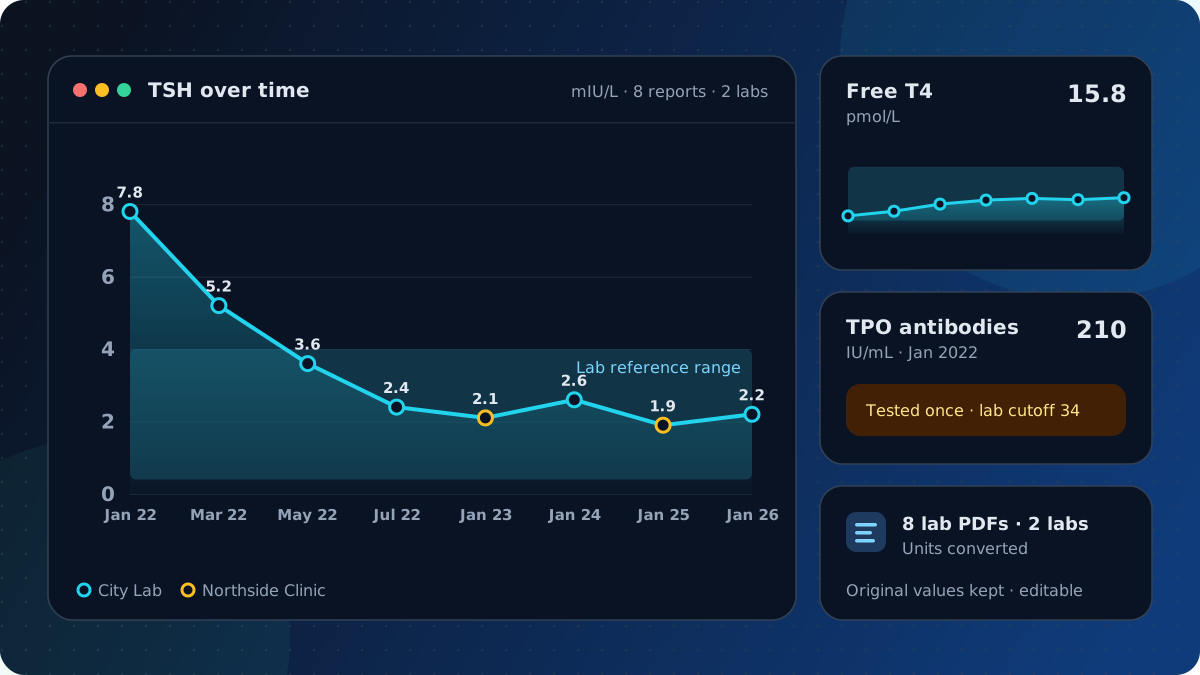
With Hashimoto's, one blood test rarely settles anything. You test to get the diagnosis, then again weeks after every dose change, then once or twice a year for as long as you take thyroid hormone. Often that happens at more than one lab. This guide covers which results matter, when they're usually rechecked, and how to keep them in a series you and your clinician can actually read.
Track your thyroid results → · See the testing schedule ↓
Quick summary
- TSH is the main monitoring test, usually read with free T4. TPO antibodies confirm the autoimmune cause and are rarely repeated in adults.
- TSH is usually rechecked 6–8 weeks after starting or changing a levothyroxine dose. Once the dose is stable, testing usually drops to every 6–12 months.
- TSH can move without a dose change. Common reasons are how and when the tablet is taken, supplements like calcium or iron, a new medicine, a brand change, pregnancy and biotin.
- Pregnancy changes everything about the schedule. The 2026 American Thyroid Association guideline recommends much closer TSH checks, starting from the positive pregnancy test.
- A readable trend needs consistency: the same lab when you can, a similar time of day, the same routine with your tablet on test days, and a dated note of every dose change.
What Hashimoto's is, briefly
Hashimoto's disease is an autoimmune condition: the immune system attacks the thyroid. Over time this can reduce how much thyroid hormone the gland makes, and it is the most common cause of hypothyroidism in the United States. It is 4 to 10 times more common in women than in men and most often develops in women between ages 30 and 50. Not everyone with Hashimoto's develops hypothyroidism. Some people have antibodies for years with normal thyroid function.
That's why the blood tests do two separate jobs. Antibody tests show whether the immune process is there. TSH and free T4 show how the thyroid is coping, and they're the ones repeated over time.
The blood tests used for Hashimoto's
| Test | What it tells you with Hashimoto's | How often it's typically repeated |
|---|---|---|
| TSH | Whether thyroid hormone levels are enough for your body; the main test for adjusting treatment | After every dose change, then every 6–12 months |
| Free T4 | How much hormone is available; confirms what TSH suggests | Usually with TSH |
| TPO antibodies | Whether the cause is autoimmune; present in most people with Hashimoto's | Usually once |
| Tg antibodies | A second thyroid antibody some labs add; also points to autoimmune thyroiditis | Usually once |
| Free T3 | Mainly used for an overactive thyroid; rarely needed to monitor hypothyroidism | Often on lab panels anyway |
For how these results fit together, from the TSH × FT4 pattern table to unit conversions, see the thyroid panel guide.
Other results that sometimes sit alongside. People with Hashimoto's are more likely to have other autoimmune conditions, such as celiac disease and type 1 diabetes. If your clinician tests for those, the results (for example tTG-IgA for celiac disease, or HbA1c) belong in the same history.
How often thyroid tests are repeated
Your clinician sets your schedule. These are the intervals the main guidelines describe, so you know what to expect and can spot a gap:
| Situation | Typical timing | Source |
|---|---|---|
| Starting levothyroxine, or after any dose change | 6–8 weeks later | ATA, NIDDK |
| Dose found that works | Again in about 6 months, then once a year | NIDDK, BTF |
| Mildly raised TSH (under 10 mIU/L) with normal free T4, not treated | Repeated in 3–6 months before any treatment decision | StatPearls |
| Positive TPO antibodies, normal thyroid function, planning pregnancy | TSH every 3–6 months | ATA 2026 |
| Pregnant and taking levothyroxine | At confirmation of pregnancy, about every 4 weeks in the first half, at least once in the third trimester, and 4–6 weeks after any dose change | ATA 2026 |
| Pregnant with positive TPO antibodies, not on treatment | Extra TSH checks as your clinician advises; for antibody-positive women whose raised TSH had returned to normal, the guideline suggests every 4–6 weeks in the first half and at least once in the third trimester | ATA 2026 |
| After giving birth, taking levothyroxine | Around 6 weeks postpartum | ATA 2026 |
| New medicine or supplement, or a change of brand | Tell your clinician; a recheck is often needed | ATA |
Why 6–8 weeks? Levothyroxine takes weeks to reach a steady level in the blood, so a test sooner than that tends to show a moving target rather than where the new dose will settle.
Why your TSH changed when your dose didn't
This is the most common surprise with Hashimoto's results. A changed TSH on an unchanged dose usually has an ordinary cause:
- How the tablet is taken. Levothyroxine is best absorbed with water on an empty stomach, at least 30 minutes before food or drink. A new habit, like coffee straight after the tablet, can lower how much you absorb.
- Supplements and foods. The British Thyroid Foundation advises taking calcium, iron, multivitamins and some cholesterol-lowering medicines at least 4 hours apart from levothyroxine. Grapefruit juice, espresso and soy can also reduce absorption.
- A new medicine. Starting or stopping antacids, estrogen (including birth control), seizure medicines and others can change how much levothyroxine you need.
- A different brand or formulation. Switching products is one of the changes the American Thyroid Association lists as a reason to contact your clinician.
- Pregnancy. Thyroid hormone needs rise in pregnancy, which is why testing becomes much more frequent.
- Biotin. It doesn't change your thyroid, but it can distort the test: falsely low TSH and falsely high free T4 on some lab methods. The American Thyroid Association advises stopping it for 2 days before a thyroid blood test.
- When the blood was drawn. TSH follows a daily rhythm. Studies disagree on how much time of day matters, but switching from morning to afternoon draws is a change worth noting.
- A different lab. Each lab uses its own method and range, so a new lab can shift the numbers slightly without anything changing in you.
- The disease itself. Hashimoto's can progress slowly over years, so needs can change over time even when nothing else did.
Bring the list of anything that changed to your appointment. It's often the fastest way to explain an unexpected result.
Do you need to retest TPO antibodies?
Usually not. TPO and Tg antibodies answer one question: is the cause autoimmune? Once that's known, guidelines say repeating them in adults is rarely useful, and the antibody level doesn't usually change treatment. The UK's NICE guideline advises against repeat TPO antibody testing in adults.
What antibodies do tell you is about risk. A positive result with normal thyroid function raises the chance of developing hypothyroidism later, and that risk is highest when antibodies and a raised TSH appear together. In one study of women in the US military who were later diagnosed with Hashimoto's, TPO antibodies were already present in 66% and Tg antibodies in 53% of blood samples taken up to 7 years earlier. That's why someone with positive antibodies and a normal TSH is often offered periodic TSH checks instead of repeat antibody tests.
If your antibody level went up or down between two reports, check that both came from the same lab first. Antibody cutoffs differ several-fold between test kits, so results from two labs often can't be compared directly.
Planning a pregnancy or pregnant: what the 2026 guideline says
At the end of May 2026 the American Thyroid Association published new guidelines for thyroid disease in preconception, pregnancy and the postpartum period, replacing the 2017 version. For people with Hashimoto's or positive thyroid antibodies, the points most relevant to testing are:
- Positive TPO antibodies, normal thyroid function, planning pregnancy: the guideline suggests rechecking TSH every 3–6 months. It adds that this can reasonably be applied to people with positive Tg antibodies too.
- Already taking levothyroxine and planning pregnancy: the guideline calls a TSH between 0.5 and 2.5 mU/L a reasonable target before conception.
- Pregnant and taking levothyroxine: TSH at confirmation of pregnancy, about every 4 weeks in the first half, at least once in the third trimester, and 4–6 weeks after any dose change. Contact your clinician as soon as you have a positive test.
- Ranges are different in pregnancy. Lab- and trimester-specific ranges are preferred. Without them, 0.1–4.0 mIU/L can be used for TSH in the first and second trimesters.
- Antibodies alone aren't treated. For women with positive antibodies and normal thyroid function who have infertility or past miscarriages, the guideline recommends against starting levothyroxine, based on three high-quality randomized trials that showed no benefit. TPO antibody status is also no longer used to decide treatment for subclinical hypothyroidism in pregnancy.
A lot of online advice still reflects the 2017 guidance. If something you read conflicts with the points above, ask your clinician which guidance they follow.
Should you take levothyroxine before a blood test?
Clinicians genuinely disagree. Taking the tablet a couple of hours before the draw can push free T4 slightly up and TSH slightly down, so some advise taking it after the blood test on test days. Others are less strict about it. Ask your clinician which they prefer, then do it the same way every time, so your results stay comparable with each other.
How to keep a thyroid history you can actually read
A thyroid trend is only as good as its consistency. Five habits make the biggest difference:
- Use the same lab when you can. If you have to switch, note it.
- Test at a similar time of day, and keep the same routine with your tablet on test days.
- Pause biotin supplements for 2 days before each test (the American Thyroid Association's advice; if a clinician prescribed biotin, ask them first). Check multivitamins and hair, skin and nail supplements too.
- Keep a dated dose log. Write down the date of every dose or brand change, plus any new medicine, supplement or pregnancy. A note on your phone is enough.
- Keep every original report. The lab's reference range and units are printed on it, and you'll need them to compare results fairly.
What to bring to your endocrinologist
- your TSH and free T4 results over time, on one timeline, with each lab's reference range;
- antibody results and the date they were tested;
- your dose log: dates of every dose and brand change;
- a list of current medicines and supplements (including biotin, calcium and iron);
- the original reports, in case a value needs checking;
- your questions, including anything from the "changed when my dose didn't" list above.
Keep your thyroid results on one timeline
MedicalHistory.app turns lab PDFs into a single timeline. Upload thyroid reports from different labs. TSH, free T4, free T3, TPO antibodies and Tg antibodies land on one Thyroid panel, with free T4 (ng/dL) and free T3 (pg/mL) converted to pmol/L and the original value and lab range kept next to each result. Results like "<9" are shown exactly as reported, and every value can be edited at any time. Celiac results (tTG-IgA, total IgA) are mapped too, and antibody results printed as words ("negative", "positive") are kept as reported.
Your dose log stays with you. MedicalHistory.app tracks lab results, not medication, so bring both to appointments.
Track your thyroid results → Free for 3 documents, no card needed.
Frequently asked questions
How often should thyroid levels be checked with Hashimoto's?
TSH is usually checked 6–8 weeks after starting levothyroxine or changing the dose. Once a dose works, it's typically repeated in about 6 months and then once a year. Pregnancy, new medicines or a brand change usually mean extra checks. Your clinician sets your exact schedule.
Why did my TSH change if my dose didn't?
Common reasons include taking the tablet with food or coffee, calcium or iron supplements taken too close to it, a new medicine such as estrogen, a change of brand, pregnancy, biotin supplements, a different lab, and a different time of day for the blood draw. Hashimoto's can also progress slowly over the years.
Do I need to retest TPO antibodies?
Usually not. TPO antibodies confirm that the cause is autoimmune. Repeating them in adults is rarely useful, and the level doesn't usually change treatment. The UK NICE guideline advises against repeat testing in adults. TSH and free T4 are the tests used to monitor Hashimoto's over time.
Should I take levothyroxine before my blood test?
Clinicians differ. Taking it shortly before the draw can nudge free T4 up and TSH down, so some advise taking it after the test. Ask your clinician which they prefer and do it the same way each time, so your results stay comparable.
What blood tests are used to diagnose Hashimoto's?
TSH and free T4 show how the thyroid is working, and TPO antibodies show whether the cause is autoimmune. Some labs also test thyroglobulin (Tg) antibodies. Free T3 is mainly used for an overactive thyroid and is rarely needed to monitor Hashimoto's.
How often is TSH checked in pregnancy with Hashimoto's?
The 2026 American Thyroid Association guideline suggests, for women taking levothyroxine, a TSH at confirmation of pregnancy, about every 4 weeks in the first half, at least once in the third trimester, and 4–6 weeks after any dose change. Contact your clinician as soon as you know you're pregnant.
Related guides
Sources
- NIDDK. Hashimoto's Disease, reviewed 2021 (definition, who gets it, tests, associated conditions, monitoring, foods and supplements).
- American Thyroid Association. Hypothyroidism (6–8 weeks after a dose change; medicines and brand changes).
- American Thyroid Association. Thyroid Function Tests (biotin 2 days; T3 use).
- British Thyroid Foundation. Levothyroxine, updated July 2025 (how to take it; 4-hour gap; yearly test).
- British Thyroid Foundation. Thyroid function tests (antibody retesting; FT3 use).
- Manchester University NHS FT, Laboratory Medicine. To test or not to test: rethinking TPO antibody requests, September 2025 (NICE NG145: repeat testing not indicated in adults).
- StatPearls. Subclinical Hypothyroidism, updated February 2024.
- Korevaar TIM, Leung AM, Alexander EK, et al. American Thyroid Association 2026 Guidelines for Thyroid Disease in Preconception, Pregnancy, and Postpartum. Thyroid. 2026;36(5):481–544.
- American Thyroid Association. Clinical Thyroidology for the Public, vol. 4 issue 10 (antibodies years before diagnosis).
- Vanderpump MPJ, et al. The incidence of thyroid disorders in the community: a twenty-year follow-up of the Whickham Survey. Clin Endocrinol. 1995.
- theMednet. Should patients hold their morning levothyroxine before the lab?
- Health Sciences Authority Singapore. Biotin interference with clinical laboratory tests, 2019.
- Sviridonova MA, et al. Endocr Res. 2012, summarized in Natural Medicine Journal; Briton-Jones C, et al. ASRM 2019 abstract (time of day: mixed evidence).