
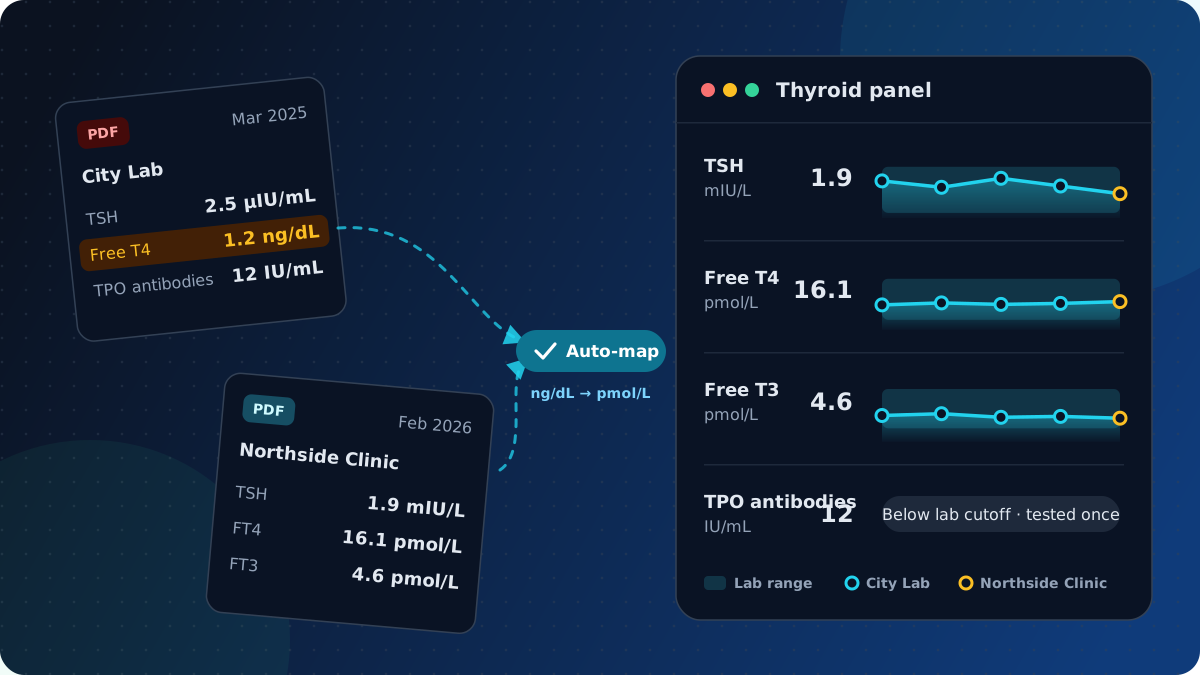
A thyroid panel is a group of blood tests that shows how your thyroid is working and, when antibodies are included, whether an autoimmune condition is behind a change. Each test answers a different question, so the results only make sense together: one TSH value without free T4 is half a picture, and one report without your earlier ones is a single frame of a long film.
Upload your thyroid results → · Jump to the pattern table ↓
Quick summary
- A thyroid panel usually starts with TSH and free T4 (FT4). Free T3 (FT3) and the antibodies TPOAb and TgAb are added depending on the lab and the reason for testing. There is no single standard panel.
- TSH is the signal and FT4 is the response. Read them as a pair: high TSH with low FT4 is a different situation from high TSH with normal FT4.
- Antibodies explain the cause, not the current function. Positive TPO or Tg antibodies point to autoimmune thyroid disease such as Hashimoto's. Adults rarely need them repeated.
- Reference ranges belong to the lab. Units differ (FT4 in pmol/L or ng/dL) and antibody cutoffs can differ several-fold between test kits, so compare each result with the range printed on its own report.
- Trends beat snapshots. A series of results from the same lab, drawn under similar conditions, tells you far more than any single value.
What a thyroid panel includes
The pituitary gland releases thyroid-stimulating hormone (TSH), which tells the thyroid to make thyroxine (T4) and a smaller amount of triiodothyronine (T3). Most T3 is made from T4 in other tissues. When thyroid hormone levels fall, TSH rises to push the thyroid harder. When they rise, TSH falls. That feedback loop is why TSH is the most sensitive first test, and why it has to be read together with FT4.
| Test | What it measures | Common units | When it's usually included | Guide |
|---|---|---|---|---|
| TSH | The pituitary's signal to the thyroid | mIU/L (= µIU/mL) | Almost always; often the first test | TSH |
| Free T4 (FT4) | Unbound thyroxine, the main hormone the thyroid makes | pmol/L or ng/dL | With TSH, or added when TSH is abnormal ("reflex") | FT4 |
| Free T3 (FT3) | Unbound triiodothyronine, the active form | pmol/L or pg/mL | Mainly when hyperthyroidism is suspected; many panels include it anyway | FT3 |
| TPO antibodies (TPOAb) | Antibodies against thyroid peroxidase, an enzyme in the thyroid | IU/mL (also U/mL, kIU/L) | When autoimmune thyroid disease is suspected, usually once | TPOAb |
| Tg antibodies (TgAb) | Antibodies against thyroglobulin, the protein T4 and T3 are made from | IU/mL (also U/mL, kIU/L) | Alongside TPOAb in some labs | TgAb |
| TSH receptor antibodies (TRAb, TSI) | Antibodies that act on the TSH receptor | IU/L | When Graves' disease is suspected | — |
| Total T4 / total T3 | Bound plus free hormone | nmol/L or µg/dL, ng/dL | Some labs and countries still report them | — |
Thyroglobulin itself (Tg, not the antibody) is a different test, used mainly to follow people after thyroid cancer treatment. It sometimes appears next to TgAb on a report, so check the label.
How to read TSH and FT4 together
The table below shows the common patterns, using the reference range printed on your own report for "high", "normal" and "low". These are patterns, not diagnoses. The same numbers can mean different things depending on symptoms, medicines, pregnancy and recent illness, which is your clinician's job to weigh.
| TSH | FT4 | FT3 | Usual name for the pattern | What usually happens next |
|---|---|---|---|---|
| High | Low | — | Primary hypothyroidism (underactive thyroid) | Clinician assesses the cause, often with TPO antibodies |
| High | Normal | — | Subclinical hypothyroidism | Often repeated in a few months; mild rises often settle on their own |
| Low | High | Often high | Hyperthyroidism (overactive thyroid) | Clinician looks for the cause, sometimes with TSH receptor antibodies |
| Low | Normal | Normal | Subclinical hyperthyroidism | Usually rechecked after 2–4 months |
| Low | Normal | High | T3-predominant hyperthyroidism | FT3 is the test that reveals it |
| Low or normal | Low | — | Possible pituitary (central) cause | Needs medical assessment; TSH alone can look misleading here |
| Normal | Normal | Normal | Typical of normal thyroid function, or of stable treatment | Routine follow-up |
A few things change how a pattern reads:
- Mild TSH rises are common and often temporary. For TSH below 10 mIU/L with a normal FT4, tests are usually repeated in 3–6 months before any treatment decision, because almost half of these results go back to normal. TSH also tends to rise with age.
- Biotin can fake a hyperthyroid pattern. High-dose biotin supplements can make TSH look falsely low and FT4 and FT3 falsely high on some lab methods, which can mimic Graves' disease. See before your test.
- Pregnancy changes the ranges. The 2026 American Thyroid Association guideline prefers lab- and trimester-specific ranges. When a lab doesn't have one, it suggests 0.1–4.0 mIU/L for TSH in the first and second trimesters.
- If you take levothyroxine, a result is read against your treatment, not just the reference range. The Hashimoto's blood test guide covers how often to retest and why TSH can move when your dose didn't.
Where thyroid antibodies fit
Antibody tests answer a different question from TSH and FT4. They don't measure how much hormone you have. They show whether the immune system is targeting the thyroid.
- TPO and Tg antibodies are the markers of autoimmune thyroiditis. A positive result in someone with hypothyroidism points to Hashimoto's as the cause.
- TSH receptor antibodies (TRAb and TSI) are the markers of Graves' disease, an autoimmune cause of an overactive thyroid.
- A positive antibody result with normal TSH and FT4 isn't a diagnosis of hypothyroidism. It does raise the chance of developing hypothyroidism later. In a 20-year UK follow-up study, the risk was highest when antibodies and a raised TSH were both present. Your clinician may suggest checking TSH periodically.
- Adults rarely need antibodies retested. Once a result is known, repeating it seldom changes anything, and the level doesn't usually change treatment. TSH and FT4 are the tests that get tracked over time.
Units and conversions
The same result can be printed in different units depending on the country and the lab. The panel is easier to follow once everything is in one unit.
| Test | From | To | Multiply by | Example |
|---|---|---|---|---|
| Free T4 | ng/dL | pmol/L | 12.87 | 1.2 ng/dL ≈ 15.4 pmol/L |
| Free T3 | pg/mL | pmol/L | 1.54 | 3.2 pg/mL ≈ 4.9 pmol/L |
| Total T4 | µg/dL | nmol/L | 12.87 | 8.0 µg/dL ≈ 103 nmol/L |
| Total T3 | ng/dL | nmol/L | 0.0154 | 120 ng/dL ≈ 1.8 nmol/L |
| TSH | µIU/mL | mIU/L | 1 (same value) | 2.5 µIU/mL = 2.5 mIU/L |
| TPOAb, TgAb | U/mL or kIU/L | IU/mL | 1 (same number) | 35 kIU/L = 35 IU/mL |
Two traps to avoid:
- mIU/mL is not mIU/L. A TSH written as "2.5 mIU/mL" is almost always a typo for mIU/L. Read literally, it would be 1,000 times higher. Check the report before converting.
- Converting the number doesn't make antibody results comparable across labs. Antibody units are tied to each manufacturer's calibration: a TPOAb of 50 IU/mL is positive on one widely used kit and within another kit's normal limit for people over 50. Compare antibody results with the cutoff on the same report.
Why results from different labs don't line up
If you have results from several labs, small jumps between reports are often about the lab, not about you:
- Each lab sets its own reference range. A common guide for adults is TSH 0.4–4.0 mU/L, FT4 9–25 pmol/L and FT3 3.5–7.8 pmol/L, but these "will vary according to laboratory" (British Thyroid Foundation). An FT4 of 19 pmol/L sits in the upper half of a 9–25 range but at the very top of a 9–19 one.
- Antibody cutoffs differ by test kit. One widely used TPOAb assay reports positive above 34 IU/mL. Another uses under 35 IU/mL as normal for people under 50 and under 100 IU/mL for people over 50. Tg antibody cutoffs vary in the same way.
- Ranges change with life stage. Pregnancy has its own ranges, and TSH tends to rise with age.
How to compare fairly: look at where each result sits within its own lab's range, keep the range from every report, and use the same lab for repeat tests when you can. A trend from one lab is the cleanest signal you'll get.
Before your thyroid blood test
Small differences in how the blood is drawn can move the numbers. You can't control them all, but you can keep them consistent:
- Biotin: the American Thyroid Association advises not taking biotin supplements for 2 days before a thyroid blood test (if a clinician prescribed biotin, ask them first). It's often found in hair, skin and nail supplements and in multivitamins.
- Time of day: TSH follows a daily rhythm. One study in people with hypothyroidism found afternoon TSH about a third lower than morning TSH. A larger study in fertility patients found no difference. Either way, testing at a similar time each time keeps your results comparable.
- Levothyroxine on test day: clinicians differ on whether to take the morning dose before or after the draw. Ask yours, then do it the same way every time.
- Fasting: thyroid tests on their own don't usually need fasting, but other tests drawn at the same time might. Follow the instructions you were given.
Track your thyroid panel over time
Thyroid care is a series of results, not a single one. If you're on treatment, TSH and FT4 are usually rechecked 6–8 weeks after every dose change, then about 6 months after the dose settles and once a year after that. Over a few years that becomes dozens of results across reports, labs and unit systems. Reading the trend means putting them on one line:
- one unit for each test, so 1.2 ng/dL and 15.4 pmol/L land in the same place;
- the lab's own range next to each result;
- results like "<9" kept exactly as reported, not rounded into a number;
- your notes on what changed (a new dose, a new lab, pregnancy, a new supplement).
MedicalHistory.app does the first three for you. Upload thyroid reports from different labs. TSH, FT4, FT3, TPO antibodies and Tg antibodies are mapped onto one Thyroid panel timeline. Free T4 in ng/dL and free T3 in pg/mL are converted to pmol/L, TSH in µIU/mL is read as mIU/L, and the original value and reference range from each report are kept alongside. Antibody results printed as words ("negative", "positive") are kept too. Every value can be edited at any time. Keep your dose notes yourself: the app tracks lab results, not medication. Upload your thyroid results → Free for 3 documents, no card needed.
Frequently asked questions
What tests are in a thyroid panel?
Most thyroid panels include TSH and free T4 (FT4). Many also include free T3 (FT3), and some add thyroid antibodies (TPO and thyroglobulin antibodies). There is no single standard panel, so check your report for the exact tests. TSH receptor antibodies are usually ordered only when Graves' disease is suspected.
What does high TSH with normal T4 mean?
High TSH with a normal free T4 is called subclinical hypothyroidism. When TSH is only mildly raised (under 10 mIU/L), the test is usually repeated in 3–6 months before any treatment decision, because almost half of these results return to normal. Your clinician will interpret it with your symptoms, antibodies and history.
Can I compare thyroid results from different labs?
Yes, with care. Compare each result with the reference range printed on its own report, because ranges and units differ between labs. Antibody results are the hardest to compare: cutoffs can differ several-fold between test kits. Using the same lab for repeat tests gives the cleanest trend.
How do I convert free T4 from ng/dL to pmol/L?
Multiply by 12.87. For example, 1.2 ng/dL × 12.87 ≈ 15.4 pmol/L. For free T3, multiply pg/mL by 1.54 to get pmol/L. TSH in µIU/mL is the same number in mIU/L.
Do I need free T3 if my TSH and free T4 are normal?
Free T3 is mainly used to look for an overactive thyroid or to judge how severe it is. The British Thyroid Foundation notes it is usually only used for that, and the American Thyroid Association notes free T3 measurement is often less reliable. Many lab panels include it anyway; if yours does, track it alongside TSH and free T4.
Does biotin affect thyroid blood tests?
Yes. High-dose biotin can make TSH look falsely low and free T4 and free T3 falsely high on some lab methods, which can mimic an overactive thyroid. The American Thyroid Association advises stopping biotin for 2 days before a thyroid blood test.
Related guides
Sources
- American Thyroid Association. Thyroid Function Tests (patterns, T3 use, antibodies, biotin 2 days).
- British Thyroid Foundation. Thyroid function tests (typical adult ranges, FT3 use, antibody retesting).
- NIDDK. Thyroid Tests (T3 when T4 is normal).
- StatPearls. Subclinical Hypothyroidism, updated February 2024 (repeat in 3–6 months; TSH rises with age).
- Donangelo I, Suh SY. Subclinical Hyperthyroidism: When to Consider Treatment. Am Fam Physician. 2017.
- Korevaar TIM, Leung AM, Alexander EK, et al. American Thyroid Association 2026 Guidelines for Thyroid Disease in Preconception, Pregnancy, and Postpartum. Thyroid. 2026;36(5):481–544.
- Mayo Clinic Laboratories. SI Unit Conversion.
- Northwell Health Labs. Thyroid peroxidase antibody (cutoff >34 IU/mL).
- Clinical Laboratory. Age-dependent reference limits for thyroid antibodies (Siemens Immulite).
- Health Sciences Authority Singapore. Biotin interference with clinical laboratory tests, 2019.
- Sviridonova MA, et al. Endocr Res. 2012, summarized in Natural Medicine Journal (afternoon TSH lower).
- Briton-Jones C, et al. Proportion of patients detected with subclinical hypothyroidism is independent of time of blood draw. ASRM 2019.
- Vanderpump MPJ, et al. The incidence of thyroid disorders in the community: a twenty-year follow-up of the Whickham Survey. Clin Endocrinol. 1995.
- theMednet. Should patients hold their morning levothyroxine before the lab?
- University of Utah Health Pharmacy Services. FDA update on biotin interference with lab tests, November 2019 (biotin in multivitamins and hair, skin and nail supplements).
- American Thyroid Association. Hypothyroidism (6–8 weeks after a dose change).
- NIDDK. Hashimoto's Disease (retest in 6 months, then yearly).